.38 Special
The SympathizerBon’s .38 Special is the weapon used to kill The crapulent major, but before it becomes an instrument of assassination, it concentrates the conflict between Bon’s need for purpose and the narrator’s doubt about their target. Its careful preparation, the decisions made around its use, and the narrator’s response give the revolver a significance that extends beyond its practical function.
Preparation and Purpose
At home, the narrator watches Bon clean and oil the .38 Special, load it with six copper bullets, and place it on a small, stained red velour pillow from their sofa. The incongruous arrangement makes the gun look like a gift for deposed royalty: a domestic cushion turned into a platform for an impending killing. Bon proposes firing through the pillow to reduce the noise, treating the shot as a practical problem to solve. The narrator agrees, yet watching Bon with the gun also prompts a moral objection: Richard Hedd, whom they intend to kill, may not be a spy. Bon answers by distinguishing assassination from murder and invoking wartime deaths, but the narrator’s question leaves the weapon entangled with uncertainty rather than simple resolve.
Bon explains that he had once found purpose in revenge for his father, then in his love for Linh and his bond with their son, Duc. Now separated from the roles of husband, father, and soldier, he sees action as the only escape from becoming nobody. Holding the .38 Special, he frames killing someone else as the alternative to killing himself. The gun thus marks both a planned act of violence and Bon’s attempt to recover a purpose he believes he has lost.
The Final Approach
At eight, after The crapulent major left the gas station, the narrator waited for him to turn the corner before driving after him by a different route. At the apartment building, the fourth parking space was open. The narrator checked the time while Bon took the .38 Special from the glove compartment, opened its cylinder to inspect the bullets once more, then clicked it shut and rested the gun on the red velour pillow in his lap. The narrator worried that the shot might scatter stuffing or pieces of the pillow’s cover, giving the police evidence to question; Bon shrugged, and they accepted that firing without the cushion would make noise. Nearby Chinese firecrackers recalled the narrator’s childhood New Year celebrations, their serpent-like red string consuming itself in flame. Against that memory of communal festivity, the gun and pillow remained poised for an act that could no longer be made quiet or harmless.
The Shot and Its Aftermath
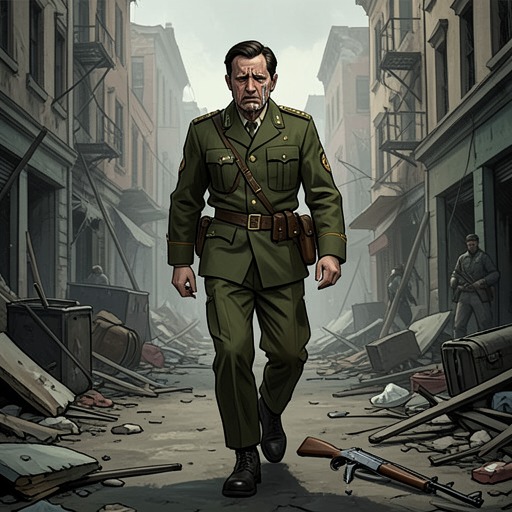
At the apartment building, Bon ultimately abandoned the pillow as a silencer. When The crapulent major approached, the narrator presented him with a bag as a Fourth of July gift, drawing him close while Bon came up behind him in socked feet. Bon hesitated long enough to greet the major instead of shooting at once; when the major turned, holding the gift in one hand and his lunch box in the other, Bon fired. The shot rang through the carport. The major’s head struck the pavement, and the bullet hole in his forehead became The crapulent major’s third eye, weeping blood. The narrator picked up the bag, now freckled with blood, while Bon took the major’s wallet and pushed him toward the car.
As they drove away at 8:13, the narrator felt numbness spread through his body. Bon explained that he could not shoot the major in the back, although he had earlier promised that the victim would not see the shot coming. The narrator was less concerned with whether the major had felt anything than with whether he himself felt anything. Before returning home, they changed the car’s license plates in an alley. The narrator found blood on the white toes of his sneakers and wiped it away with a wet paper towel; then he called The General to report that the killing was done.
Back at the apartment, the practical remnants of the assassination displaced any clean sense of completion. Bon emptied the wallet onto the coffee table: it contained identification, receipts, twenty-two dollars, change, a wedding photograph of the major and his wife, and a photograph of their infant twins. The narrator ordered the photographs burned and planned to dispose of the wallet, plates, plastic bag, and ashes the next day. The gun had accomplished its immediate purpose, but the objects left behind tied the dead man to an ordinary private life and made disposal part of the crime’s continuing aftermath.
The two men drank rye while television specials celebrated the United States Bicentennial, then ate oranges and went to bed. The narrator could not escape the image of the bullet wound: with his eyes open or closed, he still saw The crapulent major’s third eye, which seemed to reveal something about him. The weapon’s final consequence was therefore not only the major’s death or the risk of evidence being found. Its shot left the narrator with an image that turned the act of killing back upon the killer, replacing the numbness of the drive home with an enduring vision of his own implication.
The Weapon’s Vanishing and the Wound’s Persistence
After the shot, the .38 Special recedes from view: Bon tucks it into his waistband, and the narrative turns instead to the blood on the narrator’s shoes, the changed license plates, and the objects taken from The crapulent major. That shift separates the weapon’s immediate physical work from the killing’s continuing consequences. The pistol is no longer the center of attention, but the wound it made returns as The crapulent major’s third eye, an image the narrator cannot shut out. The gun disappears from the scene; the narrator’s sense of implication does not.