Affectless Lieutenant
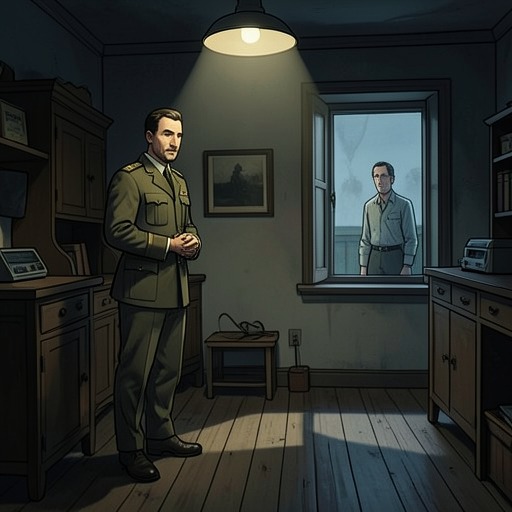
The SympathizerThe Affectless Lieutenant is a former officer, the sole survivor of an ambushed company, who has been reduced in exile to working as a deliveryman. His flat voice and nearly motionless face make grief difficult to read, but his words expose its scale: his family is dead, his old life is gone, and he sees little to return to in America. He volunteers for the General’s reconnaissance mission to Thailand, joining Bon and the Grizzled Captain in a journey that offers purpose without promising survival.
Identity and Life in Exile
Before the war’s defeat, the Affectless Lieutenant commanded a company that was ambushed; he alone survived. In exile, his military rank has given way to civilian work delivering goods. His trajectory belongs to the broader loss experienced by the former soldiers around him, many of whom now labor in menial jobs after having held military positions. The change is not simply from officer to worker: the men have also lost the country and public identity through which their service once had meaning.
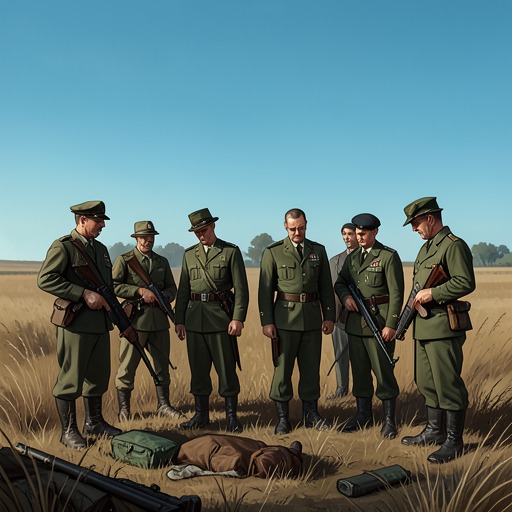
At a training exercise, the narrator sees the exiles in uniform rather than in their ordinary work clothes. The Affectless Lieutenant commands men crouching behind trees and aiming old rifles, and takes charge of a mock patrol. The gathering is part of the General’s effort to make the volunteers think of themselves as an army again. The uniforms and military routine restore a visible form of their former status, even as the narrator recognizes how far the men have fallen from their lives as soldiers.
Loss and the Decision to Return to War
During a meal beneath an oak tree, the narrator asks the Affectless Lieutenant and the Grizzled Captain about their wives and children. The Grizzled Captain explains that his family was separated from him during the Fall of Da Nang and that he has heard they were made to clear swampland because of their relation to him. The Affectless Lieutenant gives no account of what happened to his own family. He says only, “They’re dead.” His face and voice do not change; the narrator is afraid to ask for more.
Asked whether the men intend to come back from the mission, the Affectless Lieutenant turns his head slightly and answers, “Come back to what?” The brief question makes the mission’s stakes plain without giving his despair an explanation it does not have. The Grizzled Captain acknowledges that he has previously sent men to their deaths and says he is ready for his turn. The narrator understands both men, along with Bon, as volunteering with a willingness to die. For the Affectless Lieutenant, the expedition is not an ordinary assignment with a secure homecoming waiting at its end.
The narrator’s account places this willingness in sharp contrast with the practical routines of exile. The men eat army surplus rations, take a break to relieve themselves, and prepare for a ten-mile hike; around these ordinary acts lies the possibility that none of them expects to return. The Lieutenant does not deliver a speech about that choice. His short answer, spoken without visible emotion, carries the weight that a display of grief or anger might have carried for someone else.
Training, Recognition, and Masculinity
The General’s project gives the exiles a military structure: officers recruit trusted noncommissioned officers, who in turn recruit enlisted men. The force has taken more than a year to assemble, and its training is meant to rebuild discipline, physical readiness, and the idea of an army. The Affectless Lieutenant is not merely among the volunteers; he commands part of their drills. In the narrator’s photographs, men who had blended into civilian life become recognizable as a unit through uniforms, field caps, and their upright bearing.
The General also recognizes the men individually, remembering their names and asking about their families and homes. The narrator connects that attention to the soldiers’ desire to be remembered by a country that no longer exists. The Lieutenant’s own family is gone, and the evidence does not suggest that military ceremony repairs that loss. Instead, his participation shows how military identity can offer a form of purpose even when the personal and national worlds that once sustained it have disappeared.
The men’s return to uniform also exposes the limits of the masculinity the army promises to restore. The narrator describes them as men again when their posture and marching change, but the Lieutenant’s family loss makes that restoration incomplete. His service, command, and readiness to risk his life coexist with a life in which the relationships that once gave those roles meaning have been destroyed. The contrast is not resolved by the uniform: it is made visible by it.
Departure and Narrative Significance
The Affectless Lieutenant leaves America with the narrator, Bon, and the Grizzled Captain, bound for the reconnaissance mission in Thailand. During the flight, he sits between the other men and agrees with the Grizzled Captain’s farewell to the country. He asks, “Why did we ever call it the beautiful country?” His response marks his distance from the place where he has been living and from the promise that exile might become a settled new life.
Later, at an establishment Claude brings the group to, the Lieutenant enters with the Grizzled Captain and says, “Nice,” without smiling. The understated remark is consistent with the character’s pattern: he participates in the group’s actions, but the narration offers little outward emotional display. When Bon refuses to go inside and asks to walk instead, the contrast between the men’s reactions briefly surfaces; the Lieutenant’s lack of a visible smile remains as telling as his muted approval.
The evidence follows the Affectless Lieutenant as far as his departure for Thailand, not through the mission’s outcome. His story is therefore defined here by the life that has already been taken from him and by his decision to risk what remains. Across the training ground, the family conversation, and the flight from America, his composure never becomes a clear explanation of his inner life. The reader encounters its consequences instead: a dead family, a lost country, a renewed military role, and a question about what homecoming could mean.