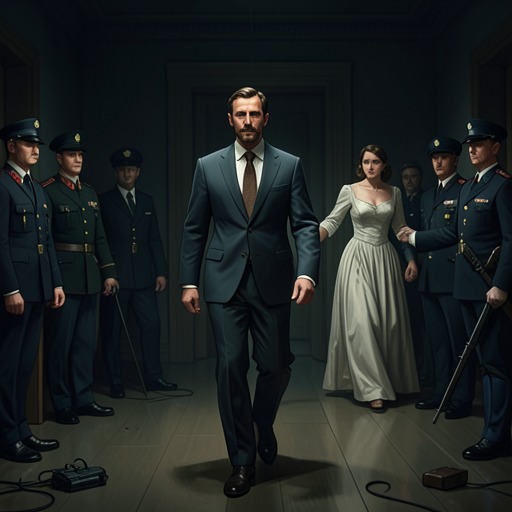
Ambush during the Mekong crossing
The SympathizerThe ambush during the Mekong crossing turns a difficult nighttime river passage into a disastrous firefight, killing members of the party and ending the mission. For the unnamed narrator, its outcome is bitterly double-edged: a plan that had been intended to save Bon works, but only by keeping him alive through the ambush.
Approach and Crossing Plan
After a day spent undiscovered, the party marched to the Mekong in the late evening. The river gleamed under the moonlight. The unnamed narrator did not yet know that the Commandant and the commissar waited on the far side, but the riverbank already felt foreboding. Leeches clung to the men as stubbornly as bad memories; one Lao farmer even pulled an animated black leech from his ankle. Amid the danger, the narrator privately wished that Lana were attached to him instead.
The party prepared to cross in a makeshift raft built by the marines from bamboo trunks bound with lianas. Four men could ride at a time, using improvised bamboo paddles. A rope carried by one marine and tied between trees on both banks would guide the raft back for its return trips. Four crossings would be needed to move everyone across the river.
The first group set off before midnight: the darker marine, the Hmong scout, the hefty machine gunner, and another marine. The rest of the party waited on the exposed bank, crouched beneath leaf capes with their backs to the water and their weapons pointed toward the forest. After the first return, a second group crossed, including the Lao farmer and the philosophical medic, whose reflection on life and death lingered with the narrator as he waited for his own turn.
The Ambush and Its Immediate Cost
When the raft scraped back to the bank, The unnamed narrator rose with Bon, Sonny, and the crapulent major to make the next crossing. The narrator remembered the river’s white noise, aching knees, and the weapon’s weight; the men looked almost inhuman beneath their leaf capes, faces painted black and weapons in hand. The grizzled captain thrust a paddle toward the narrator. Before he could take it, a whip cracked past his ear and the captain’s head split open. Gunfire erupted on both banks. A rocket-propelled grenade struck the raft, breaking it apart in fire and sparks and throwing the darker marine into the shallow water, where he lay screaming and not quite dead.
Bon yanked the narrator down the sloping bank, whose angle kept them below the forest’s line of sight. The skinny RTO was already firing into the trees. Bon ordered the narrator to shoot, but lifting his head meant exposing himself to the bullets striking the earth around them. He feared death and loved life, imagining the small pleasures he still wanted before dying; he also feared that Bon would order him to charge into enemy fire, knowing he could not make himself do it. At last he raised his weapon and fired toward the muzzle flashes. The flash gave away his position, so he kept shooting, changing magazines while the gun’s recoil bruised his shoulder and the overlapping firefights battered his ears.
Then the enemy fire stopped, leaving only Bon and the narrator firing into the dark. The RTO no longer joined them; by moonlight, the narrator saw his head bowed over his silent gun. Bon emptied his magazine and stopped, too. The fighting on the far bank had ceased, and men shouted from across the river. A northern-accented voice called from the forest on their side, “Give up! Don’t die for nothing!” The quiet that followed made the loss plain: no one was calling for his mother, and the darker marine was dead.
In the lunar light, Bon looked at the narrator with tears in his eyes. He said, “If it wasn’t for you, you stupid bastard, I’d die here.” His grief was subdued, unlike the apocalyptic rage that had followed the deaths of his wife and son. The narrator’s plot had worked, though clumsily and perhaps inadvertently: Bon survived the ambush. But the mission was over, and the rescue had saved him only from immediate death, not from what awaited them afterward.
The Crossing in the Confession
The ambush later returns not simply as a military failure but as the point from which the narrator measures the life that followed. During his interrogation, the Commandant fixes on the confession’s conclusion that Bon had been saved only from death, treating the phrase as an accusation that life in the camp was worse. The narrator’s account of the crossing thus sits inside a struggle over who may define its outcome: to Bon, survival is bound to the narrator’s intervention; to the Commandant, the narrator’s wording is an error to be edited. The Commandant marks the confession with a blue pencil and urges him to revise it, while the narrator remembers that he has spent the year since the ambush in a windowless, redbrick isolation cell, rewriting successive versions. The crossing’s ending therefore remains unsettled. The narrator did save Bon from dying on the riverbank, but the rescue did not restore their freedom or end their danger; it carried them into the captivity from which the narrator is now being made to account for what happened.
Death, Memory, and the Haunted Crossing
Before the ambush, the philosophical medic offers a benediction at the Affectless Lieutenant’s grave: “All of us who are living are dying. The only ones not dying are the dead.” Asked what this means, the unnamed narrator understands it through his own losses: his mother and father are dead, while he remains alive and therefore still moving toward death. As he watches the forest from the riverbank, the thought expands into a vision of human and animal ghosts, dead tigers and bats, plants and insects, all seeming to press their claims on the afterlife. The crossing is thus shadowed not only by the enemy hidden in the trees but by the dead already present in the narrator’s consciousness.
That vision sharpens the ambush’s reversal. The narrator fears death and longs for another cigarette, drink, and moment of pleasure; when the firing stops, survival is immediate but far from uncomplicated. Bon’s tears and acknowledgment of the narrator’s role bring the rescue into focus, while the narrator’s memory of his dead mother and the companions he will carry with him keeps survival bound to grief. The river passage becomes a threshold where the living are not separated cleanly from the dead: the party crosses under the gaze of imagined ghosts, and the survivors leave the bank carrying the losses the firefight has made real.