Bastard status
The SympathizerBastard status is the unnamed narrator’s inherited legal and social classification, but it also names the book’s larger problem of being forced to belong to one side of a divided world. Born to a native mother and a foreign father, he is successively labeled bastard, Eurasian, métis, Amerasian, and dust of life. Each name reflects the power of someone else to classify him; none gives him secure membership. The status shapes his childhood, his account of sympathy and bachelorhood, and the painful return of the word when the General rejects him as a possible partner for Lana.
Identity and Background
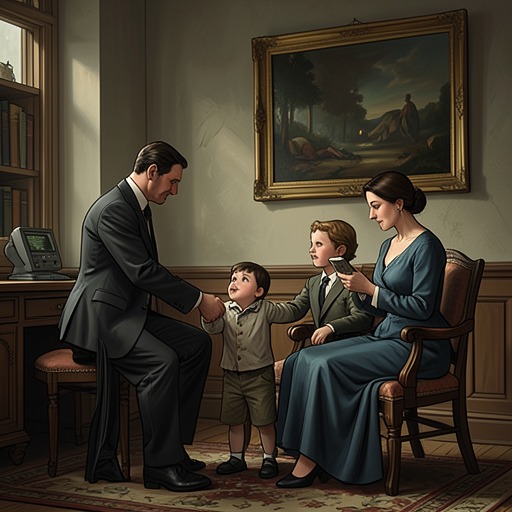
The unnamed narrator traces his status to a relationship formed across social and colonial boundaries. His mother was native and his father foreign; he describes their connection through the blurred lines between a maid and a priest. His father’s refusal to name him becomes the starkest form of rejection: while others impose labels, the man who could have acknowledged him calls him nothing at all. The narrator’s mother, by contrast, calls him her love child, a name that offers affection but cannot undo the law’s classification of him as illegitimate.
The labels change with the authority doing the naming. The French call him métis or Eurasian, terms that give him a romantic varnish in American eyes but little acceptance among the French colonizers he encounters in Saigon. Americans may mistake him for an Amerasian, although he regards the term as a misnomer for his particular ancestry. His countrymen use dust of life, a euphemism that reduces children of foreign soldiers to the residue of war and occupation. The legal phrase natural child is more technical, but it leads to the same designation: illegitimate son. The succession of names does not resolve his identity; it records the competing interests that claim the right to define it.
Social Consequences and Belonging
The insult is not merely a childhood memory. During the evacuation’s explosions and gunfire, marines call the unnamed narrator a name that wounds him less for its novelty than for the fact that he still feels it. He has been spat on and called bastard since childhood, sometimes with the insult delivered before the spit and sometimes after it. The recurrence shows how private parentage becomes a public license for humiliation. Even in the reeducation camp, the baby-faced guard uses the same word, and the narrator tells the Commandant that its persistence still hurts.
In Saigon, colonial categories place him in a contradictory position: his mixed ancestry can sound romantic to Americans while marking him as suspect to French residents who regard him like a border guard examining a passport. In the United States, the unnamed narrator encounters another version of the same conditional belonging. At Occidental, a professor treats his ancestry as a problem of divided cultural traits, asking him to sort himself into Orient and Occident on a folded sheet of paper. The exercise makes identity look like an index with two columns, but the narrator’s experience is not so neatly divisible. The categories are imposed as if they could explain him, even as the act of sorting exposes how little they contain.
Sympathy, Bachelorhood, and Exile
When the Commandant questions why the unnamed narrator sometimes identifies with the southern soldiers and evacuees as us rather than them, he links that sympathy to his own position as a bastard. He does not claim that the status automatically makes a person compassionate; instead, he credits his gentle mother with teaching him that the boundary between us and them can be blurred. His own origin, produced outside marriage and divided by racial and social judgment, gives that boundary a personal cost. The status thus becomes both an injury and a vantage point from which he recognizes other people’s exclusions.
He also describes bachelorhood as an unexpected consequence of his status. Families seeking a marriage for their daughters generally do not consider him a suitable match, including families whose daughters are of mixed ancestry and hope to improve their position through marriage to someone of pure pedigree. The unnamed narrator says that he is uncomfortable with the idea of marriage and finds freedom in remaining unmarried. He connects that choice to his subterranean life as a mole, better able to burrow alone. His bachelorhood is therefore not simply an individual preference: it is shaped by a social order that treats ancestry as a measure of marital worth, even as he turns exclusion into a condition of independence.
The status also informs his account of sympathy for Vietnamese refugees in the United States. After resettlement, sponsors help the unnamed narrator and Bon leave camp; the unnamed narrator finds work through Professor Hammer and seeks a sponsor for Bon. He describes refugees dispersed across the country rather than allowed to settle together, with families and communities separated by bureaucratic decisions. Their scattered gatherings, shared memories, and efforts to find one another form a fragile answer to the loss of home. The narrator’s account links this attention to people pushed to the margins with his own history of being treated as an outsider, without suggesting that the two experiences are identical.
Rejection and Divided Identity
The General’s earlier acceptance gives the status a temporary counterweight. When choosing the unnamed narrator for his staff, the General says that competence matters more than ancestry, even if the work itself is morally compromised. The narrator proves useful, including in arranging the evacuation, and for a time his ability appears to outrank the stigma attached to his birth. But that acceptance is conditional. When the narrator’s interest in Lana becomes explicit, the General invokes his military standing and then tells him that, despite being a fine young man, he is a bastard and cannot belong with someone of Lana’s kind. The General and Madame leave him at the gate with a bottle of whiskey. The rejection turns an old category into a present barrier, and the word catches in the narrator’s throat as if it were something physically lodged there.
Later, the Commandant proposes that the unnamed narrator’s talent lies in seeing from two sides while his destiny is to be a bastard; the Commandant argues that choosing one side would cure the conflict. The narrator concedes that acting on what is right can be harder than recognizing it. His final reflections refuse the idea that division can simply be chosen away. He connects his own divided birth to a country partitioned into north and south and to a history shaped by colonial rule and Cold War power. In both cases, people are pressured to choose between sides they did not freely create. Bastard status is therefore more than an insult or a legal description: it is the intimate form of a political and historical fracture, and a source of the unnamed narrator’s persistent awareness that belonging can be withheld even when identity cannot be made singular.