Bon
The SympathizerBon is a South Vietnamese soldier whose fierce patriotism and capacity for love are tested by bereavement, exile, and war. One of the unnamed narrator’s two sworn blood brothers, he is both a committed fighter and a grieving husband and father; after losing his family, he turns toward violence as a way to give his life purpose, while his bond with the narrator ultimately helps keep him alive.
Identity and Background
Bon is a republican and a genuine patriot who volunteered to fight the communists. His hatred of them began with the murder of his father, a village chief whom a local cadre forced to kneel in the village square before shooting him behind the ear. Bon’s military service and desire for revenge grew from that wound, but they did not define all of his life: marriage and fatherhood eventually became more important to him than vengeance.
Bon’s closest bond is with the unnamed narrator and Man, his friends since school. The three boys sealed their chosen brotherhood by cutting their palms and mingling their blood in a handshake, pledging loyalty before they knew what political conflicts would later divide them. Bon would fight against the communists, while the narrator and Man secretly became revolutionaries; the differences in their allegiances did not erase the fidelity that had brought them together. The scar in Bon’s palm remains a physical reminder of that oath, and of the friendship he understands as thicker than despair.
Exile and the Loss of His Family
Bon resists leaving Vietnam because he sees retreat as a betrayal of the country and of the dead he means to avenge. The unnamed narrator and Man persuade him to think of Linh and Duc, presenting departure as a strategic withdrawal rather than surrender. To make the choice bearable, they tell him that Man will flee with his own family the next day, though Man intends to stay and witness the communist liberation of the south. At their last gathering in a beer garden, Bon raises a glass to returning and taking the country back. He tries to disguise his tears by shaking his head, then joins the others in drinking, embracing, and singing. His hope of return is sincere, but it rests on a lie told by one brother to save another from a choice he might not survive. At Saigon airport, Bon’s promised future collapses in the evacuation’s final rush. As the General and the narrator move toward the departing aircraft, Bon and his family fall behind; Linh and Duc are shot on the tarmac. Bon kneels with Linh against his chest, unable to respond as the plane prepares to taxi away. The unnamed narrator runs back, finds Duc mortally wounded between his parents, and tries to pull Bon away. When grief leaves Bon rooted beside Linh, the narrator punches him in the jaw to loosen his grip, then carries Linh toward the aircraft while Bon follows with Duc. He hands his son to the loadmaster, slows in agony, and has to be shoved up the ramp. The escape saves Bon’s life, but it takes his wife and child from him in the very act of flight. The next day, Bon wears a white mourning scarf torn from his bedsheet as Linh and Duc are buried. Their official cause of death is a single bullet of unknown type, leaving Bon to turn over the possibility that it came from friend or foe. When Duc’s small coffin is lowered onto Linh’s, Bon throws himself into the grave, crying out that he should have died instead. The narrator climbs in to calm him and helps him out before the earth is returned over the coffins. He cannot accept the consoling belief that the dead have merely departed for a land beyond human knowledge. The burial fixes Bon’s grief to an uncertainty that cannot be resolved: the family’s deaths are certain, but the source of the shot—and therefore the shape of his anger—remains unknown.
Grief and the Search for Purpose
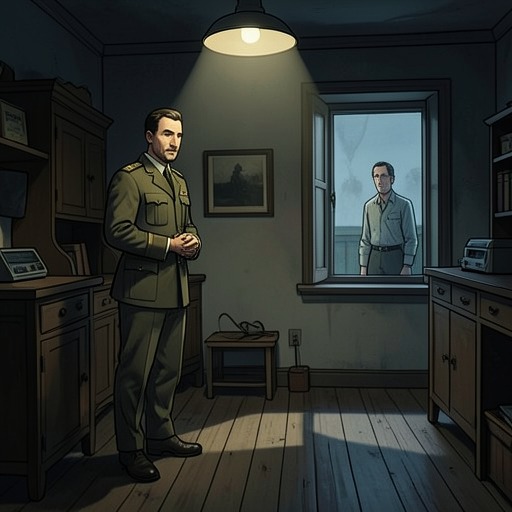
In exile, Bon’s bereavement becomes more than sorrow: it strips away the roles through which he had understood himself. Before the General’s assignment to kill the crapulent major, Bon cleans and oils a .38 Special, loads it with six copper bullets, and places it on a stained red-velour cushion. He proposes shooting through the pillow to muffle the sound. The careful preparation gives way to a confession about what the weapon means to him. Revenge for his father’s murder had once given his life direction; after he fell in love with Linh, however, she mattered more to him than vengeance, and he felt he had betrayed his father by allowing love to take its place. Fatherhood altered that understanding again. Bon recalls first failing to feel affection for the strange, ugly infant Duc, then noticing the child’s perfectly formed fingers and toes, miniature versions of his own. In that resemblance he recognized the passage of life through generations and understood his father’s love for him. Holding Duc, he wept, and came to believe that becoming a father had not betrayed the man he had lost. After Linh and Duc’s deaths, the family that had reconciled Bon to his father’s memory is gone too. He says that he is no longer a son, husband, father, or soldier, and concludes that without those identities he is nobody. His alternatives, as he sees them, are to kill himself or kill someone else. The narrator is astonished by the length and openness of Bon’s speech. For Bon, killing is not merely a military task but a possible substitute for the purpose and manhood he believes exile has taken from him. He handles the pistol with the ease of a familiar tool, while the narrator remains troubled by the possibility that their target may not be guilty. Bon answers by distinguishing assassination from murder and insisting that war makes the distinction possible. His argument does not settle the narrator’s doubts; instead, it shows how Bon’s grief and need for action are carrying him toward violence even as their old brotherhood persists.
The Assassination and the Crisis of Exile
The assignment to kill the crapulent major gives Bon an immediate outlet for the despair he has described, but the act does not appear as a simple return to soldierly certainty. On the night of the killing, he cleans and loads the .38 Special; when the moment comes, he emerges behind the major with the gun but waits until the man has turned toward him. Bon then shoots him in the forehead. The unnamed narrator notices that Bon had been unable to shoot the major in the back, a hesitation that remains visible inside the violence of the act. Afterward, Bon takes the major’s wallet, and the two men change the car’s license plates before going home. The narrator wipes spots of blood from his sneakers; Bon empties the wallet onto the coffee table, where the photographs of the major’s young family make the killing’s human cost newly concrete.
Bon’s loss also shapes his view of the South Vietnamese men stranded in America. As the General organizes an exiled army, Bon dismisses the volunteers’ hopes of returning as a cover for fear: most, he believes, will not go back, and the General has received only three volunteers for a mission he regards as suicidal. He measures manhood through protection and sacrifice, condemning men who take out their humiliation on wives and children while insisting that a man should be willing to die for family, country, and comrades. His judgment turns inward as well. Because he survived Linh and Duc, he cannot regard his own retreat as a victory; to him, the men who stayed behind and now live dead or imprisoned at least retained the identity of soldiers. The contradiction is stark: Bon has escaped in order to save his family, but their deaths leave him convinced that survival has emptied his life of the very purpose it was meant to preserve.
Bon’s despair does not make him indifferent to the others who remain in exile. He recognizes their anger and humiliation from the stories he hears while selling liquor, yet regards their attempts to reclaim military dignity as bluster unless they are prepared to return. His contempt for their excuses echoes his own harsh account of himself, even as the narrator tries to distinguish retreat to save a family from cowardice. Bon resists that comfort. He sees the proposed return not as a promising campaign but as a likely death, and the argument with the narrator exposes how little separation he can maintain between the fate of his country and the value of his own life.
The Final Mission, Capture, and Release
After the narrator decides to return to Vietnam to save Bon, Bon offers to carry out the General’s order to kill Sonny in his place. He offers this help at a billiards hall, speaking plainly about the knowledge of killing and the public silence that surrounds it: people accept that soldiers kill on their behalf, he argues, but do not want to hear what that entails. The narrator cannot accept Bon’s offer. The exchange reveals the difference between them at this point: Bon has learned to treat violence as part of a soldier’s work, while the narrator still struggles to cross the threshold into killing. After the narrator assassinates Sonny, Bon calls the act a necessary burden they must live with and urges him to return to the battlefield, where he expects the familiar demands of combat to steady him.
Bon and the narrator leave America for Thailand with the grizzled captain and the affectless lieutenant. During a reconnaissance operation across the border, Bon refuses Claude’s effort to steer him into a brothel and chooses to walk instead; the narrator joins him. The mission ends in a firefight on the riverbank. Bon continues firing until his ammunition runs out, while the narrator fears that Bon may urge him to charge into enemy fire. Once the shooting stops, the narrator realizes that members of the team have been killed, including a marine, and that northern troops are calling for the survivors to surrender. Bon looks at the narrator through tearful eyes and acknowledges that without him he would have died there. The narrator’s plan has succeeded in keeping Bon alive, though the victory has only postponed the danger and cost of their return.
The surviving men are taken to a reeducation camp, where Bon is held among the other captives while the narrator is treated as a special case and made to revise his confession. More than a year later, the narrator and Bon are released. At the camp gates, Bon waits beside the commandant and an idling truck. The narrator has not seen him for a year and many months; Bon’s hair is thinning, his skin has taken on a sickly cast, his clothes are rags, and a black patch covers one eye. The narrator knows better than to ask what was done to him. Their battered reunion is marked first by Bon’s blunt observation that the others look terrible, followed by the Hmong scout’s retort that they look worse. The narrator and Bon leave together, while the haggard scout, the philosophical medic, and the dark marine remain behind the barbed wire to bid them farewell. Bon’s survival has thus carried him from the loss of his family through a renewed campaign, a firefight, and imprisonment; release reunites the blood brothers, but does not restore what exile and violence have taken from them.
The Blood Oath Under Pressure
The old oath between Bon, the unnamed narrator, and Man returns to view not as a sentimental memory but as a commitment whose future meaning they could not have known. At fourteen, they believed in friendship, brotherhood, their country, and independence; they had sworn to sacrifice themselves for one another, without knowing what circumstances would demand or what political identities they would later take on. Bon would join the Phoenix Program to avenge his father, while the unnamed narrator and Man secretly came to believe that revolution was the way to rescue their country. Their opposing allegiances grow from different responses to violence, yet neither cancels the obligation the boys made to each other.
At the airport, while they wait beneath parachute flares and listen to Katyusha rockets in the distance, Bon points to the scar in his palm. The unnamed narrator raises his own hand, marked by the matching cut shared with Man, and traces its line in the wavering light. The scar is not only a keepsake: it is a bodily record of a pledge made before either man understood what he might be asked to do for the other. Bon answers the narrator’s recollection by insisting that friendship is thicker than despair. Their exchange gives the schoolboy ritual a harder, adult register, spoken as their country is collapsing and their next meeting is uncertain.
The oath does not make Bon and the unnamed narrator politically identical, nor does it undo the consequences of their separate choices. Instead, it supplies a standard of loyalty that persists through their divided commitments: the narrator believes he and Man would pay the price of death for Bon, even as Bon’s military role may place him against people they consider comrades. In this sense, their blood brotherhood is both a bond and a predicament. It preserves a personal fidelity across political division, but cannot spare any of them from the history their different convictions help shape.
Captivity and the Unequal Terms of Release
The camp made the brothers’ different forms of captivity explicit. The unnamed narrator had spent the year after the ambush in a windowless red-brick isolation cell, revising his confession until it reached 295 pages; Bon was housed in barracks with a thousand other inmates. When The Commandant insisted that the unnamed narrator was a guest rather than a prisoner, he pointed to those barracks and named Bon among the captives there. The distinction separated the men not only by location but by the terms imposed on them: one was isolated and compelled to narrate his errors, while the other remained among the imprisoned survivors of the mission.
That division sharpens the cost of their survival. Their blood-brother bond had endured political disagreement, bereavement, and a failed military mission, but in the camp it could not keep them together or tell the unnamed narrator what Bon was suffering. At their eventual reunion, the black patch over Bon’s eye and the narrator’s decision not to ask what had been done to him mark the limits of what their loyalty can repair or even make speakable.
Appearance and Family Portrait
A black-and-white photograph in the unnamed narrator’s wallet preserves Bon with Linh and their young son, Duc. Bon’s face, the narrator observes, looks like that of a handsome man beaten to a pulp, though it is simply the face he was born with: parachutist’s beret and sharply pressed tiger-stripe fatigues cannot distract from his prominent ears, chin tucked into folds of neck, and nose bent to the right, like his politics. Linh’s rounded face is marked by acne scars, while Duc is strikingly cute beside his parents. The family portrait’s wry contrast between Bon’s rugged appearance and his tenderness toward his wife and child gives a visual measure of what bereavement later takes from him.