Catholic Church
The SympathizerThe Catholic Church in the novel is not simply a religious institution in the background: its doctrine shapes The unnamed narrator’s understanding of guilt, his father is a priest, and a Saigon basilica becomes the setting for secret political work with Man. For The unnamed narrator, the Church’s rituals offer both a public performance of faith and a private vocabulary for interpreting family shame, violence, and belonging. His account is also sharply critical: he contrasts the Church’s moral authority with its history of hypocrisy and harm.
Doctrine, family, and Original Sin
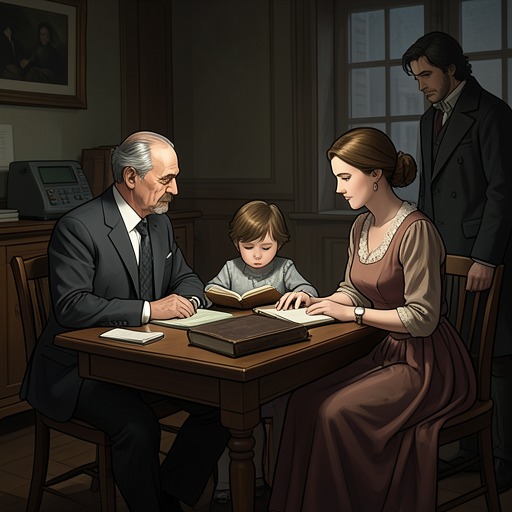
As a child, The unnamed narrator attends classes for diocesan children taught by The Father. There he learns the Bible, the history of his Gallic forefathers, and the catechism of the Catholic Church. He initially does not know that the priest instructing him is also his father. The lessons are therefore altered by a fact the child does not yet possess: religious instruction comes from a parent whose identity is concealed from him. The doctrine of Original Sin becomes especially consequential. The Father teaches the children that the sin inherited from the first parents is called Original Sin. The narrator later connects this lesson to his father’s treatment of pupils: The Father strikes their knuckles with a ruler, and when a punished child proves innocent, he shows no regret. In the narrator’s account, the teaching that everyone is already guilty can make even undeserved punishment seem just. The doctrine is not merely abstract theology; it becomes a framework that legitimizes authority and makes innocence difficult to claim. At eleven, The unnamed narrator learns who The Father is after a classmate uses an animal comparison to humiliate him. The insult leaves him feeling like a creature belonging to neither category, and he responds by beating the classmate before going home in distress. The narrator’s mother comforts him and tells him that he is not unnatural. She then reveals that The Father is his biological father. She describes having worked as his maid when she was young, and says that he taught her to read and count in his language. She frames the events that led to the narrator’s birth through her Christian belief: God must have had a role for him, and he has a destiny. The Church’s language thus reaches him through both paternal instruction and maternal consolation, but the two accounts do not erase the pain of his discovery.
The basilica as sanctuary and cover
The basilica on Tu Do is a conspicuous landmark in Saigon, with a white statue of Our Lady standing before it, her hands open in peace and forgiveness. The unnamed narrator remembers the church in relation to the street’s cafés, nightclubs, and bars, where visitors might seek pleasure before turning toward religious forgiveness. Yet the basilica is not a refuge for him in any simple sense: its priests, including The Father, have often spurned him. The site nevertheless becomes useful to The unnamed narrator and Man. They meet there on Wednesday afternoons, when the basilica is nearly empty except for a handful of older women praying. Both men are former Catholics who have chosen communism over God, and their outward posture of devotion provides cover for clandestine business. The narrator confesses political and personal failures to Man; Man takes the role of confessor, but answers with assignments rather than prayers. Religious form is retained while its expected purpose is reversed: confession becomes a means of political communication, and absolution takes the shape of work. The church’s ordinary practices remain present in the scene. The narrator no longer prays, yet finds himself silently joining the old women’s recitation. He recalls their endurance at crowded weekend Masses, where infirm and elderly worshippers sometimes faint from the heat. In a city where the worshippers have little comfort, heatstroke can be understood as religious fortitude. The details make the basilica more than a convenient meeting place: it is a living space of worship that the conspirators borrow, even as their atheism makes their participation a deliberate performance.
Critique of authority and hypocrisy
The narrator’s judgment of the Catholic Church is shaped by what he sees as a divide between sexual moralism and institutional violence. He mocks the secrecy surrounding the sexual lives of Church leaders, while insisting that sex itself is not the problem; hypocrisy is. He contrasts that concealment with the Church’s record of torturing, killing, crusading against, or infecting millions in the name of the Lord, acts he says are met with little more than pious regret, if they are acknowledged at all. The criticism does not treat religious authority as innocent simply because it speaks in the language of repentance. The unnamed narrator also recounts how The Father used religious instruction and physical discipline together. The ruler across children’s knuckles bruises them, while the doctrine of inherited guilt supplies a rationale for punishment that may be undeserved. His account places the small, immediate violence of the schoolroom alongside his broader indictment of the Church’s historical violence. In both cases, religious authority can name wrongdoing without necessarily accepting responsibility for the harm it inflicts.
Faith as inheritance and reinterpretation
Catholic belief survives in the family even when The unnamed narrator and Man reject God. The narrator’s mother has already fled the communists with him in 1954, when he was nine and had no say in the decision. The Church and its teachings remain part of the world through which she understands danger, kinship, and the child she has raised. Her appeal to Jesus’s care for the meek and the rejected turns doctrine into a defense of her son against the claim that he is unnatural. The same inheritance produces no settled reconciliation. The unnamed narrator can recall prayers, catechism, Mass, and the basilica’s rituals while describing himself and Man as atheists. He can recognize his mother’s faith as a source of comfort and still expose the institutions and authorities that have made guilt seem universal and punishment seem deserved. The Catholic Church therefore functions in his story as both a powerful moral language and an object of resistance: its words shape his self-understanding, but he repeatedly contests the authority that claims to interpret them.