Central Intelligence Agency
The SympathizerThe Central Intelligence Agency is a largely offstage presence in the novel, known through covert funding practices and a counterintelligence manual whose methods are turned against a former student. Its significance lies less in direct appearances than in the way its alleged networks and documented techniques blur the boundaries between charity, political action, intelligence work, and coercion. The narrator describes some connections as established practice, but presents the agency’s involvement in particular funding arrangements as an inference rather than a fully demonstrated fact.
Covert Funding and Front Organizations
Claude tells the narrator that the Central Intelligence Agency routinely funds activities indirectly: rather than attach its name to money that might be illegal or questionable, it uses front organizations controlled by agents and sympathizers, including people with respectable careers. The recipients of these funds may themselves be fronts. The result is a chain of intermediaries in which the public purpose of an organization does not necessarily disclose who supports it or what the money ultimately enables.
The narrator generalizes this arrangement into a broader problem of attribution. Organizations claiming to help the poor, feed the hungry, spread democracy, aid women, or train artists can make it difficult to determine who is doing what for whom. The novel’s point is not that every charitable body is secretly an intelligence instrument, but that familiar humanitarian language can conceal overlapping purposes and sponsors. The gap between what an organization says it does and what its resources make possible is central to the story’s treatment of political power.
That structure informs the creation of the Benevolent Fraternity of Former Soldiers of the Army of the Republic of Vietnam. Publicly, the organization serves veterans who have lost their army, country, and identity, and solicits tax-deductible donations in support of their needs. At the same time, it functions as a front through which the General can receive money for the Movement. The Fraternity’s genuine assistance and its political use are not mutually exclusive: money can help displaced veterans while also sustaining a secret military project.
The Fraternity’s Funding Network
The narrator and the General present the Fraternity’s proposal to the Congressman, who points them toward charitable foundations as possible sources of support. Claude’s connections and the General’s own American contacts help open doors to donors who have ties to Vietnam. In the narrator’s account, the donations are moderate enough not to attract much attention from auditors or journalists. The arrangement depends on respectable intermediaries and on keeping the visible charitable purpose separate from the less visible political one.
The narrator interprets some of these foundations as fronts for the Central Intelligence Agency, and allows that other government or nongovernmental organizations may also be involved. That interpretation belongs to his account of the network; the narrative does not document a specific agency payment to the Fraternity. The Congressman’s role in arranging official channels, and the presence of his friends or Claude’s associates among foundation trustees, establish connections and opportunities, not a complete accounting of who directed each contribution.
Money given in the United States could acquire a different practical value after reaching the Thai refugee camps. The narrator describes donations as helping provide food and clothing for the secret army, whose members were themselves refugees. Weapons and ammunition came through a distinct channel: Thai security forces supplied them, with their funding from the United States openly approved by Congress. The novel sets the covert and official routes beside one another, showing how a military effort could rely on both concealed organizational ties and publicly authorized support.
The Fraternity’s double function becomes visible when Sonny publishes allegations that donations ostensibly intended for refugees may support armed refugees in Thailand, and that the organization may profit from business investments. The General recognizes the report as well informed and suspects that information has leaked from people around him. The narrator has in fact photographed the General’s files, including the order of battle, communications with officers in the Thai camps, and bank-account statements, and sent the material to his Parisian aunt. The leak makes the funding network vulnerable to exposure, while showing how clerical work, correspondence, and access to records can serve as intelligence work inside a political front.
KUBARK and the Circulation of Interrogation Methods
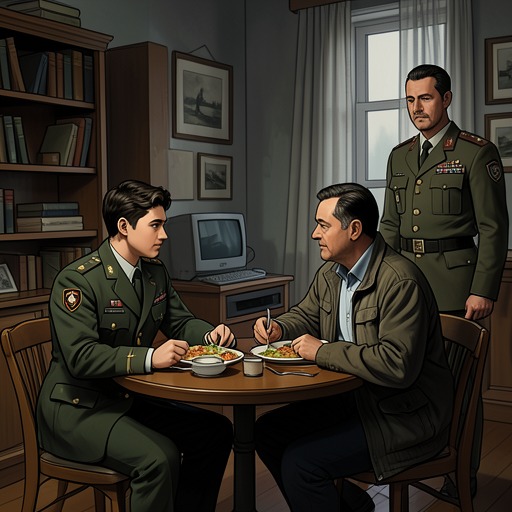
The Central Intelligence Agency’s influence also appears in KUBARK Counterintelligence Interrogation. During the narrator’s imprisonment, the commissar identifies the manual, found in the narrator’s quarters at the General’s villa, as a CIA publication. The commissar says that he has read the narrator’s marginal notes and underlined passages, and presents the ongoing interrogation as an open-book examination: the methods being used against the narrator come from a text the narrator already knows.
That knowledge does not protect him. Before becoming a prisoner, the narrator had studied the manual repeatedly as part of Claude’s interrogation course. He knows its emphasis on isolation, sensory deprivation, joint interrogators, penetration agents, and unpredictable routines, as well as techniques named Ivan Is a Dope, Wolf in Sheep’s Clothing, Alice in Wonderland, All-Seeing Eye, and Nobody Loves You. In captivity, lights, food, and electric shocks are administered unpredictably. Because he recognizes the methods, he can understand the design of the interrogation, but comprehension does not restore control over his body or circumstances.
Claude adds a personal dimension to the manual’s authority by telling his students that he underwent such techniques at the Farm and that they work even when the subject knows what is being done. The novel thus presents KUBARK not simply as a written set of instructions but as knowledge that can circulate through training, experience, and imitation. In the interrogation room, a text associated with American intelligence has been appropriated by the narrator’s captors and used to break down the person who once learned its procedures.
The novel also distinguishes the manual’s techniques from other forms of violence. As the narrator’s returning memories disclose, the abuse of a captured Communist agent in a room used as a movie theater includes acts that he says were not in the book and whose origins Claude did not know. The manual therefore represents one transferable system of coercion, not an explanation for every act of violence in the story. Its presence does not establish that the Central Intelligence Agency directed the abuse or the narrator’s specific interrogation; it shows that its methods have become available for use by other actors.
Secrecy, Suspicion, and Political Irony
The agency’s indirect presence belongs to a wider world in which a spy may be suspected without reliable proof. The General’s belief that the National Liberation Front of South Vietnam must have agents among his own men puts the narrator under pressure to name a suspect. To divert suspicion from himself, the narrator points to the crapulent major, even though he has no basis for identifying him as an actual spy. Later, the General treats the major as an informer, citing his Chinese ancestry, his family’s prosperity in Saigon, and his weight as grounds for suspicion. These episodes do not connect the major to the Central Intelligence Agency; instead, they expose how intelligence claims can be driven by fear and prejudice as readily as by evidence.
That atmosphere helps explain why the agency’s most powerful presence is often structural rather than personal. Fronts hide sponsors; official and unofficial money travel through different channels; sensitive information can be gathered through ordinary administrative access; and interrogation methods can pass from one political setting to another. The narrative repeatedly makes the unseen part of a scheme as consequential as the visible organization. In this system, neither charitable work nor technical expertise has a single guaranteed meaning: each can serve more than one cause, and each can be repurposed by people who understand how power moves behind respectable appearances.