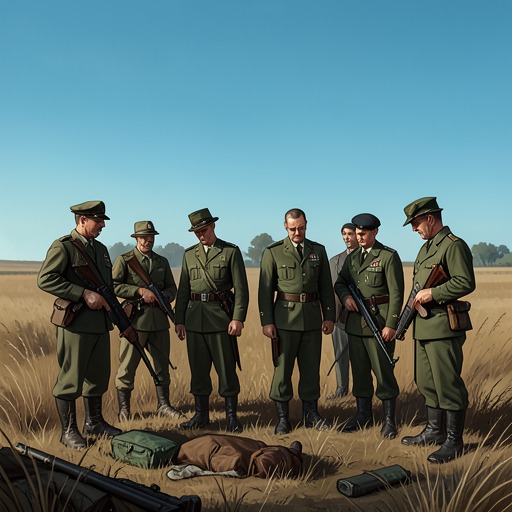
Dispatching a reconnaissance team to Thailand
The SympathizerDispatching a reconnaissance team to Thailand is the point at which the General’s exile movement turns its fundraising, veteran organization, and military drills toward a projected return to Vietnam. Publicly framed through refugee relief, the operation is meant to establish contact with a forward field base and identify an overland route home. Its immediate cost is borne by men who volunteer for a mission they scarcely expect to survive—and by the unnamed narrator, who joins to keep Bon from going alone.
From charitable front to armed movement
The expedition grows out of a network that operates in two registers. The Benevolent Fraternity of Former Soldiers of the Army of the Republic of Vietnam presents itself as a nonprofit serving veterans left without an army, a country, or an identity. For the General, however, it also functions as a front through which donations can support the Movement. Madame’s restaurant supplies another revenue stream, while charitable foundations and well-connected American donors contribute money under the public rationale of helping refugees and veterans.
The narrator understands this arrangement as more than a convenient fundraising device. Claude had explained that intelligence agencies could use respectable front organizations to channel unofficial funds; the Fraternity itself occupies a similar position in the General’s network. At a meeting with the Anti-Communist Congressman, the proposed arrangement is discussed through the distinction between official channels and money whose political purpose is not stated openly. The resulting chain of donors, foundations, refugee organizations, and military recipients makes the operation possible while distributing knowledge—and responsibility—among intermediaries.
That infrastructure has practical consequences in Thailand. Donations sent abroad buy food and clothing for veterans in refugee camps; the Thai security forces supply guns and ammunition through channels described as officially approved. The men being supported are refugees, but they are also the personnel of a secret army. The General can therefore present assistance to displaced veterans as humanitarian work while preparing them for military action.
Selecting the reconnaissance team
The General announces the next step over a meal at Madame’s restaurant, where every table is occupied by Vietnamese diners. Its profits go to the Movement, and the place has become an open secret: customers can understand that eating there supports the revolution without needing the operation explained to them. Madame has organized uniforms, flags, a women’s auxiliary, and a Tết celebration in Orange County. Veteran volunteers train on weekends, and the General says the best of them will be selected for the next stage.
That stage is a reconnaissance mission to Thailand. The team is to link up with the Movement’s forward field base and scout a route overland to Vietnam. The General says Claude believes the timing is nearly right. Bon is already assigned. The route would require passage through Laos or Cambodia, avoiding established roads in difficult jungle, forest, and mountain terrain. The narrator recognizes that this is not simply a dangerous journey: the terrain, disease, and likelihood of encountering frightened or hostile local people make the mission potentially fatal.
The volunteers’ willingness is bound up with what they have lost. Alongside Bon are a Grizzled Captain and an Affectless Lieutenant, both veterans with little attachment to the lives they have left. The Grizzled Captain says his family did not escape the disaster at Da Nang and that he has heard they were sent to clear swampland because of his connection to him. He speaks of either waiting or going to find them. The Affectless Lieutenant says his family is dead, with a flatness that makes the loss more unsettling rather than less real. Both men have volunteered for the Thailand mission. The Grizzled Captain acknowledges that he has previously ordered men to likely deaths and now accepts the possibility of his own; neither he nor the Affectless Lieutenant expects a meaningful return to the life they left behind.
The narrator joins Bon
The narrator asks whether Bon is part of the team, and the General confirms that he is. The narrator’s first response is to picture the route’s dangers and Bon’s willingness to volunteer because his chances of returning are poor. He looks at the red scar on his hand and considers how fragile life is. Rather than continue deliberating, he says that if Bon is going, he should go too.
The General is pleased that the narrator has offered, but does not want to lose him from the work at home. He argues that the narrator would be more useful handling planning, logistics, fundraising, and diplomacy. The General has already described the community’s effort to the Congressman as an aid mission for refugees in Thailand. The narrator recognizes that this description gives supporters a cause they can accept, even as the actual operation prepares a route for armed return. His decision to accompany Bon therefore conflicts with the General’s preferred division of labor: the narrator leaves the fundraising and political work to take part in the dangerous field mission.
The men’s weekend training has shown the mixture of conviction and desperation behind the deployment. The Grizzled Captain and Affectless Lieutenant practice with vintage rifles and conduct mock patrols; Bon is among the veterans who volunteer for Thailand. The narrator warns Man, through coded correspondence, that revolutions begin with men willing to fight against the odds and give up what little they have. His description is not an uncomplicated celebration of commitment. The volunteers’ readiness is also a consequence of bereavement, displacement, and the sense that death may be no worse than life in exile.
Departure and arrival in the region
After Sonny’s assassination, the narrator accepts responsibility in a coded message to Man for disobeying his orders. He says that he is returning with Bon to save his life, although he does not yet know how he will do so. The General has already provided the narrator with a ticket, and the departure is arranged two days after the killing, before the absence is widely noticed. Avoiding legal entanglement is one reason for the timing; avoiding suspicion from Sofia Mori is another.
The party leaving consists of Bon, the unnamed narrator, the Grizzled Captain, and the Affectless Lieutenant. The General and Madame see them off at the airport. As the group travels across the Pacific, the two older veterans express no nostalgia for exile and no confidence in a future return there. Bon, who has never assimilated, describes the relief of leaving a place where he has felt hidden in someone else’s home. The narrator, by contrast, recognizes the comforts and freedoms he will miss. Their different responses make the deployment more than a military transfer: it is also a departure from the competing forms of exile each man has endured.
Claude meets the group after they arrive in the region in late December. Rather than let them sleep off their jet lag, he keeps them awake and says they will set out for the camp the following day. In the crowded drive from the airport, he explains that refugee assistance brings access to the countryside, where displaced Laotians and Hmong are arriving. That access connects the humanitarian cover directly to the geography of the mission: help for refugees makes it possible for the group to move toward the border area where the reconnaissance work is intended to begin.
Purpose and limits of the mission
The deployment remains a preparatory operation in the evidence presented here. The team is to reach the forward base and scout a route; its departure does not establish that it successfully crosses into Vietnam, finds a viable path, or returns. The distinction matters because the General’s broader language of liberation can make the expedition sound like the beginning of a completed campaign. At this stage, it is an attempt to create the conditions for one.
The mission also binds together several kinds of obligation. The General sees the veterans as the force for a political return and needs the narrator’s skills in the organization that sustains it. The narrator instead makes his choice through loyalty to Bon and a promise to try to save him, even without a plan. The veterans’ volunteerism supplies the expedition with manpower, but their bereavements and despair complicate any clean account of patriotic sacrifice. The Thailand deployment thus marks the moment when the Movement’s public work of charity and its secret military preparations converge in a journey whose destination is concrete, but whose survival and outcome remain uncertain.