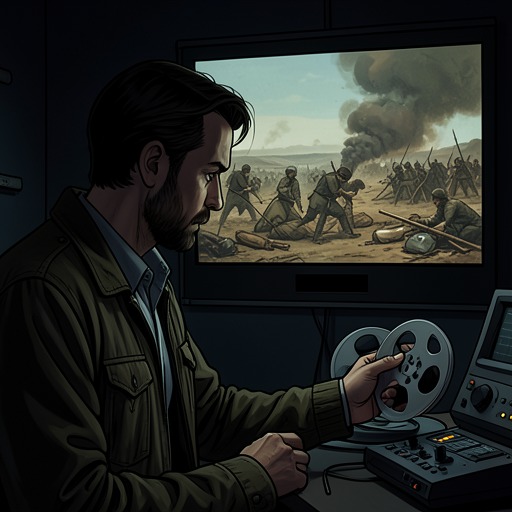
Explosion on the set of The Hamlet
The SympathizerThe explosion on the set of The Hamlet is a turning point whose visible injuries seem limited, but whose most unsettling consequence is a missing stretch of the unnamed narrator’s memory. The studio calls the blast an accident and pays for his hospital care, yet the narrator cannot account for what vanished between the explosion and his awakening. The event therefore ends not with a clear explanation, but with a negotiated settlement and a suspicion that the official account leaves something out.
Background and Immediate Aftermath
The explosion occurs during the narrator’s Philippine adventures, while he is involved in the production of The Hamlet. The surviving account does not describe the blast itself: by the time the reader encounters its consequences, he is in a Manila hospital and cannot recall the event. His uncertainty is compounded by the studio’s swift, polished response. A representative arrives with a report, a business card, and assurances that the studio will pay the hospital bills. The representative says that the report identifies the explosion as an accident, but the narrator reads the report less for its details than for what its prompt preparation implies: in his view, such efficiency depends on money changing hands.
The studio’s account is accompanied by a medical summary that makes the injuries sound contained. The narrator has suffered smoke inhalation, scrapes and bruises, mild burns, a bump on the head, and a concussion; nothing is broken or ruptured, and the representative describes nothing as permanent. The contrast between this list and the narrator’s more difficult-to-measure loss is central to the aftermath. His body has been examined and itemized, while the missing portion of his mind cannot be shown to the representative as proof.
The Settlement
The studio initially offers a five-thousand-dollar check, provided the narrator signs a receipt and a document releasing it from future obligations. He resists treating the first offer as adequate. To strengthen his bargaining position, he presents himself as the principal support of his extended family and argues that the money must account for relatives and their possible future needs. His appeal turns family obligation into both a real responsibility and a negotiating argument; he even uses the representative’s presumed familiarity with family loyalty to make the case.
The representative counters by suggesting that a claim of twenty thousand dollars would require a much more severe injury, such as the loss of a finger, a larger appendage, an organ, or a sense. The exchange makes the negotiation’s terms stark: bodily damage is translated into a price, while the narrator’s memory loss has no simple measure. The two settle on ten thousand dollars, twice the studio’s first offer but half the amount he requested. He signs the papers and accepts the check. The payment resolves the immediate dispute without resolving what happened to him or what, exactly, the studio’s release leaves behind.
Memory Loss and Uncertainty
During the negotiation, the narrator recognizes that his trouble is not merely ordinary forgetfulness. He knows that something is missing, but cannot identify what it is. He distinguishes this state from forgetting a name or date, and from forgetting so completely that one does not know anything has been lost. The gap following the explosion belongs to the more disturbing category: awareness of an absence without access to its contents. He tells the representative that a portion of his memory has been erased, extending from the explosion to his present awakening.
The narrator’s inability to demonstrate the loss does not make it less consequential. He describes the blank as a missing piece of his mind, then later continues to feel an absence on which he cannot safely rest his weight. His suspicion grows beyond the stated concussion: he wonders whether an operation was performed while he was under the influence and connects that possibility to a numbness more disturbing than pain. The account does not confirm that such an operation occurred. Instead, the unexplained gap and the narrator’s unease remain in tension with the representative’s confident description of the incident as accidental and medically nonpermanent.
Consequences and Narrative Significance
The settlement follows the narrator back to California as a concrete object and a compromised answer. He cashes the check, leaves half in his previously empty bank account, and carries the other half in an envelope. He does not tell the General and Madame about receiving compensation, even while debriefing them about his Philippine experiences. Later, he takes the money he has kept to visit the crapulent major’s widow, intending to give it to her as an act of help and, more deeply, as an attempt to seek forgiveness for what he did to her husband. The blast thus produces consequences beyond the hospital: its payment becomes entangled with the narrator’s guilt and his effort to make restitution.
The episode’s structure keeps certainty just out of reach. A report calls the explosion an accident; a medical account enumerates injuries; a signed release closes the studio’s financial responsibility. Against these documents, the narrator offers a memory he cannot recover and a suspicion he cannot prove. His skill at negotiating allows him to raise the payment, but money cannot restore the missing interval or settle whether his mistrust is warranted. The event’s decisive significance lies in that unresolved remainder: the narrator survives the explosion, yet emerges unable to say fully what happened to him.