Fall of Saigon
The SympathizerThe Fall of Saigon is the decisive rupture between the Republic of Vietnam’s final days and the refugee life that follows. In the narrator’s recollection, helicopters lift people from Saigon’s rooftops to aircraft carriers, tanks break through the presidential palace gates, and the National Liberation Front flag rises above the palace. The military collapse becomes personal in the same instant that it becomes political: a dinner in a Guam refugee camp ends with the realization that the exiles are no longer adult citizens of a sovereign country, but stateless people temporarily protected by the American military.
The Fall Seen from Guam
The narrator and the General’s family watch the evacuation on television from barracks at Camp Asan, among a hundred other refugees. The images of helicopters landing on Saigon’s rooftops bring the city’s final hours into a camp far across the Pacific. The next day, after communist tanks crash through the gates of the presidential palace, communist troops raise the National Liberation Front flag from its roof. For the narrator, these scenes settle into memory as deposits that accumulate in the mind: the last days of the Republic are not a single clean image but an encrustation of events, impressions, and later grief.
The loss of political status takes on an ordinary, bodily form at dinner. The refugees eat baked chicken and green beans, food many find unfamiliar and unappetizing; only the children seem to have an appetite. When the General scrapes his untouched green beans into the garbage, he says that his people need him and proposes walking among them to raise their morale. The narrator follows, though he doubts the effort will succeed. In the tent city, the General’s uniform and rank are visible even when his face is not familiar. Civilians answer his greetings with silence. Within a hundred meters, an old woman’s slipper strikes his temple. The gesture makes plain how little authority his rank can command among people whose country has already fallen and whose immediate need is not a military leader’s encouragement.
The narrator’s change of clothes sharpens the contrast. He has exchanged his uniform, stained with Linh’s blood, for a madras shirt and chinos; the General, whose luggage was lost at the airport, still wears his stars. Their differing appearances place them unequally before the refugees, but neither can restore the world the uniform once represented. In the narrator’s later understanding, the decisive passage into exile comes not only through the televised fall of the capital but through the humiliating act of returning a cafeteria tray: the former citizens have become refugees.
The Evacuation’s Last Signal
The final phase of the evacuation is associated with the song White Christmas, broadcast on American Radio Service as a cue for Americans and their allies. Its secrecy is ineffective: people across the city know what to listen for. Even the broadcast goes wrong. The deejay cannot find the intended Bing Crosby recording and instead plays a version by Tennessee Ernie Ford. Claude recounts the mishap to the General and the narrator, who answer it with the weary recognition that the operation has gone wrong in a way that feels familiar.
The narrator later turns the operation’s name, Frequent Wind, into an object of bitter reflection. He wonders whether it was chosen through stupidity or irony, connecting its wording to the Divine Wind associated with the kamikaze and to the more juvenile image of passing gas. He also reads the Christmas signal as an insult to countrymen who did not celebrate Christmas and had never seen snow. Beneath the joke is the image of American helicopters stirring the air above the city while leaving people behind. The narrator cannot make the evacuation’s failures into a neat ending; irony is only a last shred of dignity salvaged from a tragedy that, in his telling, neither ends cleanly nor belongs to only one side.
Flight, Choice, and the War’s Survivors
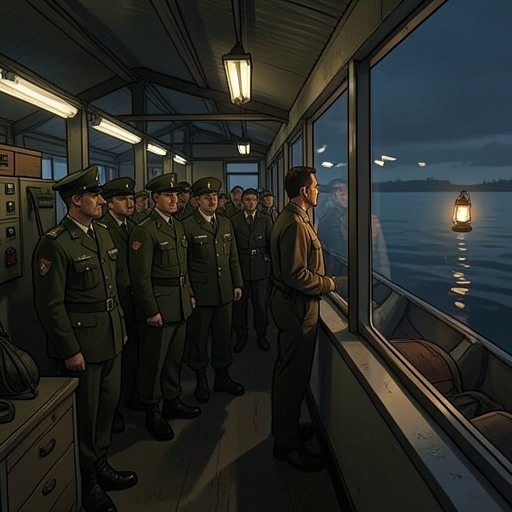
The fall sends people along sharply different routes. The Admiral recalls that on the war’s last day he commanded a transport ship carrying marines, soldiers, policemen, and civilians rescued from the piers. Rather than sail toward the Seventh Fleet, as many fellow captains did, he steered toward Thailand. He believed the Americans had already betrayed his people and that escaping to them would leave no prospect of continuing the fight. He expected Thailand to grant asylum and regarded the approaching communist pressure on its borders with Cambodia and Laos as a reason the Thai would resist. His account gives the evacuation a counterpoint: for the Admiral, flight is not a request to be saved by Americans but a decision to preserve a force and its struggle elsewhere.
The ship also carries men whose displacement will shape later events. Three marines who had been in Saigon during the narrator’s earlier wartime experience reach the docks as the city falls and board the Admiral’s vessel. They remain in Thailand, and later agree to cross the border with the narrator and Bon. Their presence links the last escape from Saigon to the later reconnaissance mission: the end of the Republic does not end the military project, but relocates its participants and changes the terrain on which they act.
The narrator’s account of the last hours also includes a fatal confusion of allegiance and fire. A South Vietnamese unit holds a bridge as the approaching liberation army advances; the narrator’s companion, still in uniform, hides his excitement at the prospect of liberation while fearing that the incoming troops might shoot him. When officers see an aircraft overhead, they hope it is their air force. The plane flies too high for a bombing run, yet drops its bombs toward the South Vietnamese troops rather than the tanks. The bombs fall on the unit, and a cloud of napalm engulfs the men. The survivor says he escaped with burns because the napalm only licked him, while others were caught in the strike. In the final hours, the line between liberation and death is crossed not through a deliberate choice by the men on the ground but through a mistaken attack from their own side.
Dispersal and the Afterlife of the Fall
The refugees’ new lives in the United States begin under a sponsorship system: no one leaves the camp without a sponsor expected to ensure that the newcomer will not depend on the welfare state. Those without immediate benefactors write to former employers, military advisers, lovers, churches, and even casual acquaintances. Some depart alone, some as families; some families are divided and sent to different places. Many are assigned to states whose names are difficult for them to pronounce. The refugees reshape the sounds of American geography into their own English and exchange phone numbers and addresses, creating a practical network for finding jobs, comparing taxes and welfare benefits, and locating places with less racism or more people who look and eat like them.
In a letter written on the first anniversary of Saigon’s fall, the narrator gathers these dispersed histories into a rambling record of loss and adaptation. He describes refugees who petition to return to their homeland and then disappear from notice; a politician’s wife who is reduced to cleaning bedpans and later committed to a mental ward; teenagers who arrive without their families, commit a robbery that ends in a clerk’s death, and receive long prison sentences; and families separated from spouses, parents, grandparents, or children. A group in a crowded, freezing room in Terre Haute dies from carbon monoxide released by a charcoal brazier. Against these accounts, the letter preserves rumors of unlikely success: an orphan adopted by a Kansas billionaire, a lottery winner, students elected to school office or admitted to Harvard, and an actress who reaches Hollywood after Tippi Hedren answers her last desperate call for help. The exile story refuses a single outcome; survival and catastrophe, opportunity and abandonment, occupy the same account.
The narrator frames this history as grief passed between people, but his letter also records hope. Refugees soap themselves in sadness and rinse themselves with hope, while many continue to resist the conclusion that their nation is dead. That refusal does not undo the flag raised over the palace or restore citizenship to the people in the camp. Instead, it shows how the fall persists as an argument over names and meanings: defeat, liberation, flight, and the beginnings of a life in exile can describe the same rupture, without making it any less final for those who have lost their home.