Fall of Saigon and Collapse of the South Vietnamese Regime
The SympathizerThe Fall of Saigon and Collapse of the South Vietnamese Regime is the decisive rupture between the narrator’s life as a South Vietnamese intelligence officer and his uncertain existence as a refugee and exile. In the account addressed to the Commandant, the end of the war is at once a military defeat, an evacuation, a family tragedy, and the beginning of a new political life that does not feel like peace. The fall is not confined to the moment when troops take the capital: it reaches backward into the choices made before departure and forward into the grief, dislocation, and divided loyalties that follow the refugees overseas.
The approaching collapse
The narrator frames the decisive month as April, when a long war was losing its remaining strength. For people in his part of the world, the month meant everything; beyond it, most people were barely concerned. He waits for the outcome behind the walls of the villa where he has lived for five years, in a room whose privacy he compares with the isolation cell in which he later writes his confession. That pairing makes the coming political collapse part of a larger personal history: the fall will end his former household and country, but it will not end his confinement to secrecy or his need to explain himself.
The danger is already present in the work of choosing who might escape. Three years earlier, the narrator and other officers captured The Communist Agent while she tried to swallow a list bearing their names. The narrator had passed the list to Man, but his warning had not reached her in time; unable to protect his cover, he helped seize the evidence. By April, she remains imprisoned. The narrator keeps her file on his desk, where photographs of her at arrest and years later record the bodily cost of detention. Her continued imprisonment becomes a measure of the regime’s violence and of the narrator’s own compromised position: as he selects people for evacuation, he is also living with a failure to save someone whose cause is his own.
The military and political order is visibly unraveling. The defenders at Xuan Loc are annihilated, Phnom Penh falls to the Khmer Rouge, and the former president secretly flees to Taiwan. Claude, who drives him to the airport, notices that the president’s unusually heavy suitcases clank with metal, suggesting that the departing leader may be taking a substantial share of the country’s gold. The sequence presents the state’s collapse not as an abstract change of government but as a rapid succession of defeats, departures, and private acts of escape.
The evacuation from Saigon
The narrator’s own departure begins as a list. He says he applies a democratic and representative principle, choosing a colonel, a major, a captain, and two lieutenants, while leaving behind senior officers with extensive knowledge of and responsibility for the Special Branch. He reserves places for himself and for Bon, Bon’s wife Linh, and their child Duc, the narrator’s godson. The selection gives the narrator a practical role in the evacuation, but it also makes him responsible for deciding who receives a chance to leave. His request that Bon be included rests on their lifelong bond: Bon is one of the narrator’s two blood brothers, alongside Man, and the three swore loyalty in a ritual exchange of blood when they were boys.
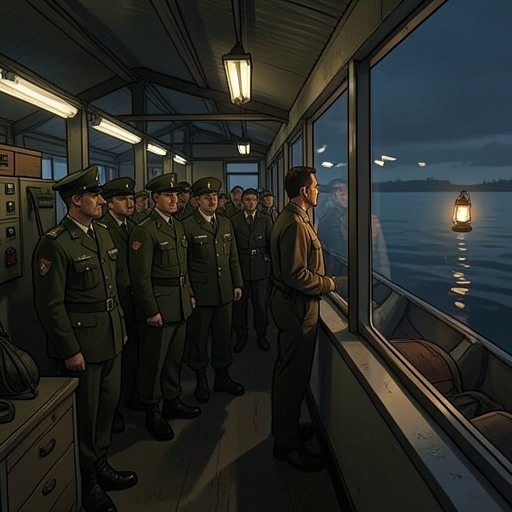
As the group travels toward the airport, the narrator sees a city still marked by defiance and impending defeat. Banners along the boulevard reject concessions to the Communists, while distant gunfire and a mortar blast break into the journey. Duc whimpers, and Linh tries to soothe him by describing the departure as a trip. Bon wonders whether they will ever see the streets again. The narrator offers reassurance that they must believe they will return, though his account makes clear that belief is not knowledge. The scene turns evacuation into a separation from a familiar city whose future the travelers cannot control.
At the airport gates, the convoy faces military police and an armed lieutenant. The narrator has sought information about the young officer’s circumstances before the encounter, learning that his salary supports an extended family crowded into a poor home. The detail sets the officer’s immediate decision within the larger pressures of the collapse: passage depends on persuading men whose own lives are precarious. The evacuation is therefore neither effortless nor purely official. It requires negotiation at a moment when the state’s authority is failing and the people trying to escape are exposed to the decisions of its remaining agents.
The narrator and Bon do not leave Saigon with Linh and Duc’s survival secured. Soon after landing on Guam, the narrator lowers Duc onto a stretcher; medics cover the child and Linh with white sheets and load them into an ambulance. Bon weeps with a force the narrator cannot match. Their deaths turn the evacuation from a passage out of danger into a bereavement that follows the survivors into exile. Bon becomes catatonic on his bunk and cannot remember the televised images of the evacuation that continue through the next day.
The fall as a public defeat
At the refugee camp, the narrator watches helicopters evacuating people from Saigon’s rooftops to aircraft carriers. The next day, after Communist tanks crash through the gates of the presidential palace, Communist troops raise the National Liberation Front flag over the building. The images fix the political outcome in public view: the government the narrator served has lost its capital, and the new authorities occupy its most visible seat of power.
The broadcast reaches the refugees in a temporary settlement under American military protection. The narrator describes memory of the republic’s last days as accumulating in his mind while he watches. A mundane cafeteria ritual makes the change in status concrete. When refugees return their trays after a meal, the narrator understands the act as confirming that they are no longer adult citizens of a sovereign country, but stateless refugees. The General, still wearing his military insignia after losing his luggage, says that his people need him and decides to walk among them to lift their morale. But the displaced civilians do not greet him as the soldiers he knows how to encourage. His uniform and rank draw silence, then hostility; his authority has crossed the ocean without the allegiance that once supported it.
The fall also remains contested in the language used to describe it. A year later, the narrator writes to his aunt that Saigon’s fall might also be called liberation. The paired terms register the opposed political accounts of the same transformation without resolving them. In his letter, he describes the exiles’ grief, their dispersal across the United States, and the need for sponsors to prevent them from depending on welfare. Some refugees arrive alone, some as families, and some families are divided among destinations. The fall thus continues through resettlement: the former residents of one country are scattered into unfamiliar places, where they use a shared network to learn where work, community, and tolerable conditions might be found.
Exile and continuing consequences
The narrator’s account refuses to make the refugees’ new lives either a simple story of rescue or an uncomplicated story of despair. He recalls reports of separated spouses, children who escaped without parents or grandparents, families missing children, and refugees who died from carbon monoxide while sleeping in a freezing room in Terre Haute. Against these losses, the community circulates stories of unlikely good fortune: a baby adopted by a wealthy family, a lottery winner, a student accepted to Harvard, or an entertainer eventually brought to Hollywood after other friends failed to answer her calls. The stories offer hope, but their circulation does not undo the separations and deaths. They show how the displaced community tries to make a future imaginable while refusing to accept that its nation is simply gone.
The fall shapes the narrator’s later encounters with other refugees and with the political aftermath in Vietnam. In the Philippines, while recruiting Vietnamese extras from the Bataan refugee camp for a film, he encounters people who have fled the country under Communist rule. One woman explains that foreigners had once victimized and humiliated them, while now their own people do so. Her account renews the narrator’s guilt and unsettles the distance he has tried to maintain from events at home. The fall is consequently not a clean dividing line between an oppressive past and a peaceful present; in his experience, violence and displacement persist under changed political conditions.
Later, Bon tells Lana that Linh and Duc are dead. His grief, usually kept from others, surfaces in a conversation about Saigon and its songs, exposing how the city’s loss and his family’s loss have become inseparable. The narrator watches Lana comfort Bon and recognizes both his love for his friend and his desire for her. This moment carries the fall into the survivors’ private relationships: exile does not merely relocate them, but changes what they can tell one another, what they have lost, and how they seek comfort.
Narrative significance
The fall is narrated through a confession written after the events, so its significance emerges through recurrence rather than through a single self-contained scene. The narrator moves between the final days in Saigon, the refugee camp, later recollections, and the political work that continues in exile. His retrospective account is also shaped by memory’s limits: he describes the last days as deposits encrusted in his mind, while later passages return to painful scenes that had been forgotten or withheld. The event’s fractured reach through memory makes the fall both a historical turning point and an unfinished personal reckoning.
Most importantly, the evacuation does not resolve the narrator’s divided allegiances. He leaves with the General’s party, but his underground connection to Man and his loyalties to Bon remain active. The fall forces him across a border without making him politically or emotionally whole. Its decisive consequence is therefore not simply that one regime ends and another begins. It is that the narrator and the other survivors carry the conflict into exile—in their losses, their memories, and the competing accounts of what happened to their country.