General and the Congressman’s Political Alliance
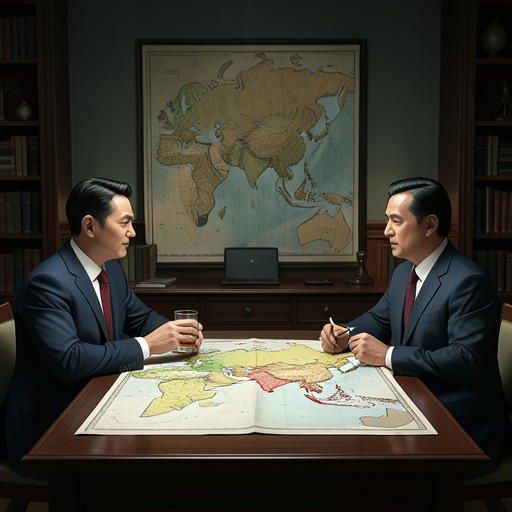
The SympathizerThe General and the Congressman’s Political Alliance is a partnership between an exiled South Vietnamese military leader seeking to rebuild his forces and an American politician who presents support for the refugees as both a moral obligation and a defense of anti-communist ideals. The alliance gives The General access to American political and charitable networks; in return, the Congressman gains a cause that joins his public image to the fate of the South Vietnamese soldiers he says he fought beside. Its central tension is that the same visible language of refugee relief and democratic solidarity can also conceal the financing and organization of a secret army.
A public alliance built on shared wartime claims
The Congressman is a Southern California representative and former Green Beret who served in the country from 1962 to 1964. His military background lends credibility to his support for the refugees, while his politics make that support conspicuously anti-communist. In his district, his aggressive reputation is reflected in nicknames that vary according to the political mood. Unlike many Americans, who regard the refugees with ambivalence or distaste because they recall the United States’ defeat, he has written editorials welcoming them and defending their presence in Orange County.
The alliance becomes visible at a wedding reception for two young Vietnamese people in a Chinese restaurant in California. Introduced to the guests, the Congressman describes the refugees as fellow Americans and recalls living among their people in the Highlands, fighting with their soldiers and sharing their fears. He casts the South Vietnamese defeat as a reversal imposed by history and by Congress’s failure to maintain its support, not as proof that the soldiers lacked courage. His speech promises that the refugees’ lost country may one day be reclaimed and presents their cause as part of the American promise of freedom, immigration, and assistance to allies.
That appeal is political as well as personal. The Congressman blames Democrats, the media, antiwar activists, students, and alleged communist influence for weakening the American commitment. His welcome to the refugees therefore does not rest on an open-ended acceptance of their difference: he places them within a patriotic account of the United States, where they represent the lost promise of American leadership. For The General, however, that public solidarity offers something practical. It creates an influential American advocate who can connect the exile community to people and institutions capable of supporting its ambitions.
From personal access to political utility
The narrator helps turn the Congressman’s goodwill into a working relationship. The following weekend, he drives The General and Madame from Hollywood to Huntington Beach for lunch with the Congressman. The modest Chevrolet Nova makes the narrator’s chauffeur role a small but meaningful remnant of the General’s former status: the couple travels with a personal attendant even in exile, and their conversation centers on their American host. The visit shows how social access, hospitality, and political contact begin to overlap.
At the meeting, the Congressman discusses his efforts to regulate movies and music, describing proposed legislation as guidance with enforcement rather than censorship. He explains that this work has made him acquainted with people in Hollywood, including a filmmaker preparing a war movie about the Phoenix Program. Since the Congressman says he left before that program began, he turns to The General for expertise and invites him to offer feedback. The General, in turn, presents the narrator as his cultural attaché and assigns him to read the screenplay. The exchange gives The General a route into a new American network while making his own experience useful to the Congressman’s contacts.
The alliance also becomes part of The General’s plans for political organization. In a discussion with the narrator, he says that Claude and the Congressman are among the allies who can help, although public support for another war is difficult to obtain. The General’s answer is to assemble his supporters gradually. The proposed organization will operate through public-facing groups as well as secluded cells, with the Congressman involved in a separate part of the network whose activities The General says he does not know. The Congressman is working on contacts that could clear the way to send men to Thailand, identified as the movement’s staging area. The separation between cells is deliberate: if one is lost, others should remain intact.
Charitable fronts and the movement’s finances
The alliance’s most consequential work takes shape through the Benevolent Fraternity of Former Soldiers of the Army of the Republic of Vietnam. Publicly, the organization serves veterans who have lost their army, country, and identity and seeks to improve their material circumstances. Privately, it also provides The General with a channel for receiving donations to support the Movement. The refugee organization is thus both a relief effort and a political instrument; its public purpose is genuine, but it does not exhaust what the organization is meant to do.
The Congressman helps make the Fraternity legible to American donors. At a meeting in his district office in a Huntington Beach strip mall, The General and the narrator present the organization and ask whether Congress can assist it. The Congressman points instead toward charitable foundations, including one of his own, as possible sources of support. The narrator connects this arrangement to methods Claude had described from the Saigon years: the Central Intelligence Agency could finance activities indirectly through fronts controlled by agents or sympathizers, and the recipients could themselves be fronts. In this account, respectable institutions and charitable language create layers between the original source of money and its political destination.
The narrator describes the financial arrangement as a performance in which he and The General appear to beg while the Congressman watches. The Fraternity is a front for the Movement, while foundations linked to the Congressman, his friends, or Claude’s associates may themselves serve as fronts for the Central Intelligence Agency or other organizations. The narration does not establish that every donor knows the full chain. Instead, it emphasizes the division of knowledge: the Congressman says he hopes the Fraternity will not engage in illegal activity, while the narrator understands the remark as allowing patriotic work to proceed so long as the Congressman can disclaim direct knowledge of its details. In this alliance, what remains unspoken helps protect what is being organized.
The donations are modest by the donors’ standards, but their value changes with location. The General raises funds through organizations introduced by Claude and through Americans who have visited the country or served there. Sent to Thailand, the money becomes baht and can provide food and clothing for soldiers in refugee camps. The account also distinguishes these contributions from weapons and ammunition: those are supplied by Thai security forces, whose funding comes from the United States with congressional approval. The network therefore combines private charitable giving, exile-community resources, foreign security assistance, and American political connections without presenting them as one transparent fund.
A reciprocal partnership with divided knowledge
The General’s ability to manage a room is part of the alliance’s operation. At a fundraising gathering attended by the Congressman and other guests, Richard Hedd argues that American happiness works as a zero-sum comparison, a claim that makes the room uncomfortable. The General redirects the conversation toward freedom, a value the guests can affirm without dwelling on refugee unhappiness. The Congressman raises his glass in agreement, and the gathering turns back toward the purpose of the meeting: support for former allies and the South Vietnamese soldier. The General’s intervention demonstrates a political skill useful to the partnership—he can shift a conversation from an awkward truth to a shared, fundable cause.
The alliance is reciprocal but not equal in function. The Congressman supplies access, introductions, public legitimacy, and pathways toward funding and contacts. The General supplies a cause with a ready constituency: exiled veterans presented as former allies, as people in need, and as potential fighters. The arrangement allows the Congressman to advocate for refugees while supporting an anti-communist project, and allows The General to pursue military preparation under the public shelter of charitable work. Neither the public identity of the Fraternity nor the patriotic language surrounding it fully reveals the movement behind it.
The narrator reports these arrangements to Man through coded correspondence, including information about the Fraternity and the officers in The General’s vanguard. He later photographs the General’s files, the order of battle, communications with officers in Thai refugee camps, and bank statements, sending the material abroad through a parcel disguised by a Hollywood-sign souvenir. The Congressman’s alliance with The General is therefore not merely a matter of speeches or friendship: it becomes part of a consequential political and financial network that the narrator can document and transmit. Its defining feature is the gap between what the public organizations say they do and what the concealed network makes possible.