Guam
The SympathizerGuam is the first refuge reached by the narrator and his companions after their evacuation from Saigon, a destination that turns the abstract promise of escape into the immediate reality of bereavement and displacement. The island offers temporary shelter, but the deaths of Bon’s wife, Linh, and their son, Duc, and the refugees’ recognition that their country has fallen make arrival feel less like rescue than the beginning of exile.
A Destination Before the Evacuation
Guam first enters the story as a destination discussed over beer by the narrator, Bon, and Man. Bon raises the prospect of meeting again in the Philippines; the narrator corrects him, explaining that the refugees are headed to Guam instead. Man tries to make the destination sound hopeful by associating it with the beginning of America’s day, while Bon answers with the sense that their own day is ending. Their exchange gives Guam a double meaning before the group reaches it: a place of refuge, but also the point at which the life they know is being left behind.
That contrast sharpens during the escape from Saigon. The narrator is dragged into the departing plane as it accelerates down the runway, while Bon remains outside, striking his head against the rising ramp and howling. Linh and Duc are already dead beside the narrator, and the aircraft’s steep ascent carries him away from the scene of Bon’s grief. Guam is therefore not a reunion or a return to safety shared by all three blood brothers. It is where the narrator arrives with the dead and without Bon.
Arrival and Bereavement
A green ambulance meets the evacuees shortly after the plane lands. The narrator carries Duc’s body to a stretcher, finding the child harder to lay down as the minutes pass. Medics cover Duc with a white sheet, remove Linh from Bon’s arms, and load mother and son into the ambulance. The narrator weeps, but Bon’s grief is more overwhelming: the narration describes him as spending a lifetime’s worth of unused tears.
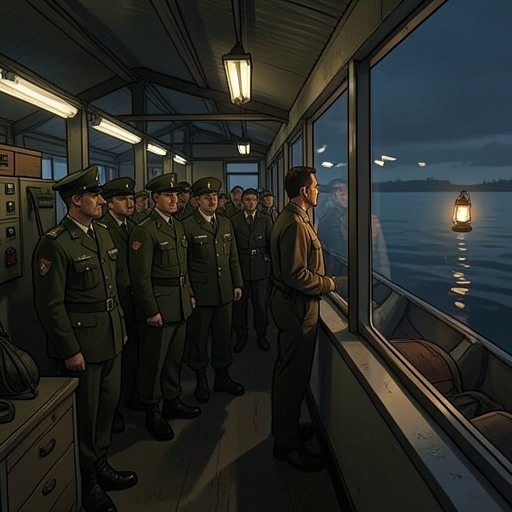
The survivors are taken to a refugee camp on Guam. Thanks to the General, they receive barracks, described as luxurious beside the tents used by other late arrivals. That relative comfort cannot undo the losses or the conditions of mass displacement. Bon lies catatonic and remembers neither the televised scenes of the evacuation nor the thousands of refugees in the temporary settlement, whose wailing gives the camp the sound of a funeral. The image turns Guam into a place of collective mourning as well as shelter: the refugees grieve not only individual deaths but a country they believe has died too soon.
Statelessness and Departure
The narrator watches television with the General’s family and other people in the barracks. Images of helicopters evacuating refugees from Saigon are followed by the fall of the presidential palace and the raising of the National Liberation Front flag. After dinner, the refugees join a line to return their trays. For the narrator, this ordinary act marks a political transformation: they are no longer citizens of a sovereign country, but stateless refugees protected, for the moment, by the military.
The General responds by deciding to walk among the refugees and raise their morale. His confidence in encouraging soldiers does not account for the civilians around him, whose experience is not that of troops trained to endure abuse. The episode shows the limits of his familiar command role in a camp of people whose losses cannot be met simply with military encouragement.
Guam is only the first stop. After days of waiting and grieving, the narrator and the others are moved onward by airliner to another refugee camp, where they enter a longer process of resettlement. In the narrator’s account, refugees need sponsors to avoid dependence on public assistance; those without close benefactors plead for support from employers, former advisers, lovers, churches, and even acquaintances. Families and individuals are dispersed to distant parts of their new country rather than allowed to establish one large, self-sufficient community. Guam thus occupies a short but decisive place in the journey: it provides temporary shelter while making visible the passage from evacuation to statelessness and onward dispersal.