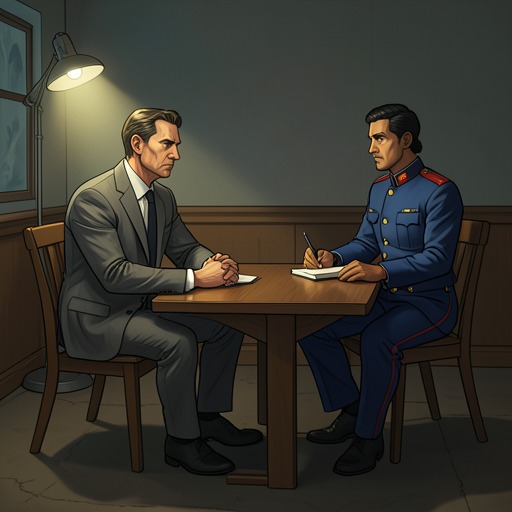
Interrogating the Watchmaker
The SympathizerInterrogating the Watchman is the unnamed narrator’s graduation test under Claude at the National Interrogation Center in Saigon, and a turning point in how he understands the power—and the moral cost—of intelligence work. The prisoner’s composure frustrates the narrator’s expectation that pressure will produce an easy confession. Instead, the interrogation becomes a contest of interpretation: Claude and the narrator seek a weakness, while The Watchman exposes the assumptions behind the justice system that holds him. The narrator ultimately uses that search not to uncover the truth but to devise a lie that threatens to destroy the prisoner’s ties to both family and revolution.
The prisoner and the interrogation room
The unnamed narrator remembers the episode as his first assignment under Claude’s supervision. He had watched the prisoner through cameras before entering the room himself, studying a man confined among white walls and white furnishings. The bed frame, desk, chair, bucket, food trays, plates, water cup, soap, T-shirt, and boxer shorts were all white; only a small opening for sewage broke the room’s sealed appearance. The narrator had been present when workmen built and painted it, so the room’s calculated character was no abstraction: he had helped make it.
Claude designed the conditions as an experiment in wearing down a prisoner. Air conditioning held the temperature at eighteen degrees Celsius, cold enough to intensify the prisoner’s discomfort. Fluorescent lights remained on continuously, erasing the distinction between day and night, while speakers stood ready to broadcast music without pause. The room’s whiteness and unchanging light made confinement feel both spaceless and timeless. The narrator was not merely observing the apparatus; Claude expected him to contribute to it and judged his performance as a student.
The prisoner was the leader of cell C-7 in Z-99, an underground unit based in Binh Duong Province. The narrator understood the cell to be responsible for grenade attacks, bombings, and assassinations that had killed thousands and terrorized Saigon. Z-99’s signature method was a paired bombing: a second device targeted people who came to help after the first explosion. The Watchman adapted wristwatches into timers by removing the hour and second hands, inserting a battery wire through the watch crystal, and setting the minute hand to meet the wire at the intended delay. The explosives came from mines taken from United States supplies, black-market purchases, or small shipments of TNT concealed in ordinary goods. His legitimate profession had also been watchmaking, a trade he had used to pay his bills before joining the revolution.
Sensory pressure and the first meeting
When Claude asked what music might unsettle a Vietnamese prisoner, the narrator recommended country music. He selected Hank Williams’s Hey, Good Lookin’ from a jukebox in a Saigon bar popular with white soldiers. The narrator associated the genre’s racial history and sound with white American culture; in his analysis, its use turned a supposedly ordinary song into an instrument of humiliation and isolation. The track played on a loop, except when the narrator entered the room.
The Watchman remained there for a week before the narrator met him face to face. Food arrived through a door slot three times daily: rice, measured portions of boiled greens and meat, and twelve ounces of water. The narrator watched the prisoner eat, wash, exercise, pace, and try to block out the music by plugging his ears. When the prisoner shouted at the Americans, Claude took it as evidence that he had begun to speak. The narration thus makes surveillance part of the interrogation: even actions performed alone were watched, recorded, and interpreted by the men controlling the room.
At their first meeting, The Watchman greeted the narrator with a reference to the song and pretended to enjoy it. He was a small, shivering man with coarse black hair, a philosophy degree from the University of Saigon, and a respectable Catholic family that had disowned him for his revolutionary activities. His light manner unsettled the narrator, who knew Claude was observing their conversation on a monitor. The narrator had to act as both enemy and conversational companion, while remaining conscious that the prisoner’s apparent ease might itself be a way of resisting the conditions around him.
A dispute over guilt
The narrator laid out charges of subversion, conspiracy, and murder, while invoking the principle that the prisoner was innocent until proven guilty. The Watchman laughed at the formula. He argued that the Americans treated Vietnamese people as guilty in practice, even while professing a secular presumption of innocence; he contrasted this with religious ideas of universal sin and accused American society of refusing to acknowledge the contradiction. His challenge makes the interview more than an exchange about the charges: it questions the moral language by which the interrogators justify their authority.
The Watchman then called the narrator a defective hybrid and a bastard. The narrator later judged that the insult may not have been intended as a personal attack, but at the time it enraged him. He recognized that he could have prolonged the interrogation with questions that went nowhere, ostensibly searching for information while secretly keeping the prisoner safe. Instead, he wanted to prove his intellectual superiority. His reasoning reduced the encounter to a struggle in which one man had to be master and the other slave, revealing how quickly the narrator’s investigative role became entangled with wounded pride and a desire to dominate.
The fabricated confession
After his anger cooled, the narrator identified what he believed to be The Watchman’s vulnerability. The prisoner had sacrificed his family for the revolution, although his Catholic background placed family among the most consequential bonds in his life. The narrator concluded that the same sacrifice that demonstrated The Watchman’s strength could be used against him. He immediately wrote a confession for the prisoner rather than eliciting one from him.
The fabricated account claimed that The Watchman had joined the revolution because he loved a man, had left his family for that reason, and had betrayed the revolution to save his captured lover. The Watchman read the document in disbelief and objected that it attributed a homosexual identity and motive to him, calling the story dirty and false. The narrator’s tactic did not depend on proving the account true. He threatened that the confession, together with the lover’s confession and intimate photographs, could be published in newspapers. When The Watchman said he would never appear in such a photograph, the narrator invoked supposed CIA powers of hypnosis and drugs; The Watchman fell silent.
The narrator then sharpened the threat by making its consequences personal and lasting. Public exposure, he argued, would alienate The Watchman from both revolutionary comrades and the family to which he might otherwise return. The fabricated confession was therefore designed to make resistance seem costly even without extracting a factual account of the prisoner’s actions. The episode ends not with demonstrated truth or a documented confession but with the narrator leaving The Watchman alone with the document. Asked whether he still considered the narrator a bastard, the prisoner answered that he was simply an asshole.
Recollection and narrative significance
The episode’s meaning deepens when the unnamed narrator later recalls it during his own interrogation. A recovered memory of another interrogation—the abuse of The Communist Agent in a room called the movie theater—places the narrator among the observers: he watches while the officers torture her, protests that the treatment is wrong, and recognizes that he has been present. That memory is distinct from the Watchman session, but its return makes the earlier training and the narrator’s later position in a coercive system resonate with one another. His claim to be both an enemy and a friend, or an observer who objects but remains in the room, cannot settle the question of responsibility.
The Watchman episode also exposes the difference between intelligence gathering and the production of a usable story. The narrator’s confession is invented, and its force lies in the social consequences it threatens rather than in evidence that it is true. Claude’s cameras, the regulated room, the endless music, and the narrator’s written scenario all turn observation into an exercise of power: the prisoner is watched, but the interrogators also decide what his conduct and identity are supposed to mean. The narrator’s skill is real, yet the scene shows that it can serve fabrication as readily as understanding. The interrogation leaves their contest unresolved while showing how the narrator’s ability to read another person becomes inseparable from his willingness to exploit him.