Interrogation and sexual assault of the Communist courier
The SympathizerThe interrogation and sexual assault of The Communist Agent is a recovered memory in which the unnamed narrator’s claim that he did nothing gives way to a more painful account: he watched the assault unfold and failed to prevent it. The scene exposes violence carried out under the cover of interrogation, but it also turns scrutiny on the witness, whose inaction becomes a source of guilt and a target of political judgment.
The memory and its setting
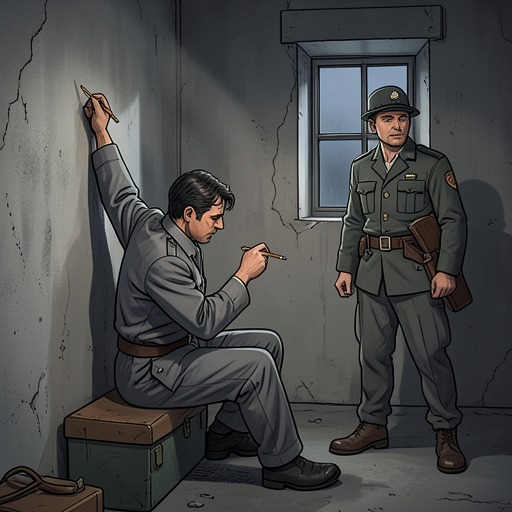
During the narrator’s reeducation, the questioning returns to a Communist courier whose fate his confession had left unresolved. The interrogators point out that he had mentioned her repeatedly, describing the list of names he pulled from her mouth, but had not said what happened to her. At first, he insists that he did nothing to her. The claim does not settle the matter: the interrogation presses him to remember the event he has omitted.
The memory surfaces in a room the police call the movie theater. When foreigners visit, the room serves as a theater; at other times, interrogations take place there. Its ordinary furnishings acquire a second meaning: blackout curtains cover the windows, folding chairs are pushed against the walls, and a Sony projector stands at the back. Claude watches beside the projector, while a screen on the opposite wall forms a backdrop to the violence. The room’s name disguises its function without changing it.
The Communist Agent had been caught with a list of police names in her mouth, evidence she was trying to swallow. The narrator’s own name was on that list. He knows she was Man’s courier, and he had passed the list to Man, though he believes she did not know his own identity. The arrest therefore places him close to the operation and to its exposure: he is not merely a distant observer, but a person implicated in the chain of information surrounding her capture.
From interrogation to assault
The crapulent major is nominally in charge, but he has yielded the questioning to three policemen and sits sweating in a folding chair. Claude, present as an adviser, tells the narrator that he must see what is happening. The narrator objects that the treatment is wrong and unnecessary, then asks the policemen to leave him alone with the woman for a couple of hours. The youngest policeman interprets the request as a demand for first access to her. The oldest dismisses the narrator’s concern and hands him a bottle of Coke. The narrator sits beside the major, holding it as his fingers begin to go numb.
The woman pleads that she is innocent. The policemen use the list as a pretext to mock her and disregard her denial. When asked her name, she eventually gives it as Viet Nam, a response that briefly leaves the men speechless before they laugh. The middle-aged policeman climbs onto the table and rapes her. The youngest and oldest take turns after him. The scene is not an exchange of information: the men have already converted questioning into punishment, while the narrator watches from his chair. As the assault proceeds, the woman’s screams stop; by the time the oldest policeman takes his turn, she is staring toward the narrator, though he feels she no longer sees him.
The witness and the aftermath
The narrator’s attention fixes on small objects and gestures that persist in the recovered memory. The Coke grows warm in his hand. After the assault, one policeman takes it, complains that he hates warm soda, and offers it back; the narrator remains unable to move. When another proposes using the bottle to wash the woman, her hatred briefly seems to revive her. The policemen shake the soda and use the bottle in a further act of degradation. Their joking manner does not lessen the violence; it makes the assault part of a casual group routine.
Afterward, the policemen splash water over the woman and the table and mop the tiled floor. She lies naked and silent, no longer screaming or sobbing. The emptied bottle is left inside her. Claude tells the narrator that he did not teach the policemen to use it; they devised that act themselves. The narrator remembers the bottle, the cleaning, and the men’s explanations alongside his own immobility. His account makes no claim that he stopped the assault or protected her.
The later interrogation establishes that the woman survived. The commissar says she was still alive when the authorities liberated her, though she could not walk. The three policemen were found and paid for what they had done. These facts complicate the narrator’s earlier statement that he did nothing to her: he did not commit the assault, but he witnessed it and did not stop it. The difference between direct violence and culpable inaction remains central to the judgment being made of him.
Recovered memory and responsibility
The scene is reconstructed through questioning rather than offered as a straightforward, uninterrupted recollection. The narrator first denies having done anything, then recalls where he stood, what he said, and what he saw. The details refute the comforting simplicity of his denial without making him one of the rapists. He objected, but his objection did not interrupt the assault; he asked for time alone with the woman, but the request was treated as sexual entitlement; and then he stayed seated while the policemen continued.
The reeducation interrogation connects this failure to the woman’s sacrifice and to the narrator’s broader record of what he did not do. The Commandant accuses him of failing to sacrifice himself to save her, while the commissar confirms that she lived but was badly injured. The accusation does not erase the officers’ responsibility or equate the narrator’s conduct with theirs. It makes his passivity another fact he must confront. The memory’s force lies in that distinction: the assault belongs to the policemen who carried it out, but the narrator cannot honestly describe himself as absent from it.
The room’s double use as theater and interrogation space sharpens the event’s concern with looking and representation. A projector and screen stand beside the machinery of questioning, while the narrator’s later confession turns what he witnessed into an account that must be examined. The assault is remembered not only through the perpetrators’ actions but through the witness’s position, his numb hand around a bottle, and his inability to act. By recovering the scene, the narrative exposes how silence can conceal a person’s role without making that role disappear.