Jay Bellamy
The SympathizerJay Bellamy is the young American sergeant at the center of the screenplay for The Hamlet, an embedded war film in which a rescue mission becomes a story of American heroism and retaliatory violence. Introduced through the unnamed narrator’s account of the script, Bellamy is less a fully developed individual than a role assembled from familiar war-movie ideals: youth, beauty, courage, and the promise of a first or final stand. The character’s plot also reveals the film’s larger imbalance, giving its American soldier a vivid identity while making Vietnamese suffering serve his story.
Identity and Screenplay Role
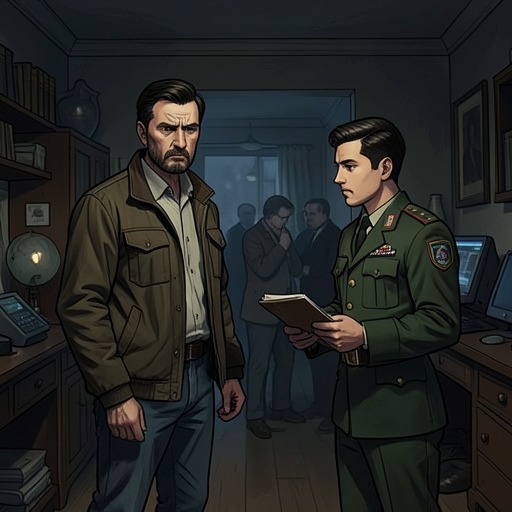
The screenplay introduces Bellamy as a blond, twenty-one-year-old sergeant arriving in Vietnam under the command of Captain Will Shamus. Shamus tells him that the United States controls the day while its enemy controls the night, setting up the mission as a struggle between American military power and an unseen threat. Bellamy is assigned to defend a hamlet near the Laotian border, where the inhabitants face the guerrillas of King Cong. In the narrator’s telling, the assignment gives Bellamy a stage on which to make what he imagines will be his first and possibly last stand.
Bellamy’s backstory marks him as a privileged young man in flight from home: he has left Harvard and run from St. Louis, his millionaire father, and his fur-cloaked mother. The screenplay presents the jungle and its inhabitants as an escape from that former life, describing them as the setting in which he can prove himself. His idealism is part of the character’s design; the script calls him young, handsome, and committed to the mission, placing him within the familiar image of an American soldier whose personal awakening coincides with a military campaign.
The narrator encounters Bellamy not as a person in the book’s primary action but as a character in the screenplay sent to him for review. That framing matters: Bellamy’s identity is constructed by a film narrative whose Vietnamese characters have initially been denied intelligible speech. The script’s later additions give several Vietnamese characters speaking roles, but their suffering still chiefly supplies motivation for Bellamy and the American force around him. His role thus establishes both the conventional hero of the film and the representational limits the narrator will confront in its story.
Mission, Allies, and the Film’s Violence
The screenplay gives Bellamy three Vietnamese characters to fight beside, but their stories remain bound to the Americans’ campaign. Binh, the older brother, serves as translator for the Green Berets and loves the American rescuers; King Cong kills him, along with a Black Green Beret. Mai, Binh’s younger sister, falls in love with Bellamy, then is kidnapped and raped by King Cong. Her assault becomes the screenplay’s justification for the Green Berets to destroy King Cong’s forces. The youngest sibling, a little boy, survives: in the final scene he is crowned with a Yankees cap and airlifted toward a new home with Bellamy’s family in St. Louis, where he will receive a golden retriever and the nickname Danny Boy. The plot offers the boy rescue and a future, but makes Mai’s violation and Binh’s death instruments in Bellamy’s war story.
In the climactic battle, Bellamy and Shamus kill four Viet Cong who tortured Binh and raped Mai, stabbing them with KA-BAR knives. The battlefield is then presented as a tableau of dead bodies, including anonymous Popular Forces troops; the film’s production turns the corpses into recurring props, with extras made up to die again and again. When Mama San emerges from a cave mourning her dead Viet Cong son, Shamus dismisses the possibility of further danger and turns away. She shoots him from hip to shoulder blades. Bellamy spins around and empties his magazine into her, and her death is staged in slow motion with fourteen blood squibs. After Shamus falls, Bellamy calls for an Arc Light strike on King Cong’s lair. The immense bombing spectacle is framed as cleansing the land of the dead, extending Bellamy’s role from combatant to the agent of a final, overwhelming American victory.
Staged Victory and the Meaning of Peace
In the climax, Bellamy’s victory is given a brief, carefully staged declaration of peace. After the Green Berets and their allies kill the Viet Cong who tortured Binh and raped Mai, Shamus asks whether Bellamy hears anything. Bellamy hears nothing; Shamus identifies the silence as the sound of peace. The moment seems to close the battle, but its calm is immediately unsettled when Mama San appears to mourn her son. Her attack kills Shamus, and Bellamy kills her in turn. The screenplay’s claim to have ended the violence thus gives way to another death, before Bellamy calls down the Arc Light strike. The sequence makes peace less an achieved condition than a name the victorious soldiers give to the silence after their own killing.
The Auteur presents the final bombing as the film’s ultimate spectacle and argues that the movie will outlast the war, becoming, in effect, the war itself. The unnamed narrator recognizes a partial truth in art’s endurance but rejects the implication that a film can outweigh the millions of dead whose lives constitute the war’s reality. Bellamy is central to that imbalance: the screenplay grants the American sergeant a legible heroic role, while Vietnamese lives are repeatedly made into casualties, motives, or signs of rescue. His scripted triumph therefore exposes the limits of the victory it celebrates. The film can stage Bellamy’s decisive action and call its aftermath peace, but the narrator’s account keeps visible the people and losses that this ending cannot resolve.
The Hero Inside the Production
Bellamy’s importance is also measured by the gap between the film’s claim to realism and the labor that manufactures it. The final battle turns extras into repeatedly killed bodies: a hundred performers must stand in for several hundred dead, and some are made to die four or five times. The elaborate Arc Light sequence, with trenches, gasoline, smoke bombs, and explosives, gives Bellamy’s victory the scale of an industrial spectacle. The Auteur calls the movie more real than reality, but the narrator sees how that claim threatens to eclipse both the people who died in the war and the poorly paid extras who enact its deaths. Bellamy is therefore not simply the screenplay’s hero; he is the figure through whom its manufactured triumph becomes visible, and through whom the narrator exposes the cost of making one American soldier’s story stand for a war.