Man
The SympathizerMan’s decisive significance lies in the double role he inhabits: he is the unnamed narrator’s closest revolutionary ally and, eventually, the comrade whose political duty places him on the other side of an interrogation room. Their bond begins in adolescence, but it is tested by the war, secrecy, and the opposing obligations of comradeship and revolution.
Identity and Revolutionary Formation
Man, the unnamed narrator, and Bon became blood brothers as schoolboys, sealing their loyalty by cutting their palms and mingling their blood in a ritual handshake. The vow joined three young men whose adult paths would diverge. Bon was an openly patriotic republican and a soldier; Man and the unnamed narrator shared a clandestine political education that Bon did not. Their blood oath thus became more than a sign of intimacy: it bound together men who would face the war from opposing convictions and, at crucial moments, conceal the truth from one another.
Man led the three-person study cell that included the unnamed narrator and another classmate. He guided their reading of revolutionary classics and taught them Party ideology, while Bon continued along a more conventional path. The cell was only one tier in a larger underground structure. Man himself belonged to another group as its junior member, but he did not disclose the identities of the people above him. He taught that secrecy and hierarchy were essential to revolutionary work, making compartmentalization part of the friendship as well as the political education: even the unnamed narrator, his intimate comrade, was not allowed to know the whole organization.
The difference between Man’s political commitments and Bon’s patriotism becomes stark as the South Vietnamese regime collapses. Bon hates the communists because a local cadre had forced his father, the village chief, to confess on his knees before shooting him. The unnamed narrator and Man persuade Bon to leave for America by presenting the departure as a strategic retreat rather than desertion. They also tell him that Man will follow with his family the next day. That assurance is false: Man intends to remain and witness the northern communists’ liberation of the South. At their parting, he presses Bon’s shoulder and renews the three men’s bond, insisting that they would remain brothers even if they lost the war. His tenderness does not erase the deception; it reveals the cost of making loyalty to the revolution govern what he can tell a friend.
Man’s underground work continues to reach the unnamed narrator after exile. Messages travel through a Paris-based aunt who can serve as a discreet intermediary, and ordinary correspondence conceals instructions in invisible ink made from rice starch. In one letter, a seemingly mundane report about bad weather carries a hidden signal; iodine brushed over the paper reveals numbers directing the reader to page, line, and word references in Richard Hedd’s Asian Communism and the Oriental Mode of Destruction. The domestic surface of the letter and its coded political use occupy the same page, extending Man’s lessons in secrecy into the narrator’s life abroad.
Counsel, Ideology, and the Work of Exile
Man remains the unnamed narrator’s political counselor after the war separates them. When the narrator worries that his work on a Hollywood movie makes him complicit in the Auteur’s project, Man answers through letters that treat art as a political instrument rather than a distraction from politics. He tells the narrator to remember the Party’s principles when considering refugees and to remember Mao at Yan’an when considering the film. The brief reference steadies the narrator: revolutionary work, Man implies, includes struggles over who gets to make images and whose account of a conflict those images serve. His own understanding of Hollywood as a vehicle for Americanization makes the counsel especially pointed.
Man’s political reasoning also gives the narrator a language for interpreting personal injury. When the narrator confides that a childhood cousin singled him out because of his mixed blood, Bon reacts with the impulse to beat the cousin, while Man turns instead to analysis. He reads the red envelope associated with the incident as a sign of how blood and ideas about luck had been used to mark the narrator. His response neither denies the hurt nor treats retaliation as its answer; it folds an intimate memory into a critique of the beliefs that made the narrator a target.
That political framework is demanding rather than absolving. After the narrator passes along film recording a Ranger battalion’s assault plans, he worries that innocent men will die. Man answers that revolutionaries cannot be innocent: they know too much and have done too much. Later, the narrator gives Man money taken from the crapulent major, describing the major’s extortion as a sin paid toward the revolution. Man takes the corruption as evidence that the revolutionary cause will win because its enemies are corrupt and its own side is not. The narrator’s later confession that the major was relatively innocent exposes the dangerous neatness of this assurance. Man’s principles can direct action and relieve doubt, but they can also make a complicated person seem reducible to the side he occupies.
Man’s advice about espionage turns that same political discipline into a way of seeing. A mole, he explains, is not simply someone hidden from view: the operative must remain where others can see him while watching what they cannot. He asks the narrator to consider what everyone can see about him that he cannot see himself. The lesson makes concealment depend not on disappearance but on occupying a visible identity strategically, a problem that parallels the narrator’s divided life as a trusted aide and underground operative.
In exile, Man’s revolutionary commitments are tested by the humiliation and frustration of refugee life. He sees former soldiers reduced to precarious civilian work and fears that assimilation will erode their authority within their own families. At the same time, he refuses to mistake mere survival for a meaningful return to life. He describes the refugees’ homes as jail cells without bars and argues that American rescue came after the United States had already used them, their families, and their country for its own purposes. His language of lost manhood reveals how deeply he measures dignity through military purpose and political agency; it also shows how exile has narrowed the choices through which he can imagine either.
The Commissar and the Divided Bond
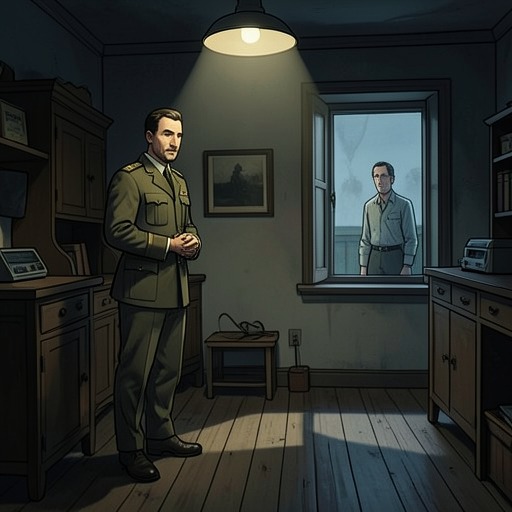
When the unnamed narrator returns to Vietnam, the friendship with Man reappears in its most terrible form. Man is now the commissar who interrogates him, and napalm has burned away his face: his lips are gone, his eyes bulge from withered sockets, and his nose has been reduced to holes. The body the narrator sees is almost unrecognizable, yet the voice identifies the friend beneath the damage. Their old intimacy has not vanished; it now exists inside the machinery of imprisonment and torture.
Man explains that he had warned the unnamed narrator not to return. His messages were not private: other people read them, and he could not send a warning without someone looking over his shoulder. The failure of the warning was therefore not simply a failure of friendship or care. Man had been trying to communicate within a system that watched both sender and recipient, while the narrator chose to come back regardless. Man’s rebuke carries the pain of a friend whose political position and physical confinement left him unable to protect the person he loved.
The interrogation exposes the contradiction at the center of their bond. Man is simultaneously the narrator’s interrogator and confidant, the person who tortured him and the comrade who remains his friend. The unnamed narrator cannot resolve these identities into a single, stable image; he recognizes that the apparent wholeness of a person may itself be an illusion. When Man tells him that he and Bon will be released, the act makes their difference newly stark: Man can help free his friend, but he cannot free himself. The narrator embraces him and weeps, recognizing that Man remains trapped in the camp, with death the only possible release from what he calls his living death.
Private Life and the Human Network
During exile, Man and a nurse had a daughter, a glimpse of family life that sits beside, rather than replaces, his clandestine political work. He entrusted the unnamed narrator with the name and address of an aunt in Paris, identifying her as a discreet go-between for letters sent home. She was a seamstress, had three Siamese cats, no children, and no suspicious political credentials; these ordinary particulars made her useful within a communications network built on secrecy. The arrangement shows Man applying the same discipline he had taught in the revolutionary cell to the intimate problem of keeping contact across borders, while the daughter and aunt give that hidden structure a distinctly personal scale.