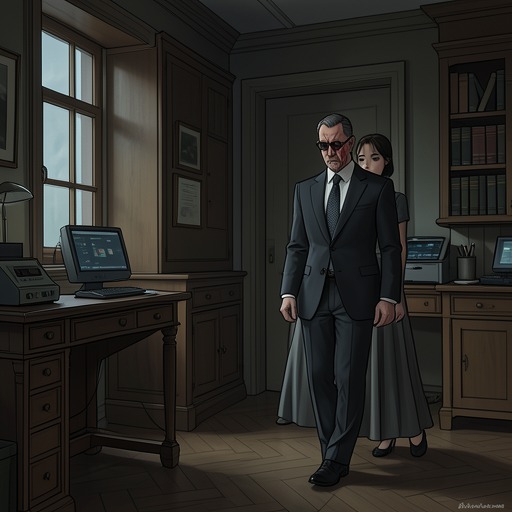
Man Burned by Napalm
The SympathizerMan Burned by Napalm is the attack that left Man with catastrophic burns and enduring pain just as the war was ending. Recalled during his examination of The unnamed narrator, the event joins a battlefield accident to its long aftermath: Man survived because his wife found him, but he could not make his injury fully intelligible to someone who had not suffered it. His account also clarifies that his examination of The unnamed narrator is meant to prevent the Commandant from breaking him and to establish grounds for his release.
Circumstances of the Attack
Man’s account begins in uniform, with liberation only hours away. His unit was stationed by a bridge as tanks of the liberation army approached, and his commanding officer ordered the men to stand firm. Man hid his excitement at the approaching end of the war, but worried about his family, who were at home with their children and near a courier assigned to protect them. He also feared that the liberating forces might shoot him before the war was over.
When someone announced the arrival of the air force, one of their planes appeared overhead. It was flying high to avoid antiaircraft fire, but also too high to make an effective bombing run. The men called for it to come closer. Instead, its bombs fell toward their own position. Man saw them descending in what seemed like slow motion; by the time he and the others ran, they had little chance to escape.
The Bombing and Man’s Survival
Napalm engulfed the unit. Man escaped the worst of the blast because he ran faster than the others, but the fire still licked him. He describes the pain as beyond what language can convey: being on fire felt simply like being on fire, and the injury was the most horrendous pain he had ever known. He refuses the comforting fiction that another person can understand that suffering by imagining it. The only way to make the unnamed narrator know it, Man says in effect, would be to burn him himself, an act he will not commit.
The narrator compares the attack with his own brushes with death on the Saigon airport tarmac and on the film set, where he was at worst lightly scorched. He cannot turn those experiences into an adequate measure of Man’s injury. He recalls learning in Claude’s class that napalm was invented at Harvard, and imagines it as a product of Western civilization, but even that historical association cannot bridge the physical distance between a slight scorching and Man’s burns.
Rescue and Continuing Pain
Man calls his survival a miracle. When he failed to return home, his wife searched for him and found him dying in an army hospital, where he had been treated as a low-priority case. She notified the authorities, who ordered the best surgeons still in Saigon to operate. Her search and intervention helped save his life.
Survival did not end the injury. For months, Man felt as though he were on fire every day. Even later, when his medication wore off, the burning returned. He acknowledges that excruciating is the right word, but insists that naming the pain does not communicate its force. The account therefore presents survival not as a clean reversal from death to recovery, but as a life prolonged under the continuing pressure of bodily pain.
The Story’s Purpose in the Examination
Man tells the story while examining The unnamed narrator, who has returned to face the Commandant’s scrutiny. The narrator asks what happened to Man after recognizing that their friendship has been damaged; Man’s account turns that question away from emotional loss and toward an experience the narrator cannot claim to share. Man says the narrator is only beginning to understand excruciation and that certain things can be learned only through feeling.
Yet Man’s purpose is not simply to inflict suffering. He explains that the Commandant regards The unnamed narrator as a dangerous figure who sees things from two sides and may contaminate the revolution’s purity. Man has constructed the examination room to prove that the narrator need not be purged and can be released. He has promised to test methods that leave no marks, because he believes the Commandant would otherwise break the prisoner through his body. The napalm story thus gives personal history to Man’s concern: he knows bodily pain from within, and uses that knowledge to explain both the limits of sympathy and his attempt to spare his former friend a different form of physical destruction.