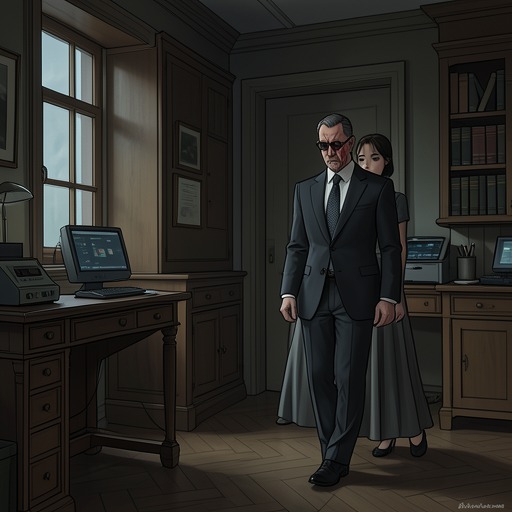
Man and the Communist female agent’s underground partnership
The SympathizerMan and the Communist Agent’s underground partnership is revealed through the work of a courier whose knowledge connects Man’s clandestine activities to the narrator’s own compromised position. The agent carries information for Man, knows who he is, and is later identified as having arranged the narrator’s father’s death. Her capture turns that covert relationship into a point of exposure, while the narrator’s effort to recover the episode shows how closely his own actions were bound to theirs.
The Courier and the Hidden Connection
The agent’s position in Man’s network is stated plainly: she is his courier. That role makes her more than a messenger passing information between operatives. She knows Man’s identity, a fact that gives their association a personal and dangerous dimension in a struggle organized around concealment.
The narrator’s connection to the same chain runs through a list he passed to Man. When the agent is caught trying to swallow the list, the narrator sees her during the interrogation and believes she does not know his own true identity. He recognizes, however, that she knows Man. The imbalance is consequential: the narrator has helped transmit the information, but the agent’s knowledge places her nearer to the hidden structure of the operation than he assumes she is to his own identity.
Capture and Exposure
The agent is found with papier-mâché evidence in her mouth, attempting to destroy the list before it can be recovered. Her capture brings her into the room used as a movie theater when foreigners visit and as an interrogation site otherwise. The narrator is present with Claude, while the crapulent major oversees the questioning and three policemen conduct it. The arrangement makes the agent’s courier work visible only through its violent interruption: the list she sought to conceal becomes the object around which her capture and interrogation turn.
The narrator’s memory of the episode is not immediate or complete. During questioning in the reeducation camp, he struggles to retrieve what happened in the room, and the scene returns as an answer to repeated questions. In that recovered account, he remembers watching the agent and recognizing that she knew Man. The partnership is therefore disclosed within a damaged recollection, where the effort to remember also reveals the narrator’s place in the chain of intelligence and its consequences.
The Agent’s Further Role
The partnership’s reach becomes clearer when the commissar states that the agent arranged the narrator’s father’s death. This disclosure connects her covert work to a killing beyond the attempted destruction of the list. It also reframes the narrator’s earlier relationship with Man: he had written to a revolutionary friend who would do what he asked, and his confession turns his wish for his father’s death into a question of responsibility. The agent’s role places her between that private wish and its political consequence, although the account does not specify the mechanics of the arrangement or establish that Man personally ordered it.
The agent survives her interrogation, but the Commandant reports that she could not walk when she was liberated. The commissar distinguishes physical injury from spiritual defeat, insisting that her body may have been broken while her spirit was not. Her survival preserves the human cost of the network’s work without making the partnership seem safe or triumphant: carrying knowledge and intelligence exposes her to severe violence, while her continued presence also means that the consequences of the operation cannot be reduced to a vanished courier or a lost list.
Narrative Significance
The relationship is presented through layers of information rather than through a direct scene between Man and the agent. The reader learns her role as courier, her knowledge of Man, and her part in the father’s death through the narrator’s recovered testimony and the commissar’s disclosures. That delayed revelation mirrors the secrecy of their work: the partnership is legible only when a chain of concealment begins to break.
It also unsettles any neat separation between political loyalty and personal responsibility. The agent’s covert service is tied to Man, but its consequences reach the narrator’s family and return as a demand that he account for what he wanted and what others did. Their partnership is thus significant not simply as an intelligence connection, but as one of the channels through which private intention becomes irreversible political action.