Man's sleep-deprivation interrogation of the narrator
The SympathizerMan's sleep-deprivation interrogation of the narrator is the final and most intimate stage of The unnamed narrator's reeducation: Man uses enforced wakefulness to make his friend recover a memory that exposes an omission as a crime. The interrogation’s purpose is not simply to extract undisclosed information. It forces The unnamed narrator to recognize his responsibility for watching the torture of a Communist agent without stopping it, and culminates in the painful realization that he had forgotten precisely what he did not do.
The Return and the Examination
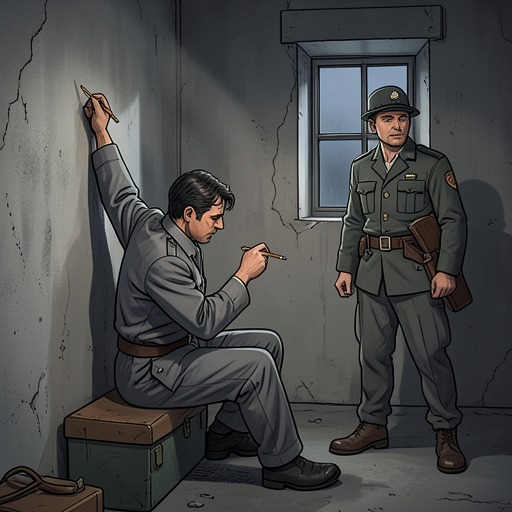
After The unnamed narrator returns to the camp, he discovers that the commissar is Man, his old friend and revolutionary comrade. Man appears severely disfigured, his face and skin scarred, and tells him that he had warned him not to return. Before The unnamed narrator can respond, guards gag, blindfold, and strip him, then secure him spread-eagled to a mattress. They block his hearing as well as his sight, leaving him in a confined examination room with no reliable sense of how much time is passing. The softness of the mattress and hood contrasts with the ropes holding him down; the room offers physical comforts only as part of an ordeal designed to unsettle him.
Man explains that the Commandant considers his pedagogical methods too gentle. To satisfy the Commandant while protecting The unnamed narrator from worse treatment, Man says, they must perform their assigned roles. The apparent division between harsh examiner and concerned friend is therefore part of the interrogation itself: Man’s concern is real, but he also controls the conditions under which his friend is confined and questioned. He says the purpose of the examination is to recover what The unnamed narrator has forgotten, or failed to include in his written confession.
Man identifies sleeplessness as the means of opening what he calls the last safe holding The unnamed narrator’s secrets. The longer he remains awake, Man argues, the greater the chance that it will crack. This logic turns memory into both the object of the examination and its instrument: exhaustion makes the prisoner suffer, while Man insists that the suffering may enable him to see what he cannot reach unaided.
The Memory Recovered
The memory Man is trying to bring back concerns the Communist Agent, whose name appeared on a list she had tried to swallow after being caught. The narrator had secretly passed that list to Man, but when the Agent was interrogated, he was present as an observer beside Claude. The room was called a movie theater when foreigners visited; when they did not, it served for interrogations. Its blackout curtains were shut, folding chairs pushed against the walls, and a projector stood behind the screen. The change of name did not change the room’s use. It concealed it.
The crapulent major was nominally in charge, but three policemen carried out the abuse while he watched. The narrator says he objected and asked Claude whether the treatment was necessary. Claude directed him to the major, who claimed that the General wanted to know how the Agent had obtained the names. Faced with the policemen, the narrator asked to speak with her alone. Instead, he remained in the room as they sexually assaulted her. The remembered scene gives the omission its precise shape: he was not absent, unaware, or unable to understand what was happening. He watched, while the men who had authority to stop the assault did nothing.
The Agent pleaded that she was innocent. When asked her name, she answered that her surname was Viet and her given name was Nam, prompting the policemen to laugh before the middle-aged man assaulted her. The other two took turns. The narrator describes being unable to look away, yet also recalls the room’s small, degrading details: a bottle of soda warming in his hand, the men’s jostling around the table, and the Agent’s face turning toward him. Afterward, one policeman seized the bottle, and another proposed using it on her. The narrator remembers the bottle being forced inside her and left there after the policemen had finished. The detail he calls sticky marks the return of the memory as more than a recovered sequence of events: the soda, the wet floor, and the bottle bind his presence to what he witnessed.
Claude later insists that he did not teach the policemen to use the bottle; they devised that themselves. His denial distinguishes the immediate act from the training and authority surrounding it, but does not undo his presence or the narrator’s. In the examination room, Man reads from the confession manuscript, which mentions the Agent and the list but leaves her fate untold. The narrator first says he did nothing to her. Man makes the omission itself the point: the concealed fact is not a further action against the Agent, but that the narrator failed to act while she was being assaulted. Under Man’s questioning, the remembered scene turns the confession from a record of what the narrator did into an account of the responsibility he had tried not to name.
The Apparatus of Wakefulness and Recognition
The interrogation makes sleeplessness a coordinated procedure rather than a single punishment. The narrator is fixed to a mattress beneath a grid of hundreds of bulbs in a white examination room, while the doctor explains that the aim is to keep him awake long enough to observe his own mind from a distance. A serum supplied by the Soviets is prepared, and an American military field telephone is modified so its current will not inflict the pain of a conventional interrogation device. Instead, a wire attached to the narrator’s toe delivers a brief spark whenever the second hand of a wristwatch crosses twelve. The doctor calls the device harmless, but its timed shocks, together with the lights and disrupted feeding, deny the prisoner control over rest and bodily rhythm. The method is presented as scientific care even as it reproduces the logic of coercion.
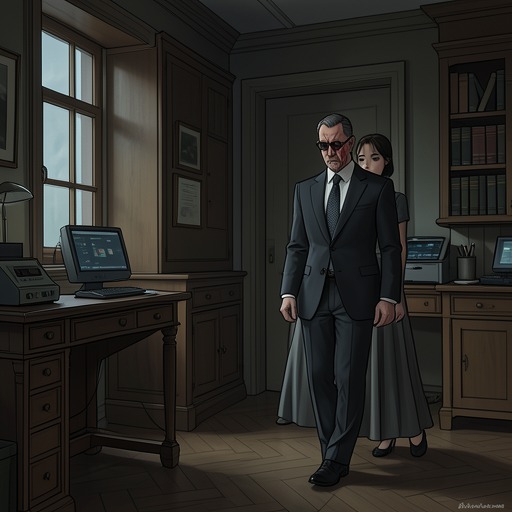
Man later shows the narrator the KUBARK interrogation manual recovered from his quarters at the General’s villa. The narrator’s underlined passages and marginal notes have become a blueprint for the treatment now being inflicted on him: the examiner has turned his own study of interrogation into an instrument against him. Sonny and the crapulent major remain in the room as observers while Man questions him, and their presence makes the examination at once private and watched. Man does not seek a secret the narrator has deliberately hidden. He argues that exhaustion may open a mental safe containing something the narrator has not managed to remember or confess.
As wakefulness erodes the distinction between prisoner, pupil, and patient, the questioning returns him to the movie theater. The room’s respectable name had concealed its use for interrogation; now the narrator must recall what happened there when the foreigners were absent. His memory restores the Communist Agent’s assault in concrete pieces, including the soda bottle and his own position beside Claude. Man reads from the confession manuscript, where the narrator had recorded the Agent and the list but omitted her fate. The narrator’s first defense—that he did nothing to her—becomes the admission Man has been seeking. His guilt rests not on a further physical act against her, but on having watched and failed to intervene.
That recognition does not arrive as a neat answer extracted by the apparatus. The narrator’s mind seems to separate from his tormented body, and the Commandant presses him to admit that he is being punished for the thing he did not do. The accusation widens beyond the Agent: Man raises the narrator’s father, whose death is connected to a message in which the narrator had written that he wished his father dead. The interrogation thus makes omission and intention part of the same moral inquiry, without treating the narrator’s earlier sacrifices as cancelling his failures. The Communist Agent survived, though she could not walk when she was liberated; Man says she was broken in body but not in spirit. He also says the policemen were found and paid for what they had done. These disclosures distinguish the narrator’s failure from the perpetrators’ actions, while refusing to let his passivity disappear behind theirs.
At the edge of collapse, the narrator returns in memory to his birth and screams the answer that had been present but inaccessible: nothing. The word completes his reeducation, not because it erases the events he has recalled, but because it exposes the absence around which his confession had been organized. Once he speaks it, Man turns off the light and sound, unbinds him, and embraces him until the screams subside. The narrator’s sobbing gives way to laughter as he understands the answer’s bitter joke; the Commandant, unsettled by the laughter and repetition, fears its effect on camp morale. The immediate pain ends, but recognition leaves the narrator with knowledge that cannot be undone. Man’s interrogation has recovered a memory, yet its deeper result is a changed account of responsibility: the narrator must confess not only what he did, but what he witnessed and chose not to do.
The Form of the Recovered Memory
The interrogation unfolds as a delayed disclosure rather than a simple flashback. Man begins with a gap in the confession manuscript: it records the Communist Agent, the list she tried to swallow, and her hatred, but not what became of her. Under questioning, the narrator’s memory first returns not as a complete account but as images—three mice, rectangles, curves, kanji, and a movie projector. The remembered room then supplies the missing context: its name changes with its audience, serving as a movie theater for foreign visitors and an interrogation room at other times. The slow movement from fragment to place to action makes the narrator’s forgetting part of the event’s structure, not merely a blank to be filled.
The scene is mediated by several forms of representation. The narrator remembers watching the Agent’s assault beside Claude, later hears his own recorded account in a voice that seems like a stranger’s, and is confronted by Man with the written confession he had left incomplete. The episode therefore places observation, testimony, and written self-account side by side without letting any one of them stand as a complete record. The narrator had seen the assault and had objected, but his manuscript’s silence about its outcome concealed the decisive fact of his inaction. When Man identifies that silence as the matter requiring confession, the examination shifts the test from factual recall to the narrator’s recognition of what his account has excluded.
The recovered memory also unsettles the boundary between staged violence and witnessed violence. Earlier, on the film set, James Yoon and a stunt performer enact water torture as the crew simulates a Viet Cong interrogation; the performance makes violence visible as a constructed scene. In the remembered movie theater, by contrast, the Agent’s assault is not a performance, although the room’s movie screen, projector, and foreign-facing name provide a theatrical frame around it. The contrast sharpens the question of what it means to watch: the narrator can identify the violence as wrong, yet his presence and perception do not become intervention. By making that distinction the center of the recovered scene, the interrogation turns the act of telling into an examination of the limits of witnessing and of the omissions through which a confession can remain technically truthful while morally incomplete.