Man–Bon
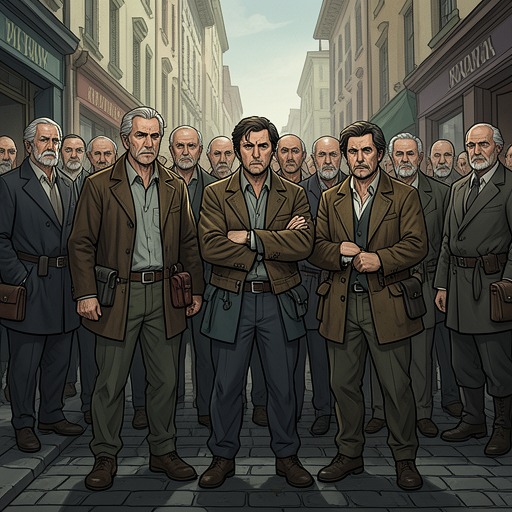
The SympathizerMan–Bon is a friendship forged in the lycée and tested by a war that places the two men on opposing political paths. Alongside The unnamed narrator, they imagine themselves as inseparable brothers; as adults, Bon’s republican patriotism and Man’s secret revolutionary allegiance put that bond under pressure. Their last farewell before Bon leaves for America makes the friendship’s central tension plain: political division may separate them, but neither man treats brotherhood as something that simply ends with defeat or distance.
Schoolboy Brotherhood
Man, Bon, and The unnamed narrator had fancied themselves the Three Musketeers since their lycée days, adopting the ideal of mutual loyalty associated with the phrase “all for one and one for all.” Man introduced them to Dumas, whose work mattered to him both as literature and as a model of someone marked by ancestry and despised by the French. The boys recognized in that example a shared experience of colonial contempt. Their literary identification gave the friendship a language larger than ordinary school companionship: they understood themselves as bound by fidelity, conviction, and willingness to stand by one another.
The group’s bond was also sealed through a blood-brother oath. The unnamed narrator recalls a scar on his palm matching Man’s and the adolescent vow that their blood belonged to one another. The account associates the mark with the three friends’ youthful belief in friendship, country, and independence, though it specifically identifies the matching scar on the narrator and Man. Their oath was made before they understood what circumstances might demand of them. In retrospect, the narrator recognizes that political loyalties would lead the friends toward conflicting actions, but describes the commitment as rooted in the same values that had joined them as boys.
Political Division
Bon’s history gives his patriotism a personal cause. He is a republican who volunteered to fight and has hated the communists since a local cadre encouraged his father, the village chief, to confess publicly before killing him. The murder shaped Bon’s view of the communist cause and made his opposition more than an abstract political position. Man and The unnamed narrator, by contrast, came secretly to believe that rescuing their country required becoming revolutionaries. The friends thus carried their earlier convictions into adulthood, but those convictions no longer pointed in the same direction.
The divide was consequential enough that Bon might have chosen to continue fighting in Vietnam or take his own life rather than leave. Man and The unnamed narrator persuaded him to think of his wife and child and presented departure as a strategic retreat, not desertion. The appeal shows their friendship operating through practical care: they try to prevent Bon from making a decision driven by despair and direct his attention toward his family. At the same time, their reassurance rests on a concealment that exposes the cost of their divided loyalties.
The Farewell Before America
Man tells Bon that he too will leave with his family the following day. That is not true: Man intends to stay and witness the southern liberation by the northern communists, the very outcome Bon despises. The lie is therefore not a small detail of the farewell. It lets Man help secure Bon’s departure while sparing him, for the moment, the full knowledge that their political paths are diverging. Their friendship is expressed through protection, but protection here requires withholding the truth.
As Man squeezes Bon’s shoulder, he calls the three of them blood brothers and insists that they will remain so even if they lose the war and their country. His eyes are damp. The scene makes separation tangible without claiming to know whether this is their final meeting: Bon may not see Man for years, perhaps ever, and does not know that this is the last time he sees him before boarding the plane. Man’s farewell places the fraternity’s promise against the imminent reality of exile and separation. The promise does not resolve their political disagreement; it asserts that the disagreement cannot wholly cancel the relationship.
The Oath and Its Limits
The friendship’s defining tension is that loyalty survives without requiring political agreement. Bon’s hatred of the communists follows from the killing of his father; Man’s commitment to revolution follows from a different understanding of what might save the country. Neither account erases the other. Their boyhood pledge had imagined sacrifice for brothers and nation, but could not specify what would happen when those obligations pulled in opposite directions. The adult relationship is shaped by that unforeseen conflict, not by a simple abandonment of their youthful ideals.
The unnamed narrator’s recollection gives the brotherhood both intimacy and uncertainty. The matching scar shared by him and Man, the oath spoken among the three, Man’s damp eyes, and the untruth about his own departure all show different forms of attachment: a bodily mark, a spoken commitment, grief, and an act of concealment. Man’s statement that there is no end to their bond is a pledge made at the moment of separation, not evidence that distance or politics will be overcome. Its force lies in the refusal to let the loss of a war, a country, or their former closeness define the friendship as finished.