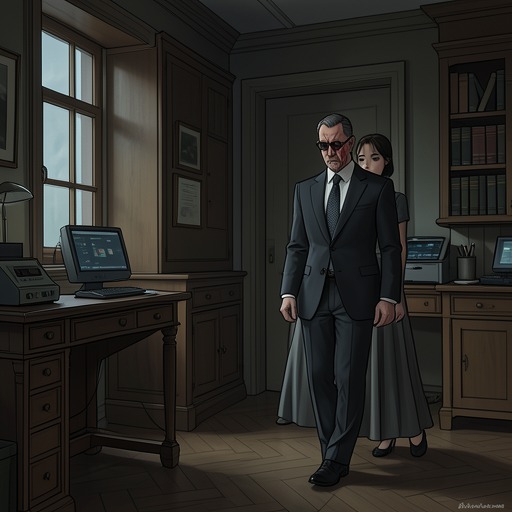
Man’s disfigurement after napalm burns
The SympathizerMan’s disfigurement is the lasting consequence of a mistaken airstrike near the end of the war, but it is also a wound that governs his life after the fighting. Napalm burns his face and body, leaving him in chronic pain and estranged from his family and comrades; years later, the friend who recognizes him must confront both the violence that made him unrecognizable and the suffering that continues beneath his commissar’s authority.
The Injury and Its Recognition
As the liberation army approached a bridge, Man’s unit was ordered to stand firm. An aircraft appeared overhead, flying too high for an effective bombing run. When its bombs fell, they landed on Man’s unit rather than the approaching tanks. He ran, but napalm engulfed the men around him. It only licked him compared with what others suffered, yet the burn was still the most horrendous pain he had ever experienced. The narrator, recalling his own brushes with death at the Saigon airport and on a film set, recognizes that neither comes close to being burned.
Man survives because his wife searches for him after he fails to come home and finds him dying in an army hospital. Her intervention leads the authorities to send the best surgeons still in Saigon to operate. Survival does not restore his former body: he describes himself as a human being turned inside out, living with the pain of having no skin and no face. For months he feels on fire every day, and when his medication wears off, the burning returns.
When the narrator encounters Man again in the reeducation camp, he first sees the damage before he recognizes his friend. Man’s lips are scorched away, his eyes bulge from withered sockets, his nostrils are reduced to holes, and his hairless, earless skull is covered in keloid scars. A cough makes a marble rattle in his throat. The altered face makes their recognition uncertain and painful: Man asks whether he is so horrible that the narrator cannot recognize him, while admitting that even Bon has seen him from afar without knowing who he is.
Exile from Family and Comrades
The injury estranges Man from the people closest to him as surely as it changes his face. He tells the narrator that his wife and children fear his appearance: his children cry when they see him, and his wife flinches at his touch. He has avoided mirrors for years, but the absence of a reflection does not spare him the knowledge of how others respond. In the narrator’s view, Man’s despair also shapes what he imagines his family sees; Man rejects that consolation, insisting that the narrator cannot know what it is like to live inside his altered body.
The separation reaches beyond his household. Bon has seen Man at the back of a meeting hall without recognizing him. Man has not called Bon forward to reveal his identity, believing that the knowledge would do Bon no good and might harm him. Yet he still dreams that Bon will recognize him despite his disfigurement—even if recognition brings the prospect of being killed by the friend he longs to reach. The injury thus makes reunion both a hope and a threat: Man longs for the bond to survive, while expecting his appearance to make that bond unbearable.
Pain, Authority, and the Meaning of Recognition
Man’s disfigurement also shapes the role he takes in the reeducation camp. He tells the unnamed narrator that friendship was not his only reason for petitioning to become commissar: he could not bear the thought of his wife and children seeing his burned face. The position places him in authority over his old friend, even as his own injuries leave him isolated from the family and comrades whose recognition he still longs for. His suffering is not behind him; he says that he burned every day for months and that the pain returns when his medication wears off.
During the unnamed narrator’s sleep-deprivation interrogation, Man’s familiar voice emerges from the camp’s coercive routine. He has come, he says, to save both the unnamed narrator and Bon, though he acknowledges that he did not seek the post purely out of friendship. The conversation exposes the cost of his survival without making his authority innocent: Man has tortured his friend, yet also works to secure his release. At the end, the unnamed narrator embraces him and recognizes the friend beneath the ravaged face. That recognition brings tenderness and grief together; Man is helping set him free, while Man himself remains trapped in the camp, unable or unwilling to leave except through death.
The Limits of Witnessing
Man’s burns become a test of what friendship and testimony can convey. He tells the unnamed narrator that imagining the pain is not the same as knowing it: the only way to demonstrate the agony would be to burn his friend, an act he refuses. The distinction resists easy sympathy. The narrator can listen and compare the injury with his own near-death experiences, but neither comparison gives him access to Man’s bodily reality.
The injury also carries the history of the war into the camp. The unnamed narrator recalls learning from Claude that napalm had been invented at Harvard, and imagines it as the light of Western civilization turned into a weapon. That thought does not lessen Man’s immediate pain or make it merely symbolic; it connects his scarred body to the military power that shaped the conflict. Man’s survival is therefore no clean escape from the war: the body saved by his wife and surgeons remains its continuing evidence.
At the end, Man’s ravaged face becomes inseparable from the unnamed narrator’s recognition of him, but it does not explain Man away. The narrator sees in Man a capacity to perceive what others overlook: confronting the void in the mirror has taught him something about nothingness. Their embrace acknowledges both the friendship that persists and the gulf no act of recognition can close. Man can help his friend leave the camp, yet the face and pain left by the bombing remain with him.