Means of representation
The SympathizerMeans of representation names the power to construct and control how a person appears to others—and whether that person’s account can survive at all. The unnamed narrator recognizes this power first as an instrument of interrogation: he helps make The Watchman into a character in a scene Claude has produced and he has directed. Later, reflecting on his own confession, he sees representation as a form of ownership with consequences as grave as control over material production.
Representation as an Instrument
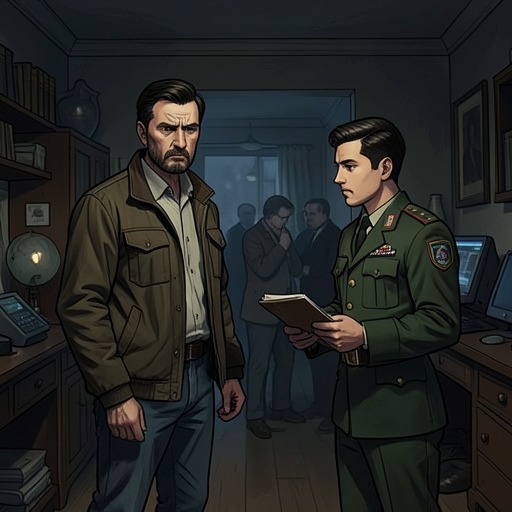
During The Watchman’s interrogation, the unnamed narrator uses the threat of public exposure to pressure him. The encounter is later replayed in a surveillance room, where the narrator watches himself watching The Watchman stare at his confession. That doubled view makes the interrogation resemble a film: Claude has produced the scene, the narrator has directed it, and The Watchman has been placed within an account shaped by others. The unnamed narrator’s admission that The Watchman could not represent himself, because the narrator had represented him, identifies the imbalance at the heart of the scene. The power at stake is not simply the ability to speak; it is the ability to determine what another person’s speech and silence will mean.
The unnamed narrator also confesses that he took pleasure in the interrogation, not merely that he carried out Claude’s request. He had learned what his teacher wanted and enjoyed Claude’s praise after breaking The Watchman. His sympathy for American modes of thought further complicates his position: he recognizes himself, to some extent, in those whose authority The Watchman threatened. Representation therefore operates through a personal as well as institutional relation. The narrator can treat another person as a subject to be rendered, while also finding his own identity implicated in the viewpoint from which that rendering occurs.
Ownership, Memory, and Death
The concept broadens after the unnamed narrator leaves the hospital. His services are no longer needed, and an airplane ticket has been reserved for his immediate departure from the Philippines. Still wounded, he reflects that lacking the means of production can lead to premature death, while lacking the means of representation amounts to another kind of death. If other people control the account, they may erase the dead from memory as if removing them from a laminated floor. The image turns representation from an abstract question of storytelling into a struggle over who remains visible in collective memory.
The unnamed narrator does not resolve that struggle by writing. Instead, he asks whether he owns his own representation or whether his confessor does. The confession that recounts his control over The Watchman is itself addressed to someone who may control how the narrator is understood. His account thus exposes a contradiction: he can recognize the violence of representing another person while remaining uncertain whether his own self-narration escapes the same power.
The Narrator’s Unresolved Claim
The unnamed narrator’s reflections connect representation to ownership without treating them as identical. Material production concerns control over what can be made; representation concerns control over how people and events enter an account and persist in memory. The Watchman’s interrogation makes that distinction intimate, as the narrator helps direct the scene in which another person’s confession is made to signify. The later reflection makes it personal: the narrator can write about that act, but cannot be sure that writing gives him control of its meaning.
The concept consequently frames the confession as more than a record of conduct. It is an attempt to narrate responsibility while acknowledging that narration itself confers power. The question of who represents whom remains open, linking the narrator’s treatment of The Watchman to his uncertainty about the story now being told in his own name.