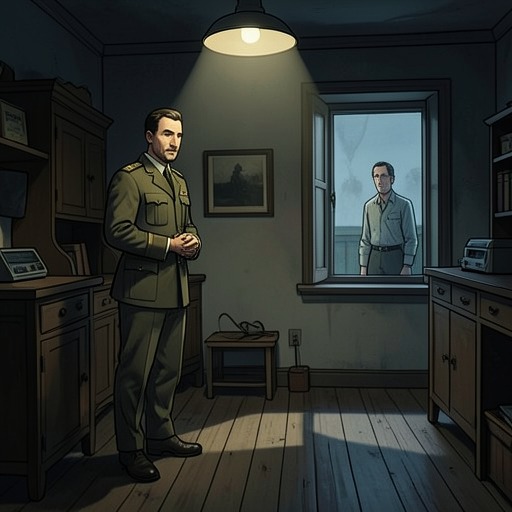
National Police of the Republic of Vietnam
The SympathizerThe National Police of the Republic of Vietnam is presented as a security institution whose intelligence work reaches into the highest levels of government while its coercive practices turn suspected political opposition into a target of violence. The narrator serves within its ranks, and his divided loyalties make the institution’s surveillance and abuses inseparable from the personal costs of his work.
Institutional Role and Intelligence Work
The police appear through the narrator’s position as a junior intelligence officer and aide to The General. His duties include preparing notes on communist writings for his superior, who uses the material to display his understanding of the enemy without having read the texts himself. The narrator’s work thus joins intelligence gathering to the performance of political knowledge: information is not only collected but also selected and presented for a powerful audience.
The institution’s reach is not one-sided. When officers break into the home of a suspected communist agent, they find a list of police names concealed in her mouth. The narrator recognizes that the names demonstrate a reversal of surveillance: the watchers themselves have been watched. He had sent a warning to Man, but it did not reach the agent in time. During her arrest, the narrator pulls the saliva-soaked list from her mouth, while privately knowing that he is on the side of the resistance and cannot safely disclose this to her. To her, he appears to be an agent of the oppressive regime; to the institution, his concealed allegiance makes his official position a cover that must remain intact.
Coercion and Interrogation
The institution’s coercive power emerges most starkly in the narrator’s recovered memory of a room called the movie theater. When foreign visitors were present, it served as a theater; otherwise, interrogations took place there. The narrator recalls being brought in with Claude to watch a young communist agent, captured with a list of police names in her mouth. The crapulent major was formally in charge, but he had left the three policemen to carry out the interrogation while he watched from a folding chair. The General wanted to know how the names had been obtained, and the major invoked that demand as the reason nothing could be done to stop what followed.
The policemen raped the agent, then used a soda bottle to assault her further. Her words, identifying herself as Viet Nam, briefly silenced them before they laughed and continued. The narrator objected that the abuse was wrong and asked to be left alone with her, but neither the major nor Claude intervened; the narrator watched, numbed, as the assault proceeded. Afterward, the officers washed the woman and the room, while the major later claimed that he had ordered the cleanup. The scene makes institutional violence visible not only in the acts themselves but in their surrounding chain of command: a superior’s demand for information, a nominally responsible officer’s evasion, and policemen treating sexual violence as interrogation.
The narrator’s memory of the episode is fragmented and belated. During the later questioning, details surface through the contrast between the room’s public use and its concealed function, and through objects he had not understood as evidence at the time, including the bottle and the soda spilled on the floor. His recollection does not present the abuse as an isolated departure from police work: the room’s routine double use and the officers’ casual handling of the aftermath expose violence hidden behind official procedure.
From Security Work to Evacuation
As the regime’s collapse became immediate, the narrator’s official intelligence work gave way to a different kind of list-making. After the president resigned, the General delegated the evacuation manifest to him while attending Joint General Staff meetings, reading interrogation reports, and conferring with allies about whether to defend the city or abandon it. The narrator’s task was to decide, name by name, who would be included; he understood each stroke of his pen as carrying life-or-death weight.
His administrative skill then helped move ninety-two people toward escape. With $10,000 supplied through the General and Madame, he secured passage arrangements, learned which airport guards would be on duty, and directed evacuees onto two buses. This operation is not presented as a formal action of the National Police of the Republic of Vietnam, but it shows how the narrator’s intelligence-service experience and access to official networks remained useful as the state disintegrated. The institution’s final context is therefore one of transformation and loss: its officer’s practical knowledge survives, redirected from the machinery of security toward getting people out.
The Police in Retrospect
The National Police of the Republic of Vietnam also survives in the narrator’s account as an institution whose violence has to be reconstructed under pressure. During his later confinement, the memory of the agent’s abuse emerges through questions about the room called the movie theater: when foreigners visited it served as a theater, but otherwise it was used for interrogations. The narrator’s answer places him there with Claude, the crapulent major, and the three policemen, and establishes that he watched. The episode is therefore not only a record of police violence but part of the narrator’s forced effort to describe his own place within it.
That account reaches the Commandant as part of a confession repeatedly revised during a year of isolation; by one review, its pages number 295. The formal demand to correct and refine his testimony contrasts with the police scene the testimony exposes, where the General’s demand for names and the major’s claim of helplessness displaced responsibility. The institution’s violence is thus carried forward not as a closed matter of the past, but as knowledge the narrator must recover, write down, and defend under another system of authority.