Pendleton Camp
The SympathizerCamp Pendleton is the Southern California refugee camp where The unnamed narrator and Bon spend part of their first summer in exile after leaving Guam. It replaces the hastily erected tents of the earlier camp with barracks and a more developed set of amenities, but its significance is not simply material: it is a temporary staging ground where grief, covert communication, and the practical work of resettlement converge. The camp also becomes a lasting point of reference in the scattered refugee community’s stories of loss and possibility.
Setting and Conditions
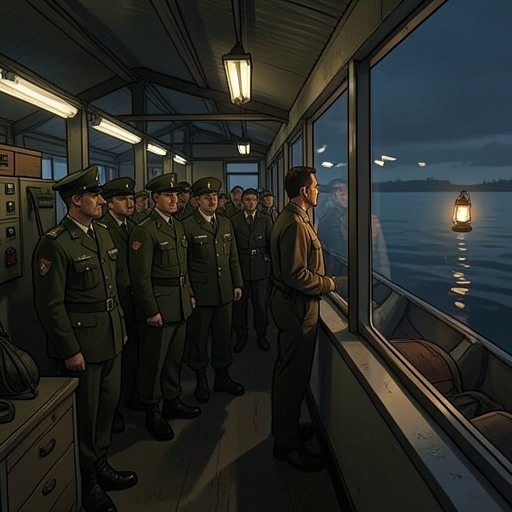
The refugees are shuttled from Guam to Camp Pendleton by airliner. For The unnamed narrator, the flight itself offers an unfamiliar comfort: a real seat and a real window. The change continues on arrival. Whereas refugees on Guam had lived beneath tents quickly put up by marines, Camp Pendleton provides barracks. The narrator describes the camp as a boot camp for learning Americana, suggesting that its institutional order prepares refugees not for military service but for life in a country whose customs they must learn.
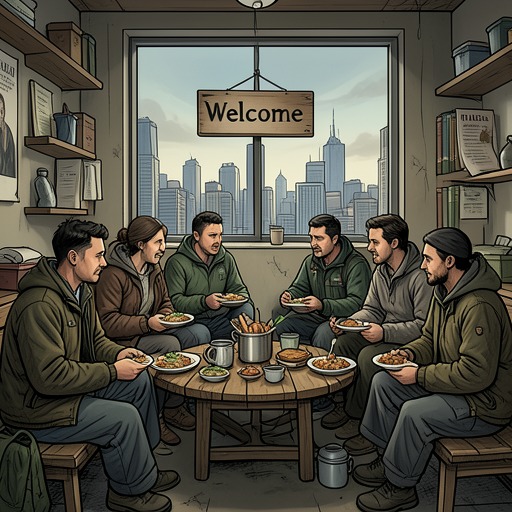
The improved facilities do not remove the strain of collective refugee life. Thousands of people bathe in showers without stalls and share barracks with strangers. Bon, already devastated by the deaths of Linh and Duc, is tormented at night by memories of Man and the dead, and the narrator fears he will starve unless pulled from his bunk and taken to the communal mess hall. The camp therefore offers shelter without privacy or respite: the routines of eating and sleeping continue amid bereavement that has not eased.
Letters, Surveillance, and Waiting
During the summer of 1975, The unnamed narrator writes his first letters to Man’s aunt in Paris, using the supposed aunt as a cover for correspondence with Man. Weather, health, and French politics serve as agreed opening topics; when those cues appear, the ordinary letter contains another message in invisible ink. When they do not, the letter means only what it says. The method turns the familiar routines of correspondence into a private channel linking the camp to a comrade left behind.
At this early stage, however, the narrator judges that the exiled soldiers are in little condition to organize a counterstrike. The information sent from Camp Pendleton is useful, but does not yet require secrecy. This distinction gives the camp a double character: it is a place from which the narrator continues his intelligence work, yet the refugees’ immediate exhaustion and dislocation make political action seem remote. The correspondence keeps a connection alive even when there is little operational news to transmit.
Sponsorship and Departure
Camp Pendleton is also a threshold in the sponsorship system that determines where refugees can go next. The unnamed narrator writes to Avery Wright Hammer, his former professor, who becomes his sponsor and arranges a clerical job in the Department of Oriental Studies. By the middle of the summer, Hammer’s help, together with money collected from former teachers, makes it possible for the narrator to leave the camp. He uses the funds for a bus ticket to Los Angeles, a few nights in a motel, an apartment deposit near Chinatown, and a used car.
Bon’s route out depends on a different kind of sponsorship. After reaching Los Angeles, the narrator seeks help from local churches; Reverend Ramon agrees to sponsor Bon and serve as his nominal employer. The two friends are reunited in their apartment by September, just in time for the academic year. Their movement from Camp Pendleton to Los Angeles makes resettlement concrete, but also shows how it is mediated by individual sponsors and charitable institutions rather than by a single path available to all refugees.
The camp’s departing population is dispersed much more widely. In the narrator’s account of the first year after Saigon’s fall, some refugees find sponsors through former employers, military advisers, lovers, churches, or even distant acquaintances; others leave alone or as families, and some families are split apart. Many are sent to states whose names are unfamiliar to them. The narrator imagines that, had the refugees been allowed to remain together, they might have formed a self-sufficient colony with the range of occupations, beliefs, and political views found in a whole society. Instead, bureaucratic dispersal prevents that community from staying intact, though people seek one another out in basements, churches, backyards, and other informal gatherings.
Memory and the Refugee Community
Camp Pendleton recurs in the community’s stories as more than an administrative waypoint. The narrator recounts a boy accepted to Harvard from Fond du Lac, with the camp’s soil still in the tracks of his sneakers: a specific remnant of the place carried into a story of achievement. That hopeful image stands beside accounts of refugees exposed to exploitation, family separation, cold, violence, and death. The camp is thus remembered through sharply contrasting outcomes, not as a guarantee of safety or success but as one shared beginning from which lives diverge.
Its place in the narrative also links personal resettlement to collective displacement. The narrator and Bon can leave through sponsorship, yet the larger refugee population is scattered across the country, rebuilding social ties wherever people manage to find one another. Camp Pendleton offers improved shelter and a route onward, but not a settled home or a restored community. Its lasting significance lies in that tension: it is both a temporary refuge and a point from which exile becomes a dispersed, continuing condition.