Post-unification Vietnam’s ban on yellow music
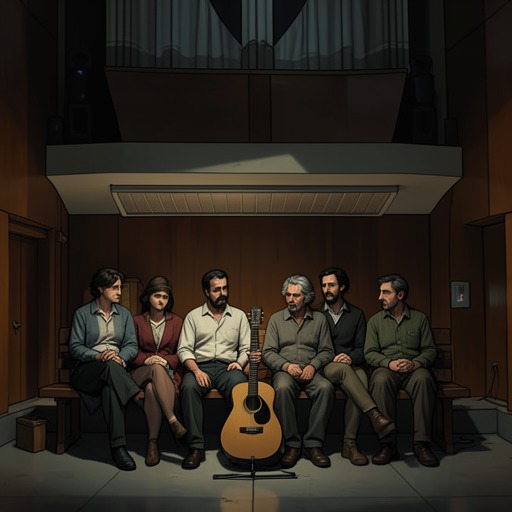
The SympathizerPost-unification Vietnam’s ban on yellow music makes the absence of familiar songs audible in the streets of Saigon. By permitting only red, revolutionary music, the authorities turn the soundscape into a marker of political conformity; for returning exiles, the silence where romantic and pop songs once played registers both cultural loss and the changed country they have come back to.
The Ban in the Changed City
After a two-day journey back to Saigon, the narrator and Bon notice that the city has no romantic songs or pop music playing in its sidewalk cafés or on transistor radios. The navigator, Bon’s cousin, confirms the explanation: yellow music has been prohibited, and only red, revolutionary music is allowed. The ban is presented not as an abstract rule but as an everyday absence, encountered while the travelers move through a city they had known by its public music.
The restriction belongs to a broader postwar landscape of political control. The narrator and Bon have returned from a reeducation camp, and their departure from Saigon is still being prepared under surveillance. During the two months they wait, they and their companions must periodically submit written confessions to local cadres, inventing minor failings despite having done little since their return. The declarations end with a required affirmation that nothing is more precious than independence and freedom. In this setting, the ban on yellow music is one part of a public culture in which permitted expression is explicitly ideological.
Music, Exile, and Recognition
The travelers’ reaction is sharpened by the music they have carried with them in memory. In Los Angeles, Bon and the narrator attend a performance where a singer renders Pham Duy’s City of Sadness; the narrator describes sadness as a portable city borne by exiles. That performance gives communal form to an emotional vocabulary shaped by displacement. Back in Saigon, by contrast, the absence of romantic and pop songs makes the return feel less like a restoration of home than an encounter with a place transformed.
The contrast is not simply between music and silence. In exile, Vietnamese refugees gather to hear songs and to make a temporary refuge together; in the reunified country, the state draws a boundary between prohibited yellow music and authorized revolutionary sound. The former sustains memory and shared feeling beyond the homeland, while the latter defines what may be heard in public at home. The ban therefore gives the exiles a measure of how radically the political order has changed.
Music as an Instrument of Power
Earlier in the narrator’s life, music had already appeared as a tool of coercion. Under Claude’s supervision, he recommends country music as a sound Vietnamese prisoners would find difficult to endure. As his examination in interrogation, the narrator is assigned to break a prisoner by keeping Hank Williams’s Hey, Good Lookin’ on an endless loop in a white room, where constant light and cold compound the isolation. This episode is distinct from the later prohibition on yellow music: the country song is chosen as a means of torment, while the postwar rule controls which kinds of music can circulate publicly.
Together, these episodes show music operating on several levels—as a remembered language of exile, an instrument used against a captive, and a medium regulated by the state. The ban’s distinction between yellow and red music makes political allegiance audible, while the earlier interrogation scene reveals how sound can be imposed on a listener rather than chosen. Neither episode treats music as politically neutral.
The Exiles’ Response and the Ban’s Significance
When the navigator confirms the rule, the narrator and Bon respond with laughter at the contradiction they perceive in prohibiting yellow music in a country described as yellow. Their laughter does not undo the restriction; it registers their distance from the political order that has imposed it. They have not returned to the country for which they fought in quite the form they imagined, and the soundtrack of public life makes that difference immediate.
The ban also forms part of the conditions under which they plan to leave again. As the group waits to join the navigator’s family on a boat, its members continue writing confessions for local officials and preparing their escape. The prohibition is thus more than a cultural policy mentioned in passing: it helps define the altered society they encounter after the camp and gives concrete form to the gap between revolutionary promises and the constrained life awaiting them.