Reeducation
The SympathizerReeducation is the novel’s name for a political and psychological process that seeks to remake the narrator through confinement, confession, self-criticism, and examination. Presented by the authorities as a cure for dangerous ideas, it becomes a contest over who may interpret his life and what words he is permitted to use. The process ends not in simple ideological agreement but in an insight that leaves him changed, damaged, and with no secure place in the society that has supposedly educated him.
Confinement and the language of cure
After the ambush, the narrator spends a year in a windowless, redbrick isolation cell, emerging for only an hour of exercise each day. The Commandant calls him a special case rather than a prisoner, then revises that description: the narrator is a patient who has encountered infectious foreign ideas and must be quarantined until cured. The medical metaphor makes coercion sound protective. In the Commandant’s account, isolation is not punishment but a necessary defense of people whose minds are supposedly unprepared for exposure.
The camp’s physical arrangement gives this claim a material counterpart. Barbed wire separates the guards’ interior camp from the barracks holding a thousand inmates, while the narrator’s solitary rooms occupy the guarded interior. Family visits take place at a pavilion by the fence; the surrounding plains are watched from towers. The Commandant and the commissar have electric fans, luxuries in a camp otherwise marked by damp heat and scarcity. The narrator, allowed to look out from the Commandant’s patio after the darkness of his cell, experiences ordinary light and space as privileges. Meanwhile, the Commandant’s assurances of hospitality coexist with a year of isolation and enforced writing.
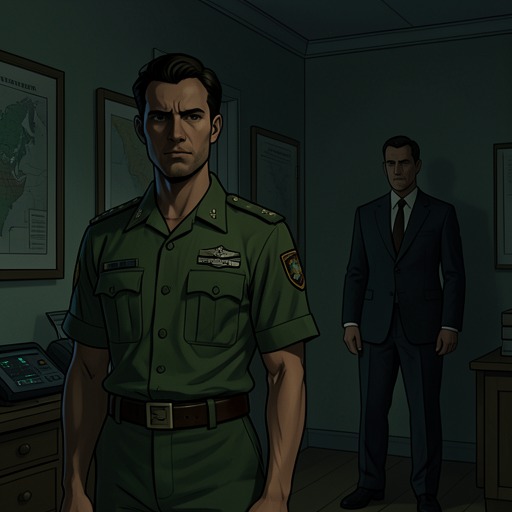
The Commandant’s role is not simply to issue orders. He reads and edits, wielding a blue pencil to mark the narrator’s confession for deletion, revision, or expansion. He explains that completion depends not only on the text but also on his reports about the narrator’s weekly self-criticism sessions to the unseen commissar. Reeducation thus works through observation and evaluation as well as confinement: the narrator must produce a written account, examine himself, and satisfy officials who judge whether the account sounds genuine.
Confession as a struggle over style
The narrator’s confession reaches 295 pages, yet length does not persuade the Commandant that it is adequate. Other prisoners, the Commandant says, have confessed to being puppets, lackeys, or collaborators in the defeated regime. The narrator, by contrast, will not give the authorities the language they expect. The Commandant’s criticism is explicit: the problem is not merely the content but the style. Reeducation demands a prescribed way of speaking about guilt, history, individual weakness, and collective duty.
That demand exposes a conflict between self-examination and scripted self-condemnation. The narrator can acknowledge acts such as killing Sonny and the crapulent major, but resists describing them in the formulaic ideological terms required by the camp. He believes some of the political slogans he is urged to write, yet cannot bring himself to put them on the page. To him, writing a cliché would compound rather than clarify his relation to what he has done. His refusal prolongs his confinement; compliance might have shortened it, but would have required him to surrender control over the meaning of his own account.
The Commandant interprets this resistance as evidence of moral weakness and bourgeois individualism. He contrasts the narrator’s southern background with northern deprivation and argues that the narrator lacks collectivity, faith in historical necessity, and willingness to sacrifice himself for the people. His criticism makes the confession a test of political identity: the narrator must not only recount a life but present himself as the kind of person the revolutionary order can recognize. The more closely he examines his past, however, the less readily it fits that expected narrative.
Examination and the return of remembered violence
After the written phase is declared complete, the narrator is taken toward the next stage, which the Commandant calls an oral examination and the commissar calls a cure. The shift from writing to questioning turns the struggle over words into a physical ordeal. In the examination room, the narrator is restrained under a grid of hundreds of bright bulbs. His hood, gag, earplugs, and blindfold are removed, only for light and repeated questions to keep him from sleeping. The questions ask who he is, what he is, and what he has forgotten. The examination makes identity itself the subject of interrogation, while exhaustion and pain compromise the narrator’s ability to answer.
The process forces the narrator back into a memory he had not been able to integrate: the interrogation of a Communist agent in a room called a movie theater when foreigners visited, but used for interrogations at other times. She had tried to swallow a list bearing the narrator’s name. He had passed the list to Man, and, at the earlier interrogation, understood that the agent knew Man’s identity. The narrator recalls watching while three policemen raped her. He had objected to the crapulent major and Claude, asked for time alone with the agent, and failed to stop the assault. Afterwards the policemen used a soda bottle to further humiliate her. The memory returns not as a neat confession but as a scene whose details expose what the narrator witnessed, what he tried to do, and what he did not prevent.
The novel also sets this remembered abuse beside the staged violence of an American war film. On that set, James Yoon’s character, Binh, is subjected to simulated water torture by extras playing the Viet Cong; the stuntman uses a breathing tube, although the performance is designed to resemble drowning. This is filmmaking, not the camp’s examination, and the distinction matters. Yet both episodes draw attention to how violence is performed, watched, and narrated: the film converts Vietnamese characters into images for an American production, while the interrogation memory becomes material the narrator must confront under coercive questioning. Reeducation does not merely demand that he remember; it makes the terms and costs of remembering part of its power over him.
Completion, damage, and the unfinished self
The narrator’s reeducation is completed when he arrives at a single answer: nothing. The word resolves the examination’s central question for him, but it does not restore him to an undivided or politically accepted identity. He is still a man with two minds, and he recognizes that people who have completed reeducation have no place in the revolutionary society. His knowledge of this exclusion hurts beyond the immediate pain of the examination. Completion is therefore a reversal: the authorities can declare the process finished without being able to incorporate the person it has produced.
After the examination, the narrator is returned to his former isolation cell, now unlocked, and no longer shackled. Freedom of movement does not immediately amount to recovery. His eyes are sensitive to daylight; he sleeps, remains silent, and sometimes has to be coaxed out of corners. When the Commandant asks whether he is still saying nothing, the narrator repeats the word that marked the end of the examination. The doctor eventually proposes a familiar activity: copying the narrator’s own confession. The 295 numbered pages become both a record of what he wrote under pressure and a means of slowly approaching the person represented by those words.
Copying takes months. As the narrator’s concentration returns, he develops sympathy for the intelligence operative on the pages and questions whether that man chose the right side of history or was foolish, compromised, or too clever for his own good. Once he finishes, he asks for more paper so he can write about the examination itself. This second account extends rather than closes the confession: the first text cannot contain what happened during the process that judged it. Reeducation’s central contradiction remains. It demands self-knowledge in a form controlled by the authorities, yet the narrator’s eventual understanding requires him to continue writing beyond their approved examination.
The process ends with a departure rather than reintegration. The narrator is preparing to leave the country by water, a necessity rather than a choice he welcomes. Reeducation has made him see that even those who regard themselves as revolutionaries may be unrepresentable within the new order. Its significance lies in that unsettled outcome: confession can be imposed, edited, and evaluated, but neither the prescribed style nor the declared cure can make a divided life fit a single political account.