Reeducation camp
The SympathizerThe Reeducation camp is a landscape of fences, watchtowers, and sealed rooms in which political instruction and coercion share the same ground. It confines defeated soldiers and officials while subjecting The unnamed narrator to a separate, prolonged process of written confession. The camp’s decisive contradiction is built into its language and layout: its authorities distinguish a privileged guest from ordinary prisoners, but his isolation, surveillance, and compelled self-examination make that privilege another form of captivity.
Setting and Spatial Order
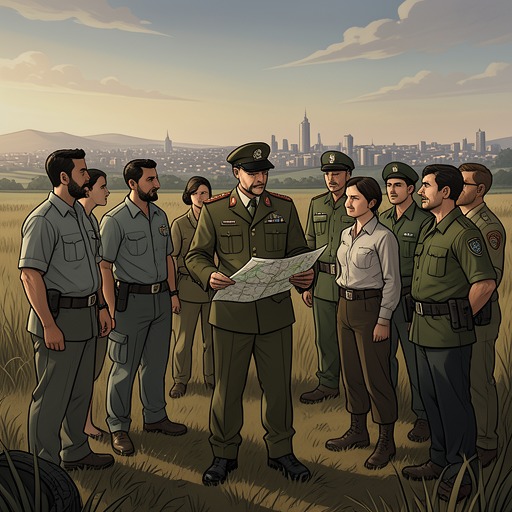
The camp is divided into an interior compound for guards and an exterior compound for inmates, with barbed wire marking the boundary between them. Near the base of two hills stand the kitchen, mess hall, armory, latrines, and guard warehouses. The Commandant’s quarters occupy an elevated position, while Man’s bamboo quarters sit atop the larger hill. From the Commandant’s patio, the camp’s hierarchy is visible as a physical arrangement: authority looks down across the guarded compounds and the barren, cratered plains beyond.
The inmates’ exterior compound is itself fenced off from the surrounding wasteland and watched from towers by guards with binoculars. Near a gate between the compounds, a pavilion accommodates family visits. Wives and children make the arduous journey by train, bus, and motorbike, but can see their imprisoned relatives only a few times a year. The pavilion offers contact without undoing the camp’s separation: families meet at the edge of a system that keeps inmates under guard and at a distance from ordinary life.
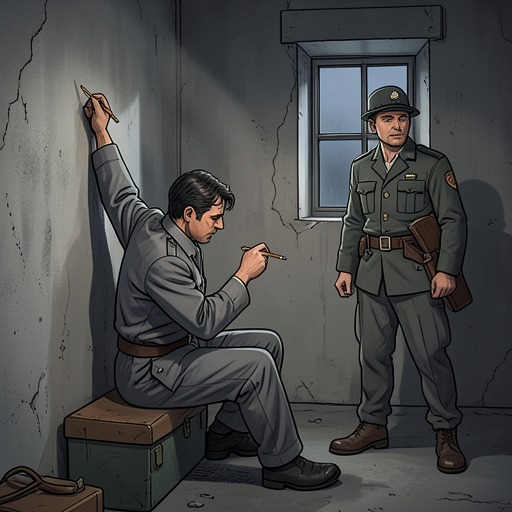
The unnamed narrator’s isolation cell lies on the flatland between the hills. It is one of a dozen red-brick rooms likened to ovens, where prisoners endure the heat with little relief. The cells are not entirely silent: inmates tap messages through the walls with tin cups, using a simple code that they teach The unnamed narrator. The method turns the architecture of confinement into a limited channel of fellowship. Messages cross the walls even when the prisoners cannot.
A Guest Under Confinement
The Commandant insists that The unnamed narrator is not a prisoner but a special case and a guest of himself and Man. The distinction separates him from roughly a thousand inmates housed in the barracks, among them Bon and the other survivors of the ambush. Yet The unnamed narrator has spent the past year in a windowless isolation cell, brought out to write and reflect rather than to attend the political lectures given to the general prison population. His exemption is not freedom; it marks him for a different kind of scrutiny.
The Commandant describes confession as the necessary prelude to a cure. The unnamed narrator’s written phase of reeducation takes a year, and the completed manuscript fills 295 pages. The Commandant edits closely, marking errors and urging revisions, while judging the result inadequate because it does not supply the ideological submission he expects. Other inmates, he says, have confessed to being puppets, lackeys, or traitors; The unnamed narrator will not simply tell him what he wants to hear. The camp thus makes writing an instrument of discipline: confession is required, but an acceptable confession must also conform to the authorities’ account of the writer’s past.
The unequal conditions reinforce the difference between official status and lived experience. The Commandant sits in a bamboo chair and has one of the camp’s two electric fans; the other is in Man’s quarters. The unnamed narrator, damp and sweating in the tropical heat, has no comparable comfort in his cell. He is permitted to see the view from the patio only briefly before returning to isolation. The camp’s language of hospitality therefore sits beside material arrangements that keep him confined and make his dependence visible.
Isolation, Memory, and Political Authority
The separation between the ordinary prisoners and The unnamed narrator does not prevent news from reaching him. Through the wall-tapping code, his neighbors tell him that they regard his long isolation as evidence of republican credentials and his Special Branch past. They credit Bon with helping establish this heroic reputation, although The unnamed narrator understands that Man, rather than The Commandant, holds the camp’s real authority. The same commissar inspires fear and respect among prisoners and guards, and even casual mockery is dangerous because a listener might report it as antirevolutionary thought.
The camp’s political order demands vigilance among comrades as well as obedience to authority. The Commandant explains that people do not share the same level of ideological consciousness and presents surveillance of one another as necessary to prevent antirevolutionary thinking. The unnamed narrator understands the stated rationale for his detention but remains troubled by the fear it produces. The camp’s rhetoric of comradeship does not dissolve suspicion; it gives suspicion a revolutionary justification.
During the final stages of questioning, the demand for confession also forces The unnamed narrator back toward memories he has been unable to articulate. The recalled scene is not an event that takes place in the camp: it is an earlier interrogation in a room called a movie theater, where the Communist Agent was sexually assaulted by three policemen while The unnamed narrator watched. The camp’s examination makes him recover that memory through questioning, including the fact that his own name appeared on the list the agent had tried to swallow. This return connects the camp’s demand for disclosure to an earlier history of state violence and compromised witnessing. Confession does not simply produce a clean account of the past; it exposes the acts, silences, and responsibilities that the narrator has struggled to face.
Departure and Narrative Significance
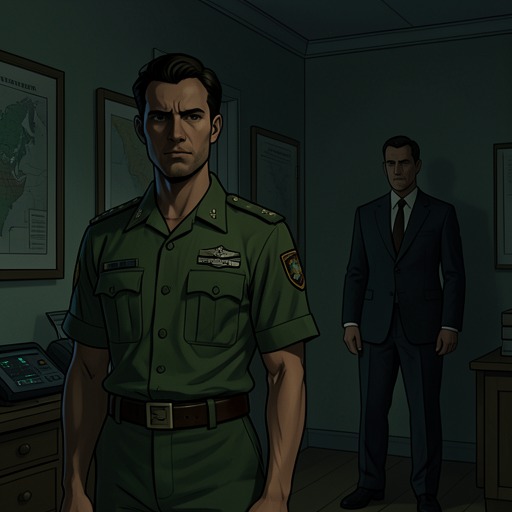
After The unnamed narrator completes the written phase of reeducation, The Commandant takes him to meet Man. Man tells him that he and Bon are to leave the camp and the country. A truck is waiting at the gates; their immediate destination is Saigon, where Bon has a cousin who has previously tried to flee. The release is abrupt enough to startle The unnamed narrator, who had assumed that he would die in the camp. It is not presented as proof that the authorities’ power has vanished: it comes by Man’s decision, after painful interrogation and a lengthy process of enforced writing.
At the gate, The unnamed narrator and Bon reunite after more than a year apart. Bon appears in rags and patchwork, with thinning hair, sickly skin, and a black patch over one eye; The unnamed narrator knows better than to ask what has been done to him. Other haggard survivors watch from behind the barbed wire. They exchange brief farewells, then climb into the idling truck as the guard locks its hatch. The Commandant asks whether The unnamed narrator has anything more to say; he and Bon keep silent rather than risk having their release revoked.
The Reeducation camp therefore functions as more than a backdrop to imprisonment. Its divisions between guest and prisoner, guard and inmate, permitted speech and compelled confession give physical form to the political contradictions The unnamed narrator confronts. The truck carries him beyond the gate, but his departure follows a year of isolation, a history recovered under interrogation, and the continuing need to escape Vietnam. Freedom begins here as a precarious passage out, not as a completed cure.