Representation and its ownership
The SympathizerRepresentation and its ownership concerns who gets to portray a person or people, whose account is accepted, and who controls the means by which an image circulates. The novel makes this more than an abstract question: the narrator helps break The Watchman through interrogation, encounters himself classified in Dr. Hedd’s political typologies, and contributes to The Hamlet, a film whose images turn Vietnamese people into objects of spectacle. His later confession implicates his own narration in the same struggle: to tell another person’s story can give that person a voice, but it can also replace that voice with the teller’s version.
Interrogation and the power to represent
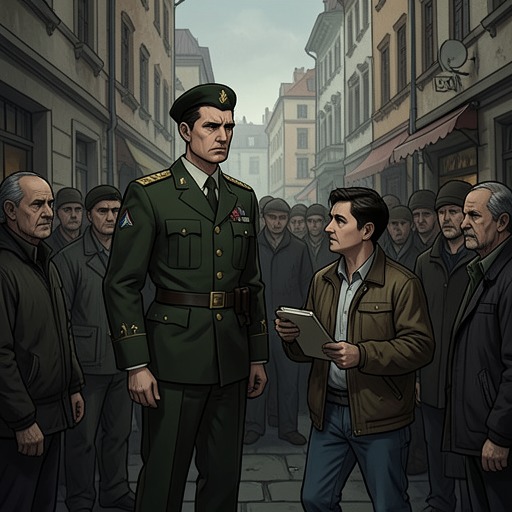
The narrator’s treatment of The Watchman exposes representation as an instrument of coercion. In the interrogation, he presses the prisoner with the prospect that disclosure of his homosexuality would bring condemnation from his revolutionary comrades and close off any return to his family. He also presents private confession as a way to preserve the prisoner’s reputation, while warning that silence will leave him forgotten. The appeal is calculated: the narrator uses the very social judgments that might injure The Watchman to try to force him to speak.
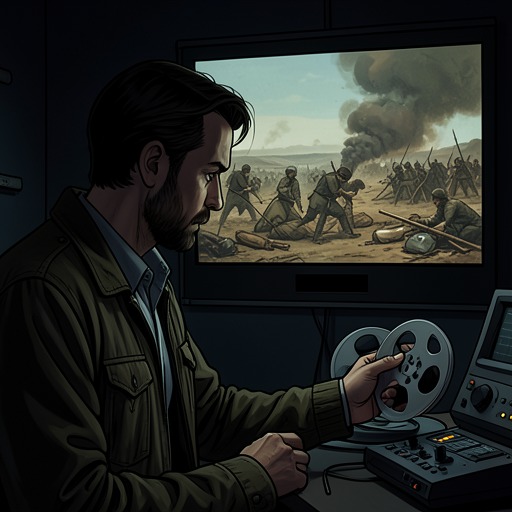
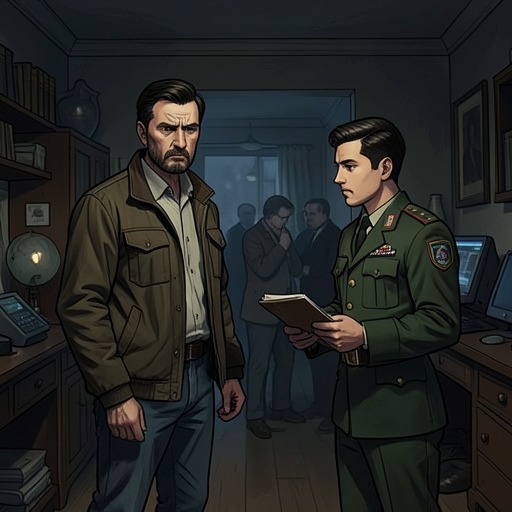
Afterward, the narrator admits that he did not merely carry out his role as a mole or follow Claude’s request to interrogate The Watchman until he broke. He took pleasure in the work. In a surveillance room, Claude showed him a replay of the scene: the narrator watched himself watching The Watchman stare at his confession. The narrator understands the encounter as a production he helped direct, with The Watchman made into a character inside it. The prisoner could not represent himself in that room; the narrator had represented him instead. The recorded image fixes the imbalance in place: one man is watched and interpreted, while the other gains authority over what the watching means.
That authority does not amount to ownership without consequence. Claude praises the narrator for breaking The Watchman, and the narrator recognizes that he has performed well for his teacher, in part because he identifies with the Americans whom The Watchman had rejected. But the satisfaction is temporary. The Watchman ultimately outsmarts him by sabotaging the means of production he does not own and destroying the representation that had come to own him. The narrator’s account thus links control over images and accounts to control over people, while showing that a person denied that control may still act against the system that represents him.
Political categories and the classified self
Dr. Hedd’s book presents another kind of representational power: the authority to sort Vietnamese people into political types. The narrator has read the book closely and finds himself addressed by opposing descriptions. One portrays the average Viet Cong fighter as an idealistic young man deceived by communism who would recognize America as a friend if he understood it properly. Another casts the Vietnamese radical intellectual, familiar with Western and revolutionary thought and critical of the denial of rights to his people, as an irretrievably lost cause. A third identifies young Vietnamese people attracted to America as the key to South Vietnam’s freedom.
The narrator sees that these categories do not contain him, even as they claim to explain people like him. He describes himself as composed of many pages, whereas he suspects that Dr. Hedd sees only a single, easily read sheet. That contrast makes classification a form of attempted possession: a complex person becomes manageable when an author’s scheme presents him as one legible type. The narrator’s response is not to deny that the categories touch parts of his experience, but to resist their claim to be complete. He intends to prove that the person under scrutiny cannot be mastered by a single page in a book.
The Hamlet and the spectacle of war
The Hamlet brings representation into the public space of cinema. The narrator and Bon watch it in a theater full of local spectators whose calls, laughter, movement, and commentary make the screening an active encounter rather than silent reception. The audience responds most strongly to the climactic battle. Its force comes from a combination of a menacing score, slowed helicopter sounds, crosscut gazes between airborne American characters and Vietnamese antiaircraft fighters, and the spectacle of weapons striking their targets. The narrator finds himself swept up in the scene even as he recognizes the disturbing likeness between the Vietnamese figures on screen and the spectators around him.
The film’s construction directs that response. Its Vietnamese opponents are rendered as savage figures, and the climactic violence culminates in a gruesome hand-to-hand fight. The last image, by contrast, follows Danny Boy as he rises away from his war-ravaged homeland in a helicopter, crying as he looks down. That ending gives the American character a sorrowful departure while the Vietnamese people remain largely within the film’s violent spectacle. The narrator admires the Auteur’s technical skill, but understands the result as a work of beauty and horror whose purpose is destruction. His admiration and shame coexist: he contributed to a production whose craft intensifies the unequal distribution of sympathy and visibility.
The credits make that production’s representational machinery concrete. Vietnamese performers appear under roles such as dead girl, lame boy, sad refugee, idealistic student, and weeping widow; four veterans are credited as Viet Cong rapists. The names reduce performers to functions within the film’s account of war, even as the narrator takes pride in the grace with which they performed those roles. He also recalls the labor of people working behind the scenes, including Harry, whose detailed sets were praised despite his use of actual corpses obtained from a nearby graveyard for the finale. The film’s images, then, are not detached from labor or material resources: they are made through the work of performers and crew, and the narrator later reports that the completed film has provided the Movement with a source of revenue.
Confession, authorship, and the limits of ownership
The narrator’s return from the Philippines makes the problem explicitly self-reflexive. After leaving the hospital, he learns that his services are no longer needed and is sent by plane to Los Angeles. He broods over the parallel between not owning the means of production and not owning the means of representation: the first can lead to physical death, while the second threatens erasure from memory. His confession extends the question to its own form. As he writes, he wonders whether he owns his representation or whether it belongs to the person hearing his confession.
The uncertainty is central to the concept. The narrator can expose the violence of other people’s portrayals and acknowledge his own role in producing them, but the act of confession does not automatically restore the represented person’s voice or place the story wholly under the narrator’s control. Across the interrogation, Dr. Hedd’s book, and The Hamlet, representation appears as both a means of making people visible and a means of fixing them in roles they did not choose. The novel’s insistence on ownership therefore asks not only who tells a story, but who has the power to make that story consequential—and who remains at risk of being written out of memory.