Representation as a form of power
The SympathizerRepresentation as a form of power describes the struggle over who may speak for Vietnamese people and who controls the images through which others understand them. The General’s efforts to establish a Fraternity and the narrator’s work on a Hollywood war film give that struggle two different arenas: organized political advocacy and mass entertainment. In both, Vietnamese people seek a voice within institutions whose resources and authority largely belong to others. The narrator’s eventual recognition that better details cannot overturn the film’s governing perspective makes representation not a matter of simple visibility, but of who owns the means to produce it.
Political Advocacy and the Right to Speak
At a meeting in the Congressman’s district office, the General and the narrator present the Fraternity and ask whether Congress might help. The setting is a modest strip mall in Huntington Beach, its parking lot and small businesses an unceremonious backdrop to the negotiation. Inside, an American flag and photographs of the Congressman with Republican celebrities establish the office’s political affiliations. The conversation begins with the ordinary courtesies of cigarettes, families, and sports, but turns to the question of who can represent a defeated and displaced community.
The General invokes Marx’s argument that “They cannot represent themselves; they must be represented.” He applies it to the Vietnamese exiles, who, in his view, cannot rely on their own political standing to shape how they are seen. Hollywood already represents them, so the Fraternity must work to influence that representation. The Congressman understands the request but says Congress will not support the organization; even naming Vietnam, he says, is unwelcome. The General accepts that official backing from the American public is unlikely. The exchange makes the imbalance concrete: the exiles can propose an organization and make a case, but the gatekeeper with access to political power declines to endorse them.
The General’s appeal is not limited to formal government. The Fraternity’s principal donors are expected to be wealthy individuals and charitable foundations interested in supporting America’s former allies. This dependence reveals a practical bind: the exiles need resources and recognition from the society in which they now live, even as they try to resist being defined solely by its account of them. Representation is therefore both a political demand and a negotiation conducted under unequal conditions.
Refugees as Images and as People
The narrator’s experience recruiting Vietnamese extras at the Bataan refugee camp makes the distance between public categories and individual lives palpable. He recruits a hundred people for a dollar a day. Their need is so urgent that none bargains for better pay, a reversal that unsettles his expectations about his countrymen. Western media have given the displaced a new collective label, but the label risks making them seem like an unfamiliar species rather than people driven from home. The narrator encounters thousands of refugees and hears a lawyer describe the change in their circumstances: foreigners had once victimized and humiliated them, and now their own people did so. The bitter observation refuses the comforting assumption that political change alone has ended victimization.
The same struggle over identity appears among former soldiers in exile. The narrator knows the men through his work as the General’s aide and has reported their circumstances to Paris. Former commanders now make livings as a pizza-parlor owner, a janitor, a mechanic, a short-order cook, or a deliveryman; others collect welfare or remain underemployed. Their loss is material, but the narrator also describes the strain of watching wives work and children master English faster than their fathers. The crapulent major interprets these changes through a wounded, nostalgic account of masculinity. The narrator suspects that exile has altered the men’s memories of family life as well as their present sense of themselves.
The General’s military training offers a counter-image. He has spent more than a year assembling experienced volunteers through trusted officers and noncommissioned officers, then organizes them into platoons, including a heavy-weapons unit for which weapons have not yet been obtained. When roughly two hundred men gather for training, the narrator photographs them. The General wears camouflage, a red beret, polished field boots, and an airborne patch; his uniform restores a dignity he had lost as a liquor-store and restaurant proprietor. The men, previously dispersed among low-wage jobs and often overlooked as a mass, stand straighter and march with pride. The camera records a change in how they appear, while the planned army gives them a collective image other than that of defeated refugees.
Hollywood and the Ownership of Images
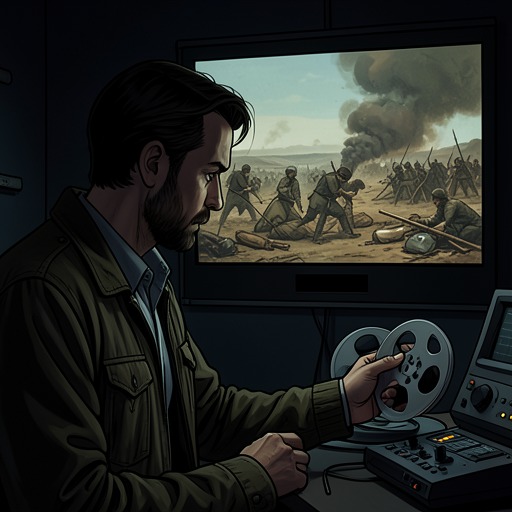
The film set seems to offer another opening. As technical consultant, the narrator can correct the script, recruit Vietnamese extras, and encourage the inclusion of speaking parts. His work matters in specific ways: actors can wear authentic clothing, speak real Vietnamese, and bring the sound of a dialect into scenes that would otherwise erase it. But the scale of the production dwarfs those interventions. The Auteur describes the film as something that will outlast the war and become as real as reality. The narrator sees the presumption in that claim: a work made by a powerful production can present itself not merely as an account of the war, but as the war itself.
The film’s destruction sequence makes the disparity between artistic spectacle and human history especially stark. Its production requires trenches filled with two thousand gallons of gasoline, a thousand smoke bombs, phosphorous, dynamite, rockets, flares, and tracers. The spectacle is designed to simulate the destruction of King Cong’s ammunition stockpile, and the crew anticipates it as a landmark cinematic explosion. The narrator instead measures the claim of artistic importance against the millions of dead who, in his view, compose the war’s real meaning. They cannot speak for themselves; extras playing Vietnamese people are similarly vulnerable to being made visible only as scenery, then killed within the story.
The narrator’s small changes do not redirect the production. He has altered passages in the script and helped create speaking parts, yet he has not changed the film’s overall course. His role is to make its Vietnamese details convincing: the dialect and costume must be authentic, while emotions and ideas can remain inventions imposed by the production. He compares his work to that of a garment worker, responsible for correct stitching on an outfit designed, produced, and consumed by wealthy white people. Those who own the means of production also own the means of representation. The best the people on screen can achieve, he concludes, is a word before their anonymous deaths.
Self-Representation, Masculinity, and Its Limits
The struggle is also visible in the language exiled men use to define themselves. The crapulent major’s account of women’s work and authority expresses a fear that the social changes of exile have displaced male power within the household. Bon’s account is more devastating: after losing his home, family, and soldierly identity, he sees no purpose left in his life and reduces his choices to killing himself or someone else. His sense of manhood is bound to being a son, husband, father, and soldier; when these identities are stripped away, he describes himself as nobody. His words show how an imposed status can become an intimate crisis, shaping what actions seem possible.
Bon later condemns the Americans’ promises of rescue as another form of dispossession. In his account, they first demanded that the Vietnamese fight on American terms in exchange for freedom, then rescued them without telling them that exile would leave them emasculated and voiceless. The General’s training, the Fraternity’s political appeal, and the narrator’s limited interventions in the film all answer this injury differently: they try to restore collective standing, political agency, or narrative presence. None has uncomplicated control over the conditions in which that restoration is attempted.
The narrator’s account therefore refuses the easy equation of representation with inclusion. Vietnamese people may appear in a film, speak a line, wear authentic clothes, or stand in uniform before a camera and still lack control over the image’s meaning. The central question is not simply whether they are shown, but who frames the showing, owns its machinery, and determines which voices endure. The film’s spectacle and the exiles’ efforts to organize themselves remain in tension: one turns them into material for an American story, while the other seeks the means to tell a story of their own.