Richard Hedd
The SympathizerRichard Hedd is an English immigrant and prominent author whose book, Asian Communism and the Oriental Mode of Destruction, gives an authoritative voice to arguments about Vietnam that reduce Asian people to types. His celebrity helps open political doors for The General, but his encounters with the unnamed narrator expose the limits and contradictions of his expertise: Hedd can recognize a sharp argument even as his own writing treats people as categories to be interpreted and managed.
Public Profile and Political Influence
Hedd appears first as a public figure at a distance. During a television interview about the situation in Cambodia, he is visible to the unnamed narrator and Bon as a commentator whose English accent stands in sharp contrast to the interviewer’s Bostonian one. Later, a photograph of Hedd among Republican luminaries hangs in The Anti-Communist Congressman’s office, alongside images of Ronald Reagan, Gerald Ford, Richard Nixon, John Wayne, and Bob Hope. His presence in that collection marks him not simply as a writer but as a figure with cultural and political standing.
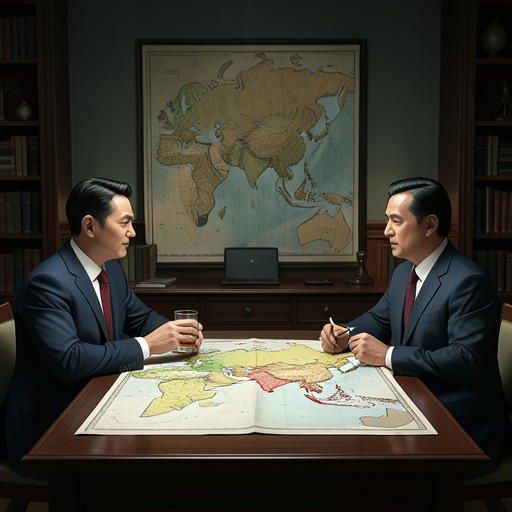
The General’s circle treats that standing as a practical resource. At a dinner arranged by The Anti-Communist Congressman, Hedd is the main attraction and The General the secondary one; the gathering is meant to connect the exile leader with advocates, supporters, and potential investors. The Congressman has presented Hedd’s good opinion as a way to open doors and pocketbooks. Hedd’s influence therefore operates through more than his arguments: access to him can be converted into support for The General’s cause.
The Book and Its Categories
The unnamed narrator has studied Hedd’s book closely, dog-earing its pages until it has swollen from use. Its claims range from the proposition that Vietnamese peasants are apolitical and chiefly concerned with feeding their families to the argument that bombing can persuade them that communism cannot protect them. The book casts coercive airpower as a means of political instruction, treating the destruction of a village as a calculation whose cost may be outweighed by its effect on the people who live there.
Hedd’s descriptions of Vietnamese people extend the same logic from populations to individuals. He presents the average Viet Cong fighter as an idealistic young man misled by communism who would recognize America as a friend if he understood its true nature. He also identifies the radical Vietnamese intellectual as a particularly dangerous opponent: someone who has read Western political and literary thinkers and asks why the rights praised by Western civilization have not been extended to his people. In Hedd’s account, that intellectual is beyond persuasion and cannot return from the radical cause.
Yet the book offers a contrasting category as well. Young Vietnamese attracted to America, Hedd argues, may be cultivated as the people who will eventually replace South Vietnam’s generals, whom he describes as French-trained. The unnamed narrator recognizes that these classifications address parts of himself: he is both the radical intellectual Hedd regards as lost and a young Vietnamese who has studied American culture. His response is not to accept one label as definitive. He understands himself as made of many pages, not a single readable sheet, and resolves to prove Hedd wrong about how easily he can be mastered.
The Dinner and the Narrator’s Challenge
At the dinner, Hedd’s authority is tested through conversation as well as invoked for political advantage. The unnamed narrator gives him the book for an autograph and explains that understanding a person’s character includes understanding what that person thinks of others. The observation redirects attention from Hedd’s study of Asia to the assumptions built into that study. Hedd’s writing may claim to explain the Vietnamese, but the narrator suggests that its account also discloses the American observer’s own character.
Hedd’s questioning of the narrator makes the encounter more personal. Asked whether Vietnamese refugees are becoming Americans, the narrator repeats the familiar promise of life, liberty, and the pursuit of happiness. Hedd presses him to say whether he is happy. The narrator finds no safe answer: unhappiness could be read as personal failure, while a claim to happiness could sound boastful. Hedd interprets that hesitation as evidence of a broader problem, arguing that American-style happiness works as a zero-sum comparison: one person’s happiness implies another’s unhappiness, while visible unhappiness unsettles a society that expects people to pursue happiness as though success were within everyone’s reach.
The narrator’s discomfort is sharpened by the unequal terms of the exchange. As a refugee, he could not easily voice such criticism before the American guests without risking exclusion; Hedd can speak with greater license because he is an English immigrant whose accent and heritage lend him authority in the room. The General redirects the discussion from happiness to freedom, and the guests raise their glasses. Hedd’s critique is perceptive, but its force also depends on a social privilege the narrator and The General do not share.
War, Race, and the Argument over Human Value
The dinner’s discussion of the Vietnam War reveals the most brutal premise in Hedd’s account of the Orient. He contrasts American attrition warfare with a war of obliteration, invoking the destruction of Tokyo, Hiroshima, and Nagasaki as examples of the strategy he believes American generals understood but were not free to pursue. He then describes life in the Orient as plentiful and cheap, suggesting that Asian people place less value on life than Westerners do. The General initially agrees that the uncomfortable truth should be acknowledged, leaving the unnamed narrator to answer the claim.
The narrator counters by distinguishing between life being valuable to an Oriental and life being invaluable to a Westerner. Hedd accepts the formulation as more exact than his own. This moment complicates the imbalance between author and subject: the narrator is not merely resisting Hedd’s generalizations but demonstrating his ability to expose a distinction those generalizations obscure. Hedd’s approval does not undo the book’s essentializing framework, but it shows that the encounter can unsettle that framework from within its own terms.
Narrative Significance
Hedd embodies the power of representation: a celebrated writer can convert descriptions of Vietnamese people into knowledge that circulates among politicians, donors, and audiences. His claims about bombing, political persuasion, and the supposed Asian valuation of life give imperial violence an intellectual rationale. The novel sets this public authority against the narrator’s intimate knowledge of the cultures and political commitments that Hedd compresses into types.
At the same time, Hedd is not presented solely as a mouthpiece whose every statement is dismissed. His analysis of the pursuit of happiness identifies a genuine contradiction in American national self-description, and he recognizes the narrator’s answer about human value. The tension between those insights and his reductive writing makes him consequential: he can perceive contradictions in American ideology while reproducing a racial hierarchy that grants Western judgment the power to define the Orient. His role thus links literary celebrity to political influence and makes the narrator’s refusal to be read as a single type both a personal defense and a challenge to who gets to represent whom.