Thailand
The SympathizerThailand serves first as a projected staging area for the General’s counteroffensive and then as the setting for the unnamed narrator’s return to Southeast Asia. It is at once a logistical bridge toward Vietnam and a place of asylum for soldiers who reject rescue by the United States. The shift from plans discussed in Los Angeles to a secluded camp near the Lao border reveals the distance between an exile movement’s imagined army and the worn men who are expected to make its return possible.
Strategic Staging Ground
In the General’s plans, Thailand is not merely a destination but the indispensable base for an eventual overland return to Vietnam. He tells the unnamed narrator that a sea crossing would be too difficult; the men must instead reach Thailand and proceed overland. There they will need weapons, training, a place to train, and transport. The plan depends on the Congressman’s contacts to clear the way for sending men, while Claude is tasked with finding money. The General frames the undertaking as a long underground struggle, requiring the movement to plan over decades and to borrow the disciplined, compartmentalized methods of its communist opponents.
That ambition has a public and a concealed side. The General and Madame organize the exile community in the United States through political and social fronts, veterans’ training, uniforms, flags, and fundraising. Their Los Angeles restaurant is presented as a nonprofit enterprise whose profits support the Movement; patrons know, in an open-secret fashion, that eating there helps the cause. Madame also arranges a Tết celebration in Orange County, where uniformed men and the movement’s flag stir emotion among the exiles. Behind these visible activities, the General describes a reconnaissance team bound for Thailand to join a forward field base and find an overland route into Vietnam. Thailand therefore connects community organizing and fundraising in America with the clandestine military project abroad.
Bangkok and the Journey Inland
After Sonny’s assassination, the unnamed narrator leaves the United States with Bon, the grizzled captain, and the affectless lieutenant. The General has arranged the departure, and the narrator understands the trip as both a return to the battlefield and an effort to rescue Bon from the danger into which he has drawn him. The group gives away its apartment key to Reverend R-r-r-r-amon, asking him to sell their belongings and keep the proceeds for his church. By the time they reach Thailand, everything the narrator owns fits in his rucksack, including a worn copy of Richard Hedd’s book concealed in its false bottom.
The journey takes twenty sleepless hours and includes a change of planes in Tokyo before the group arrives in Bangkok. Claude meets them at the international gate in a Hawaiian shirt and linen pants, now deeply tanned but recognizable to the narrator. Working under the guise of an employee of a nongovernmental organization assisting refugees, Claude is the familiar intelligence operative who will connect the arrivals to the movement’s arrangements. He welcomes the group and proposes a night in the city before the journey onward. For the narrator, even the crowded airport carries unease: he wonders whether one of the people around them might be an agent of Man.
The next morning Claude drives them from Bangkok toward a camp near the Lao border. The trip takes a day. Near its end he turns onto an unpaved side road, steering around craters and dips through a white-barked cajeput forest. At a checkpoint, two young soldiers in olive-green battle dress remain in their jeep, Buddha amulets around their necks and M16 rifles in their laps; without getting up, they wave the vehicle through. The road continues deeper into the forest before opening onto a clearing of small huts raised on stilts. Palm leaves roof the huts, electric light shows through their windows, and wooden planks connect their elevated doors to the ground. The hidden base is not a grand headquarters but a remote encampment reached by a damaged road and an unceremonious checkpoint.
The Camp and Its People
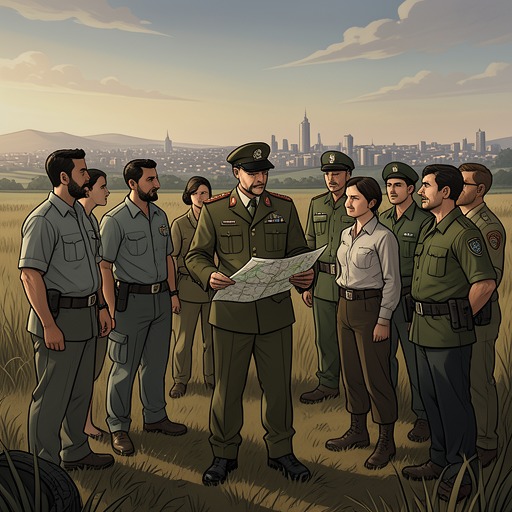
Claude identifies the approaching group as the last men standing of the Armed Forces of the Republic of Vietnam. The soldiers who emerge from the huts look nothing like the polished men in the General’s photographs. Those images showed clean-shaven fighters in jungle camouflage, combat boots, red scarves, and berets, standing at attention beneath filtered forest light. The men at the camp instead wear rubber sandals, black clothes, checkered peasant scarves, and broad hats; their hair is untrimmed, their faces unshaven, and their eyes dull. Each carries an AK-47. The contrast makes the camp’s military purpose unmistakable while stripping away the visual confidence of the movement’s recruitment imagery.
The camp is under the authority of an admiral who calls himself uncle, dresses simply in a black blouse and trousers, and receives visitors in a sparse hut furnished with reed mats, bamboo bookshelves, and a bamboo desk. He recounts that on the final day of the war he commanded a transport ship carrying marines, soldiers, policemen, and civilians rescued from the piers. Rather than sail to the Seventh Fleet, he chose Thailand, where he had friends and expected asylum. In his account, the choice is also a refusal to depend on the Americans, whom he regards as having betrayed the South Vietnamese and abandoned Asia. He swore before his crew to continue fighting for months or decades if necessary.
The admiral gives the campaign a religious frame, comparing the men in the camp to the first Christians: a small body of believers with faith, a radio station broadcasting freedom into their homeland, and guns. His confidence offers the returning soldiers a sustaining explanation for their presence in Thailand, but the camp’s austere setting and its ragged inhabitants keep that rhetoric grounded in material hardship. The base is a place of preparation, not evidence that the promised return has already succeeded.
Reconnaissance and Narrative Significance
The unnamed narrator and Bon spend two weeks acclimating to the weather and to their new comrades. Among them are three marine lieutenants they had encountered in a Saigon alley. They had escaped by reaching the docks on the day Saigon fell and boarding the admiral’s ship; they have remained in Thailand ever since. Their reunion carries the history of flight into the camp itself, and one marine joins the new expedition despite an earlier confrontation in which the narrator had drawn a pistol on him.
A twelve-person reconnaissance team then sets out at night, led by a Lao farmer and a Hmong scout. The farmer has been kidnapped during an earlier reconnaissance and is now compelled to guide the group because he knows the terrain. He does not speak Vietnamese, so the scout translates. The group includes armed marines, one carrying an AK-47 and another the M79 grenade launcher. The evidence establishes the team’s departure and its purpose as reconnaissance; it does not establish the outcome of its route-finding mission.
Thailand’s significance lies in this meeting of refuge and renewed war. For the admiral, it is a country where asylum is possible and where the approaching threat of communism makes continued resistance seem urgent. For the General, it is the necessary staging ground for an overland campaign. For the unnamed narrator and Bon, it is where exile gives way to a dangerous return to military life. The camp’s contrast with the General’s idealized photographs, and the farmer’s coerced role in the reconnaissance, also expose the human costs hidden inside the movement’s plans: the army is assembled from displaced survivors, while its route depends on people who have not freely chosen to take part.