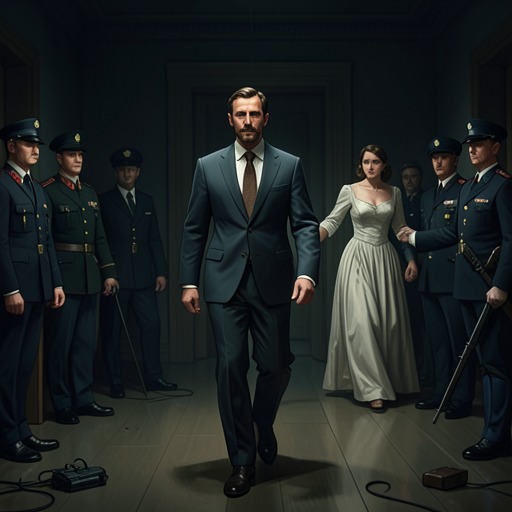
The Admiral
The SympathizerThe Admiral is an exiled naval commander who chooses to continue the war from a forest camp rather than seek rescue with the American fleet. To his followers he is Uncle: a sparely dressed, scholarly figure whose resemblance to Ho Chi Minh lends his leadership an uncanny, almost staged authority. He promises a long resistance, grounding it in Christian faith while equipping his followers with weapons, a radio station, and the conviction that their cause still has a future.
Appearance and Arrival
The unnamed narrator, Bon, and their companions encounter The Admiral after a dozen guerrillas lead them to his hut. He stands on its narrow porch beneath a bare electric bulb, his angular, gaunt face almost handsome, his thinning gray hair cut short, and his neatly shaped goatee marking him as a middle-aged commander. Bon recognizes the resemblance before he can finish asking about it; Claude confirms that everyone notices it. The Admiral’s calm, cultivated voice recalls recordings of Ho Chi Minh, completing an impression made by his face.
The resemblance extends beyond appearance. Like Ho Chi Minh, The Admiral calls himself Uncle, wears a simple black blouse and pants like his guerrillas, and keeps his quarters sparse and scholarly. The visitors sit barefoot on reed mats in a plain room, with bamboo bookshelves along one wall and a bamboo desk and chair against another. There is no visible bed; the plank floor appears to be where he sleeps. During dinner, the group drinks whiskey belonging to The General, while The Admiral taps his ashes into an ashtray fashioned from half a coconut shell. The room’s deliberate simplicity makes the likeness to the revolutionary leader more than a matter of physiognomy: it is expressed in dress, domestic surroundings, and manner.
From Naval Command to Forest Resistance
In recounting his past, The Admiral describes the final day of the war, when he commanded a transport ship carrying marines, soldiers, policemen, and civilians rescued from the piers. He could have sailed to the Seventh Fleet, as many other captains did. Instead, he sailed toward Thailand, where he had friends and expected asylum. He regarded the Americans as already finished in Asia and believed the Thai would resist communism as it pressed against their borders with Cambodia and Laos.
His decision is framed as a refusal of rescue, not simply a search for another refuge. The Admiral says that he did not want to be saved by Americans, whom he considered betrayers, and that he had sworn before his men to continue fighting for months, years, or decades if necessary. His appeal to a view of the struggle from God’s perspective turns the immense span of that promise into a test of faith: years of defeat and exile need not mean the cause is over. The account establishes a commander who treats retreat as a political and moral choice, and who gives his men a framework for imagining continued resistance after the South Vietnamese defeat.
Faith, Numbers, and the Promise of Resistance
When Bon asks whether the group has a real chance, The Admiral answers through the origins of Christianity. He compares his followers to Jesus and the apostles, emphasizing their faith and the Word of God. The camp, he says, has two hundred apostles, guns, and a radio station broadcasting freedom into their enslaved homeland—advantages he presents as exceeding those available to the earliest Christians. The analogy turns a small armed force into a community with sacred purpose, while acknowledging the disparity between its limited numbers and its ambition.
Bon immediately punctures the analogy by pointing out that Jesus and the apostles died. The Affectless Lieutenant draws the bleak implication that they, too, may die, without changing his unemotional manner. The exchange does not resolve whether The Admiral’s faith is confidence, persuasion, or both. Instead, it reveals the terms on which his leadership operates: death is not denied, but set beside belief, collective purpose, and the possibility of a struggle lasting decades. The Admiral offers no guarantee of survival; he offers a way to understand continued danger as service to a cause.
Radio, Ritual, and Political Practice
The Admiral’s authority is also sustained through practical preparations and public communication. Before a reconnaissance mission across the southern end of Laos, the team spends its days discussing tactics, preparing rations, and studying a route through terrain the marines have previously probed. The Admiral gives each man a laminated, wallet-sized picture of the Virgin Mary to wear over his heart and blesses the images before the team departs. For most of the men, the blessing is a relief. Claude, who believes in no god, offers a contrasting secular send-off with high fives.
The camp’s radio station, Radio Free Vietnam, broadcasts from a bamboo shack near The Admiral’s hut. Its programming includes his speeches, translated newspaper items, and pop songs, including favorites by James Taylor and Donna Summer. The Admiral argues that the communists reject love, romance, and entertainment in favor of devotion to the revolution and the country; because ordinary people love love songs, he regards broadcasting them as a way of serving those people. The songs cross Laos and reach into the homeland, carrying an emotional message as well as a political one. In this program, resistance is not only an armed campaign: it also contests who may speak for the people and what forms of feeling they may hear.
Leadership and Narrative Significance
The Admiral’s leadership joins symbolic authority to material means. His resemblance to Ho Chi Minh, his use of the familial title Uncle, the simplicity of his quarters, and the Christian analogy all help give the camp a coherent identity. But his account also points to concrete instruments of action: a body of two hundred followers, weapons, reconnaissance, and a radio operation. The image of the Virgin Mary worn over each man’s heart places religious protection directly beside the practical risk of an armed crossing.
The narrative presents the force of The Admiral’s conviction without allowing it to settle the question of whether his campaign can succeed. Bon’s reminder of the apostles’ deaths and the lieutenant’s matter-of-fact response keep the promised future shadowed by sacrifice. The Admiral nevertheless insists on the possibility of continuing the fight. His character therefore concentrates the novel’s tension between defeat and renewed purpose: exile has not ended political action, but the means of carrying it forward remain inseparable from faith, performance, and the prospect of death.