The American Dream and the refugee condition
The SympathizerThe American Dream and the refugee condition are presented as inseparable but unequal realities: the United States offers safety, work, and the possibility of citizenship, while refugees encounter dependence, dispersal, poverty, and the expectation that their suffering will serve someone else’s purposes. Through the unnamed narrator’s resettlement, his account of scattered Vietnamese communities, and the General’s political organizing, the novel tests what freedom and opportunity mean when refugees have little money, limited political power, and little control over how they are represented.
Arrival, Sponsorship, and Dependence
The unnamed narrator’s first foothold in the United States comes through a chain of personal sponsorship rather than self-sufficiency. After writing from the camp near San Diego to Avery Wright Hammer, his former professor, he receives help leaving the camp. Avery Wright Hammer finds him a scholarship, becomes his sponsor, arranges a clerical job in the Department of Oriental Studies, and collects money from former teachers. The funds cover a bus ticket to Los Angeles, a few motel nights, an apartment deposit near Chinatown, and a used car. The sequence makes refuge concrete: a new life begins not with an abstract guarantee of happiness but with a sponsor, a job, transport, and the cash required to secure a room.
The narrator then uses neighborhood churches to find a sponsor for Bon. The Everlasting Church of Prophets agrees to sponsor him and make him a nominal employee after a small cash donation. By September, the two men are reunited in a modest apartment, furnished with necessities bought from what remained of the narrator’s sponsorship money. Their arrangement gives Bon shelter and a job, but it does not restore the life he had lost. He works nights as a janitor, paid in untaxed cash, and receives welfare because his reported income is low. The narrator describes this combination as an improvised survival system: Bon’s service in an American-determined war has not translated into a livelihood, and the state benefit functions as compensation where a medal and a military career cannot.
The General and Madame also reach Los Angeles through a sponsor, but their arrival does not preserve the General’s former status. They rent a bungalow rather than a villa, and he remains unemployed, no longer a general in any practical sense despite the continuing deference of his former officers. His dependence and anger expose the distance between remembered rank and present circumstances. The narrator’s visits find him shifting between fury and melancholy, while Madame’s presence and the household’s reduced means mark exile as a change in daily life as much as a change of country.
Work, Welfare, and the Limits of Assimilation
The refugees’ new economic roles are often sharply mismatched with the skills and identities they carried from home. Bon can jump from airplanes, march long distances with heavy equipment, shoot accurately, and endure punishment, yet those capacities do not secure him a job suited to his experience. Instead, he cleans a church at night and lives partly on welfare. The narrator stresses the contradiction: a man trained for military service can be treated as unnecessary in the labor market, while public assistance becomes a more dependable reward for his service than formal recognition.
The crapulent major’s circumstances offer another version of the same adjustment. In Los Angeles, he works as a gas station attendant in Monterey Park, paid in cash so that he can qualify for welfare. His wife works in a sweatshop and has become nearsighted from close, repetitive sewing. At breakfast, he tells the narrator that the couple’s twins were born in the camp and given the American names Spinach and Broccoli after he panicked when a nurse asked for names. His joke about the children’s names carries an anxious hope: he wants them to be strong enough for a country he considers difficult for the weak and the fat. His account of getting the gas-station job also shows how he turns his body and vulnerability into a means of persuasion, using humor and the appearance of hardship to give an employer a reason to hire him.
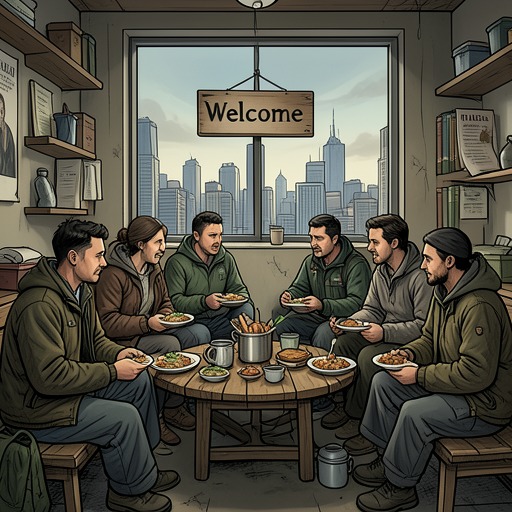
The narrator’s account of resettlement widens these individual difficulties into a dispersed collective experience. Refugees seek sponsors from former employers, military advisers, former lovers, churches, and even casual acquaintances. Some leave alone, some as families, and some after their families have been divided among different destinations. Many are sent to states whose names are unfamiliar to them. They develop distinctive pronunciations of American place names and exchange addresses and phone numbers before leaving camp, relying on a refugee network to compare jobs, taxes, welfare, racism, and the presence of people with similar food and customs.
That network sustains community, but it cannot reverse the policy that scattered refugees across the country. The narrator imagines that, had they been allowed to remain together, Vietnamese refugees could have formed a self-sufficient colony containing the full range of professions, beliefs, political positions, and social classes. Instead, bureaucratic dispersal sends them to distant locations. They gather in basements, churches, backyards, and beaches, carrying food from home because buying refreshments at beach concessions costs more. The gatherings create a social life across the distances imposed on them, but their attempts to reproduce familiar meals are imperfect: dependence on Chinese markets gives the food what the narrator regards as an unwelcome Chinese tinge, and the absence of Vietnamese fish sauce makes the past both present and irretrievable.
A Political Community and Its Price
The General’s Benevolent Fraternity of Former Soldiers of the Army of the Republic of Vietnam embodies the double purpose of refugee organization. Publicly, it serves veterans who have lost their army, country, and established identities, and it promises some increase in their limited measure of happiness. Politically, the organization is also a front for the General’s Movement, enabling it to receive donations. Its main support is expected not from impoverished Vietnamese refugees but from wealthy individuals and charitable foundations sympathetic to the United States’ former allies. Relief and political mobilization therefore occupy the same structure: the Fraternity can meet real needs while also converting those needs into support for a cause.
The General and the unnamed narrator bring the proposal to the Anti-Communist Congressman at his district office in a Huntington Beach strip mall. The setting places the political negotiation amid the ordinary commercial landscape of American aspiration: shops, a large parking lot, and campaign signs promising constancy. Inside, photographs of the Anti-Communist Congressman with Republican figures and public celebrities, including Richard Hedd, make political influence visible as a network of money, recognition, and access. The General’s appeal treats the refugee community as a future political investment. Although its members cannot yet vote and are not citizens, their children will be citizens and voters; the General suggests that their future votes might repay the Congressman’s support.
The unnamed narrator makes the exchange more explicit. Words of sympathy cost nothing, he argues in effect, whereas money does; a community’s political participation depends on support from those who deliver material resources. The Congressman replies that he also needs money to run for office and pay his staff. Their conversation exposes the two-way transaction beneath the language of civic belonging: money can flow through unofficial channels to the organization and return to a politician as votes. Refugees are not simply welcomed into political life. They must demonstrate their usefulness to people who already possess the resources and influence they lack.
This political arrangement parallels the novel’s concern with representation. The General’s organization claims to serve a community whose members have little power to shape their public image, while the unnamed narrator recognizes that American film can determine how Asians appear to audiences. His work as a consultant on a war film offers a chance to influence that representation, but it also makes him conscious that refugees may have to work within institutions controlled by others. The American Dream thus includes not only the pursuit of individual security but also a struggle over who can speak for a community and whose version of its experience will be believed.
Happiness, Displacement, and the Continuing Journey
The narrator presents the promise of happiness with skepticism. In his letters, he is careful to sound like an immigrant glad to live in a country where the pursuit of happiness is guaranteed in writing. But a guarantee that people may pursue happiness is not a guarantee that they will attain it; it offers an opportunity to try, while leaving the costs and outcome to the individual. For refugees, that distinction is sharpened by the conditions of arrival: the need for a sponsor, work that may bear little relation to prior experience, dependence on welfare, and separation from family and community.
A year after Saigon’s fall, the narrator writes to his aunt about the dispersed exiles and feels pity for his countrymen even though he left partly by choice. He describes loss as something passed among people until he, too, moves through a fog of memory. In the United States, small clans recover forms of belonging through shared food, familiar stories, and repeated visits, but these practices cannot restore what departure has taken. Their memories are close enough to evoke home and altered enough to confirm that home is gone.
The refugee condition also remains tied to the prospect of return. A clock shaped like Vietnam, with its hands pivoting in the south and its dial arranged around Saigon, makes the lost country into a measure of time. The distance home is finite, but the years separating refugees from it may be endless; the question of when return will become possible therefore governs their sense of the future. At the same time, the unnamed narrator encounters boat people in the Philippines who accept work as film extras for a dollar a day, none bargaining for more. A lawyer among them explains that foreigners had once victimized and humiliated the people of her country, and now their own people do so. The reversal unsettles any simple account in which political victory or national independence automatically ends oppression.
At the novel’s close, the unnamed narrator and his companions prepare to leave Vietnam by sea, carrying a manuscript intended as their testament and their effort to represent themselves. They expect to join a crowded fishing trawler with families and children, risking a passage whose chances of survival are grim. The journey does not resolve the contradiction between refuge and displacement; it returns the refugees to flight. Yet their insistence on telling their own story revises the American Dream’s promise from a guarantee of comfort into a contested claim to survival, memory, and self-representation. The desire to live persists, even when neither a new country nor a victorious revolution has made freedom secure.