The Commandant
The SympathizerThe Commandant is the official who oversees the unnamed narrator’s reeducation and repeatedly examines his confession. He occupies an uneasy position between intimate interlocutor and coercive authority: he invites candid self-scrutiny, yet judges it by political standards and controls the conditions under which it is written. Through his criticism, lectures, and participation in the narrator’s final interrogation, the Commandant makes the confession both a record of the past and a test of obedience.
Identity and Authority
The Commandant is the camp’s principal authority over the narrator’s written reeducation, though he answers to the commissar, who determines whether the narrator may advance to the next stage. The Commandant conducts recurring review sessions, reports on the narrator’s self-criticism, and communicates the commissar’s decisions. He calls the narrator a special case and a guest rather than a prisoner, distinguishing him from the thousand inmates housed in the barracks. The classification does not change the narrator’s confinement: he has spent a year in an isolation cell and is allowed out for only an hour of exercise each day.
The camp’s arrangement gives visible form to this hierarchy. The guards’ interior area, containing administrative buildings and the solitary rooms for special cases, is separated by barbed wire from the exterior camp for former soldiers, security officers, and bureaucrats of the defeated regime. Family visits take place at a pavilion by the barrier; beyond the outer fence stretch barren plains watched from towers. The Commandant receives the narrator on a patio above this enclosed landscape. From there the narrator can see a view denied from his cell, but only briefly, before entering the Commandant’s quarters for another review.
The Commandant’s own appearance carries signs of a life shaped by enclosure. He wears glasses that magnify his eyes, and his poor eyesight is attributed to ten years spent in cavernous darkness. Seated in a bamboo chair, he can seem reasonable to the narrator, who momentarily shares his perspective. That impression is repeatedly unsettled by the Commandant’s power to decide how long the narrator remains isolated and what will count as an adequate confession.
The Confession and Its Editor
The narrator addresses the Commandant directly throughout his account, treating him as both intended reader and examiner. The Commandant’s notes, together with the commissar’s, prompt the narrator to clarify whom he includes when he says “we” or “us.” The question exposes a central difficulty in the narrator’s account: he sympathizes with the southern soldiers and evacuees he was sent to spy on, although they were his assigned enemies. The Commandant’s scrutiny therefore reaches beyond wording to the narrator’s divided loyalties and his difficulty drawing a stable boundary between comrades and opponents.
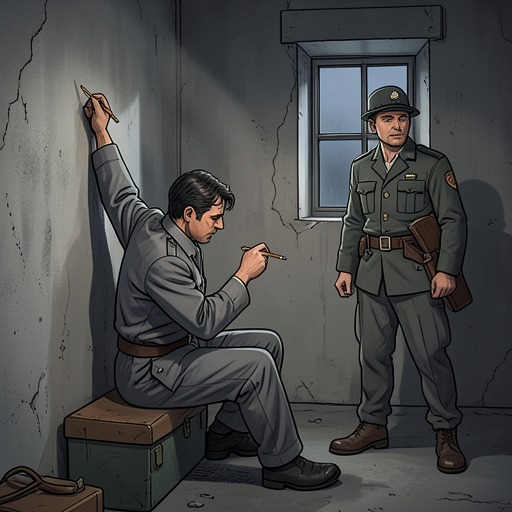
The Commandant is a persistent editor. He uses a blue pencil, said to be the color Stalin also used, and urges the narrator to delete, excise, reword, or add material. By the time he discusses the latest draft, 294 earlier pages have accumulated. The narrator has spent a year composing and revising the confession in isolation, while the Commandant continues to find it unsatisfactory. The physical stack of pages records the length of the process, but it does not resolve the conflict over what the writing should accomplish.
In the Commandant’s judgment, other inmates have supplied the expected accounts of themselves as puppets, lackeys, stooges, or henchmen. The narrator, by contrast, will not simply tell the Commandant what he wants to hear. The Commandant frames this refusal as a choice between being smart and being stupid, and questions whether the narrator’s writing amounts to a genuine confession. Yet his own standard is not straightforward candor. He warns that, during the sensitive period of rebuilding, absolute honesty is not always appreciated. Later he advises that prisoners must sincerely say what the teacher wants to hear. The contradiction makes sincerity a form of discipline: the narrator is expected to speak inwardly and truthfully, but only toward an approved political conclusion.
Political Lessons and Pressure
The Commandant’s criticism turns the narrator’s life into a set of charges. Before handing him over to the commissar, he cites his attachment to alcohol, prostitution, and yellow music; his counterrevolutionary manner of writing; his responsibility for the deaths of a Bru comrade and The Watchman; and his failure to undermine a film that misrepresents and insults the revolution. He says that, if the decision were his alone, he would send the narrator to the fields for a final cure, and warns that this remains possible if the next stage does not go well. The narrator thanks him for his tutelage, acknowledging that the criticism has taught him something even as the threat makes plain that gratitude is being expressed under continuing authority.
The Commandant also uses an exhibit to make political history physically present. He uncovers a jar containing a malformed infant specimen with two heads, which the narrative associates with an American chemical defoliant. He asks the narrator to imagine the parents’ horror, then contrasts the revolution’s offer of rehabilitation through labor with the possibility of executing prisoners, including Bon, whom he identifies as a Phoenix Program assassin. The jar functions in his argument as evidence of wartime harm and as a reason to condemn the former regime and its allies. At the same time, his appeal to mercy is inseparable from the camp’s confinement and compulsory labor.
His lectures connect the narrator’s personal examination to the revolution’s account of history. The Commandant says that the struggle is also inward: foreign invaders may kill the body, but a person can kill his own spirit. He presents vigilance over oneself and one’s comrades as necessary because not all comrades possess the same level of ideological consciousness. This framework turns self-criticism into a political obligation. The narrator’s account is not accepted simply as a memory of what happened; it must demonstrate that he has absorbed the correct interpretation of it.
Final Examination and Narrative Role
At the transition to the next stage of reeducation, the Commandant tells the narrator that the commissar believes him ready to be cured. The narrator has never met the commissar, who remains a distant authority visible only at a distance or during public lectures. The Commandant thus acts as the narrator’s immediate judge and intermediary, explaining the process while enforcing its consequences. He says that the written confession must satisfy the authorities before the narrator can proceed to an oral examination.
The Commandant’s authority becomes bodily as well as editorial in the final interrogation. As the narrator lies under harsh lights, divided in consciousness from the suffering body below, the Commandant kneels and presses a finger lightly against his open eye. He refuses the narrator’s plea to sleep until the confession satisfies him. He argues that the world watched the destruction of the narrator’s country and did nothing, and that the narrator was no exception: he spoke up but did not save the Communist agent. Under this accusation, the narrator recognizes his guilt not as an act he committed but as a failure to act. The Commandant’s charge gives that omission a political and moral shape, even as it is delivered through coercion.
In the same interrogation, the Commandant and the commissar question whether the narrator should be punished for the deaths of The Watchman and the Bru comrade, and weigh his responsibility against the lives he took. The commissar says the agent survived, though she could not walk when she was liberated, and raises the life of the narrator’s father as another measure of value. The Commandant’s presence within this exchange makes him part of a larger tribunal: he presses for accountability while the commissar weighs the narrator’s conduct and the doctor participates in the examination.
As a character, the Commandant embodies the tension between care presented as education and power exercised as confinement. His calm manner, editorial attention, and professed concern for sincerity do not cancel his threats or his role in the narrator’s interrogation. Instead, they show how the camp makes political control intimate: the prisoner must inspect his own past, revise his own words, and learn to express the judgment demanded of him. The Commandant is both the reader who keeps asking for a better confession and the authority who decides when the narrator has written enough.