The Communist Agent
The SympathizerThe Communist Agent is a courier for Man whose capture exposes both the vulnerability of the underground network and the violence hidden inside official interrogation. Though the narrator initially claims he did nothing to her, her fate returns in his confession as a measure of what he failed to do: she survived, but the Commandant says she could not walk when she was liberated.
Identity and Capture
The agent is caught with a list of police names concealed in her mouth, evidence that she had been trying to swallow rather than surrender. The narrator recognizes his own name on it: he had passed the list to Man, while the agent, as Man’s courier, knew Man’s identity. At the time, however, the narrator believed she did not know who he really was. Her capture thus brings the secret intelligence network into the hands of the very police whose names the list records, while placing the narrator’s own concealed role close to the danger.
The list becomes a recurring image in the narrator’s account, but initially leaves a decisive gap. During the later interrogation, he is challenged over his manuscript’s repeated references to the agent: it records that he pulled the evidence from her mouth and saw her hatred, but does not say what happened to her. Asked directly, he answers that he did nothing to her. The omission is not merely a missing piece of plot. It is the silence around an act of violence he witnessed and did not prevent, a silence that his interrogators insist must be examined as part of his confession.
The Interrogation and Its Violence
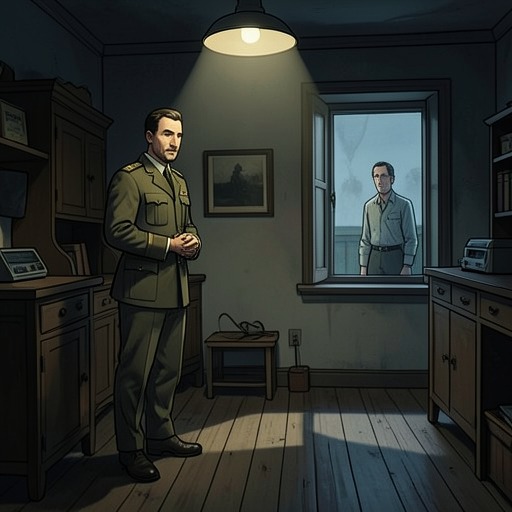
The agent’s abuse takes place in a room the police call a movie theater when foreigners visit. When they are absent, the same room is used for interrogations. Its ordinary furnishings make the transformation stark: blackout curtains cover the windows, folding chairs are pushed against the walls, and a Sony projector faces a screen. The agent lies naked on a black rubber-covered table, her hands and feet tied to its legs. The crapulent major is nominally in charge, but has ceded the interrogation to three policemen; Claude watches from beside the projector as an adviser. The room is thus both a site of state violence and a stage on which its participants can act as though they are only observing.
The narrator says he watched, objected that the treatment was wrong, and asked to be left alone with the agent for a couple of hours. The policemen reject his request: the youngest accuses him of wanting first claim on her, while the oldest tells him that the American has no cause for concern and presses a Coke into his hand. The narrator sits beside The crapulent major, holding the bottle as his fingers grow numb. His attempted intervention does not stop what follows; nor does his position beside the officers make him a neutral witness. He remains present while the agent is sexually assaulted by all three policemen.
When asked for her name, the agent answers that her surname is Viet and her given name is Nam. The policemen laugh and continue. The narrator describes them jostling around the table, leaving him at times with only a view of their bodies and the agent’s struggling legs. Afterward, when the oldest policeman touches her knee, she opens her eyes and glares at the men. They remain unharmed; she remains bound and exposed. The contrast between her fierce look and the men’s impunity makes visible how completely the supposed interrogation has become punishment without a meaningful chance to answer or defend herself.
The assault continues after the three men have finished. The agent sobs, then falls silent, while the policemen smoke and discuss her as an object. They pour soda over her and leave the bottle inserted inside her body, turning the scene into a deliberately degrading joke. The narrator remembers the sticky soda on the floor even after the table and tiles have been washed; the physical trace becomes inseparable from the memory he had tried to omit. Claude disclaims having taught the policemen this particular abuse, but that distinction does not erase his presence as an adviser, the major’s authority, or the narrator’s failure to prevent it.
Survival and the Narrator’s Failure
The later interrogation supplies the fact missing from the narrator’s earlier account: the agent survived. The Commandant says that when she was liberated she could not walk; the commissar answers that her body may have been broken, but her spirit was not. This exchange does not turn survival into a reassuring resolution. It establishes the bodily consequence of the violence and gives the agent a future beyond the scene the narrator had left out, while offering no account of her subsequent recovery.
Her fate also becomes the measure against which the interrogators judge the narrator. The Commandant argues that she had been willing to sacrifice her life to save the commissar, whereas the narrator had not been willing to sacrifice himself to save her. The accusation shifts the focus from what he did to what he failed to do: he is made to recognize his passivity as a moral act with consequences. The agent’s survival therefore does not absolve him or diminish her suffering. Instead, her endurance exposes the gap between witnessing violence and resisting it, and makes the narrator’s omission part of the confession he must finally confront.
Narrative Role and Political Meaning
The agent’s brief answer when the policemen demand her name gives her a moment of self-definition inside a scene designed to deny her any control: “My surname is Viet and my given name is Nam.” The wordplay turns a demand for identification into an assertion of national belonging, but the policemen laugh and proceed with the assault. Her speech is heard, yet it changes nothing. That gap between speaking and being granted agency sharpens the novel’s concern with who can be represented, who is listened to, and who retains power over the meaning of violence.
Her experience also stands in stark contrast to the staged rape of Mai in the film being made for the Americans. The Auteur defends that scene as necessary because rape happens in war; the narrator questions its dramatic purpose. The agent’s assault, by contrast, is not a scene constructed to teach an audience a lesson: it is violence inflicted during an interrogation, witnessed by officials and recorded only later through the narrator’s confession. Placing these forms of representation alongside one another exposes the difference between depicting violence for an audience and confronting responsibility for violence that a witness has failed to stop.
The agent’s suffering further complicates the political language of liberation. The narrator eventually recognizes that a revolution founded on independence and freedom can turn into a power that withholds those same ideals from its defeated opponents. The agent’s ordeal under the southern police does not erase the later political contradictions, nor does that wider history explain away her individual fate. Instead, her survival and lasting injuries remain a human measure against which competing claims of duty, sacrifice, and political principle must be judged.