The Father
The SympathizerThe Father is the priest father of The unnamed narrator, a character whose presence is assembled through memory, a deacon’s phone call, and the political arguments that follow his death. His relationship with his son is marked by distance and unresolved resentment: the narrator once wished him dead, later insists that he did not mean it, and must face the possibility that his words were taken as a request. The Father’s death therefore remains at once a family loss, an act attributed to a revolutionary agent, and a test of how responsibility is assigned.
Identity and Presence
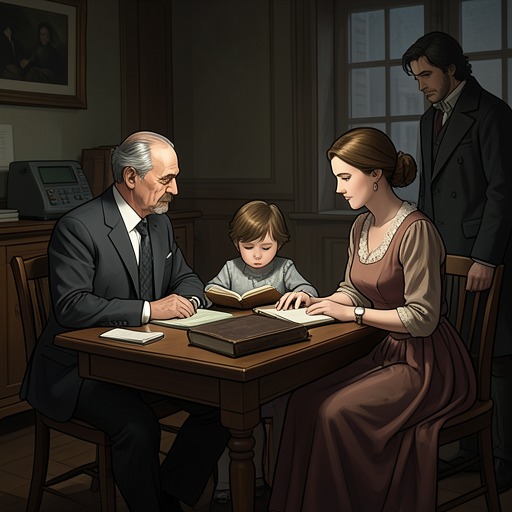
The Father is identified as a priest and as The unnamed narrator’s father. He does not appear as a speaking character in the available scenes; instead, readers encounter him through recollections and other people’s accounts. That mediated presence matters: the narrator remembers a childhood punishment, receives the news of his father’s death from a deacon, and later hears the death discussed during interrogation. The Father is thus defined less by an account of his own inner life than by competing interpretations of what he meant to his son and what his religious position signifies politically.
One childhood memory gives their relationship a concrete, lasting form. The Father made the narrator hold a Bible out in front of the classroom as punishment for a transgression. Years later, while carrying a dead soldier’s leg, the narrator recalls the weight of that book and the strain of holding it at arm’s length. The memory joins discipline, religious instruction, and bodily burden without resolving what the punishment meant to either father or son. It shows how an ordinary episode of childhood continues to shape the narrator’s associations under the pressure of war.
The narrator also remembers The Father’s coffin and the church congregation’s chanting. These fragments place the father’s death within a religious setting, but they do not make the relationship sentimental or simple. The funeral memory coexists with the narrator’s earlier anger, while the church’s communal ritual contrasts with the son’s private uncertainty about what he owed his father.
Estrangement and the News of His Death
The narrator learns of The Father’s death when a deacon calls him at police headquarters. The narrator questions how the deacon obtained the number; the deacon explains that it was among The Father’s papers. The exchange brings the father’s private records into the narrator’s official working life, where he is handling a classified investigation. It also makes clear that the father had retained information connecting him to his son, even though the relationship appears to have been distant.
When the narrator says he has no time to go, the deacon urges him to attend and explains that father and son mattered to one another. The call does not erase their estrangement or settle the narrator’s feelings. Instead, the deacon’s insistence forces a recognition that the bond persisted despite distance and resentment. The narrator understands that the deacon knows who The Father was to him, though the exchange does not specify how the deacon learned the full history.
The narrator’s recollection of the funeral and the call arrive amid other evidence of wartime violence. On his desk is an investigation of a 1968 massacre near Quang Ngai, in which an American platoon killed villagers and then reported them as enemy combatants despite the absence of recovered weapons. The account does not connect The Father to that investigation. Its juxtaposition with the phone call instead places private mourning beside the institutional language used to classify, report, and obscure deaths.
Death and the Narrator’s Responsibility
During a later interrogation, The Commandant and the commissar confront the narrator with his past words to Man: he had written that he wished his father were dead. The narrator answers that he did not mean it and did not intend Man to act on it. Under pressure, however, he acknowledges that he wanted The Father dead. The scene separates the wish from the outcome while refusing to let the narrator treat them as wholly unrelated.
The commissar presents the father’s death as an assassination by a bullet and says that the assassin confessed. He then states that his agent arranged the killing. This account makes the death more than a report of loss: it connects the narrator’s private writing to an operation carried out by people within the revolutionary world to which he was writing. The narrator had addressed Man as a revolutionary with influence, a friend, a brother, and a writer who understood the force of words. Those roles make his message intimate and political at once, and they sharpen the question of what his words authorized, whether or not he intended them to become action.
The Commandant doubts the narrator’s account and raises the possibility that the story is being invented to protect Man. The father’s death is therefore also a point of uncertainty within the interrogation: the account is disputed, and the narrator’s statements are tested by people with political and institutional stakes in the explanation. The evidence supplied does not establish a fuller account of the agent’s motives or the circumstances of the killing.
Religion, Politics, and Narrative Function
The Commandant interprets The Father not simply as a parent but as a representative of colonial power and religion. In the Commandant’s atheistic view, the priest serves a colonial order, preaches a faith that has justified suffering, and speaks for a God invoked in the name of salvation. From this political perspective, the father’s death can be framed as a just sentence rather than murder. That judgment belongs to the Commandant’s argument; it does not cancel the narrator’s grief or establish an objective verdict on The Father’s life.
The character’s significance rests in this unresolved overlap. The Father is remembered through a Bible used as punishment, a coffin and church ritual, a son’s angry sentence, and an interrogation that turns personal history into evidence. His priesthood makes him available to political condemnation, while his position as a father makes the narrator’s wish and subsequent denial emotionally consequential. The novel does not provide The Father’s own account to arbitrate between these versions. His absence instead exposes how family memory, revolutionary loyalty, and official explanation compete to give meaning to a death—and how a sentence written to a trusted friend can acquire consequences beyond its writer’s stated intention.