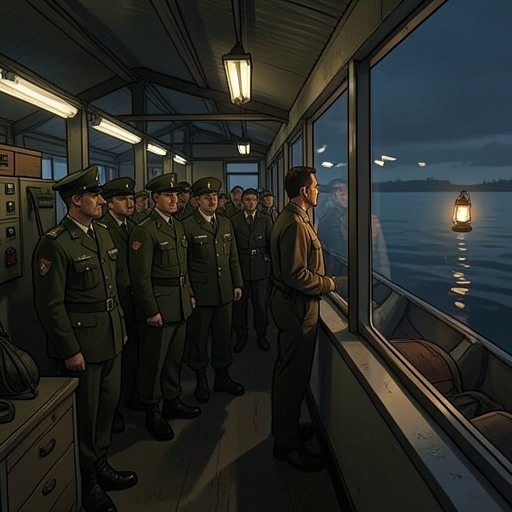
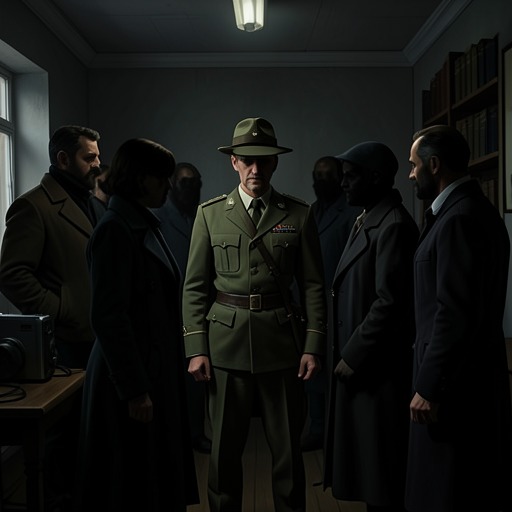
The General is beaten by refugees at the Guam camp
The SympathizerThe General is beaten by refugees at the Guam camp when his effort to encourage them instead confronts him with the human cost of his country’s defeat. The attack strips away the authority of his uniform, while The unnamed narrator’s intervention turns their command relationship into a moment of physical protection and shared humiliation.
Setting and Provocation
After the South Vietnamese government’s collapse, The unnamed narrator and The General are among refugees protected, for the moment, by the American military. The narrator recalls watching the evacuation from Saigon and the fall of the presidential palace, then describes how an ordinary task in the camp cafeteria made their displacement undeniable: turning in their trays meant they were no longer adult citizens of a sovereign country, but stateless refugees. The General leaves untouched green beans behind and decides to walk among the displaced people to raise their morale. He expects a response familiar from soldiers accustomed to abuse; he and the narrator have forgotten that most of those in the camp are civilians.
The narrator has changed out of the uniform stained with Linh’s blood and wears a madras shirt and chinos. The General, whose luggage was lost at the airport, still wears his stars. Few civilians recognize him, but they see his rank and uniform. His greetings and questions about their welfare meet silence as the two men walk down a dirt lane between tents. Less than a hundred meters into the tent city, a slipper strikes The General at the temple, and an elderly woman confronts him over the absence of her husband.
The Attack and Its Aftermath
The elderly woman’s challenge drew other women into the confrontation. From several directions, they closed around The General with shoes and slippers, umbrellas and canes, sun hats and conical hats, demanding to know where their sons, fathers, and brothers were. The General ducked and covered his head as they struck, tore at his uniform, and scratched his face and neck; he sank to his knees. The unnamed narrator was hit by flying footwear and intercepted blows from canes and umbrellas as the crowd pressed past him to reach the officer. Their anger had a public cause: the premier had urged soldiers and citizens over the radio to fight to the last man, then left by helicopter soon after delivering that message. The General was not commanding soldiers in the field but the secret police, a fact that would hardly have improved the civilians’ view of him. The women would not listen to explanations. The unnamed narrator pushed between them, shielded The General with his body, endured more blows and spit, and dragged him away while the surrounding refugees jeered at them as cowards and villains.
The General, unused to such contempt, was horrified by what the crowd had done. His stars had been torn from his collar, his sleeves ripped, half his buttons gone, and scratches bled across his cheek and neck. He refused to return to the barracks in that condition, so The unnamed narrator told him to wait in the showers and found spare clothes from other officers, attributing their bruises and torn appearance to a quarrel with rivals in the Military Security Service. When The unnamed narrator reached the showers, The General stood at the sink, his face washed clean except for his shame. He looked at himself in the mirror and ordered that the assault never be discussed. The two men kept that silence thereafter, leaving the episode as a private rupture in their command relationship: the officer who had intended to restore morale had been confronted by civilians as a symbol of military failure, while his subordinate had protected him from their blows.
The Camp’s Continuing Bereavement
The assault did not settle the grief that had gathered around the refugees. The next day, Linh and Duc were buried together, Duc’s small coffin lowered on top of his mother’s; Bon, wearing a white mourning scarf made from a bedsheet, threw himself into the open grave and cried out over their deaths. The General, Madame, and an exhausted priest watched in silence. Their presence links the humiliation of the uniformed officer to a camp where loss was not a political abstraction: families were waiting for people who had not escaped, and the dead were being buried far from home.
Narrative Significance
The encounter exposes a failure of military language: The General approaches the refugees as if morale were something an officer could restore by appearing among them, but the civilians answer the uniform as a visible sign of a defense that did not protect their families. Their questions make the cost of defeat personal and immediate. The unnamed narrator recognizes that he and The General had misread the camp by treating its residents like soldiers, people expected to endure abuse and accept encouragement from above. Here, rank does not persuade; it makes The General answerable, in the refugees’ eyes, for absent husbands, sons, fathers, and brothers.
The episode also leaves a deliberately unresolved division between public judgment and private memory. The unnamed narrator helps The General escape, then helps conceal the signs of the assault; The General’s demand for silence ensures that the humiliation is neither explained away nor repaired between them. The silence preserves the scene as a wound in their relationship, while the narrator’s account sets it against the refugees’ wider bereavement: their anger and contempt coexist with deaths that no uniform, escape, or official explanation can undo.