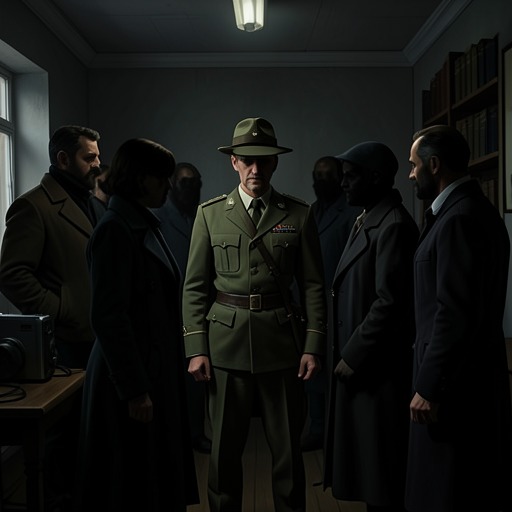
The General organizes a counteroffensive movement in the United States
The SympathizerThe General organizes a counteroffensive movement in the United States by turning the institutions of exile into both a support network for displaced South Vietnamese veterans and cover for a future armed return. The plan depends on compartmentalized cells, civic organizations, private donations, and a route through Thailand; its public language is relief and patriotism, while its private objective is to rebuild a force against the new regime. Through The unnamed narrator’s role as aide and covert reporter, the movement appears not as a single army in formation but as a network of people, money, documents, and carefully divided knowledge.
Exile and the Recovery of Military Purpose
The movement takes shape after the South Vietnamese defeat has made its former officers refugees without an army or a country. On Guam, The unnamed narrator and The General arrive among evacuees in a temporary settlement where the collapse of the republic is witnessed on television. In the refugee camp, women attack The General, blaming him for a war whose ordinary people have paid for in missing relatives. The unnamed narrator shields him and later finds him at a sink, his uniform torn and his face rinsed clean except for his shame. This episode does not itself establish the counteroffensive plan, but it gives the later language of lost honor and restored manhood a specific setting: military rank and national authority have been stripped away, while resentment and defeat remain.
In the United States, The General presents the prospect of fighting again as the only way for former officers to regain honor and become men again. He has already spoken in person with the officers on a list for the movement’s first meeting; he says they are eager to fight because, in exile, they have nothing. The proposed force is therefore more than a military instrument. It promises to restore a collective identity to men whose previous army and state have disappeared. That appeal also reveals the pressure behind the project: military belonging is offered as a remedy for displacement, even as the movement’s strategy requires its members to work without the public recognition a national army would possess.
Cells, Fronts, and the Public Face
The unnamed narrator helps shape the movement’s organizational model. He argues for a vanguard that can lead people toward a political destination they may not yet recognize, a proposal Madame initially objects to as communist terminology. The General accepts the analogy, and the plan borrows organizational methods from the enemy it seeks to defeat. The vanguard is to operate clandestinely while presenting a different face to the public through voluntary organizations. The General proposes that Sonny’s newspaper become one such front, alongside youth, women’s, and intellectual groups.
The movement’s security depends on keeping its parts apart. The unnamed narrator describes cells secluded from one another so that the loss of one will not expose the rest. The group gathered with The General constitutes one cell; the cells involving Claude and The Anti-Communist Congressman are separate, and The General says he knows nothing about their internal work. This arrangement is a practical response to the danger of exposure, but it also distributes responsibility and limits what any participant can know. The General insists on gradual construction: contacts are being developed before men are sent abroad, and the organization must learn to think and plan over decades rather than expect an immediate return.
The proposed military route is overland through Thailand. The General rejects a return by sea as too difficult and identifies Thailand as the staging area. The Anti-Communist Congressman is working on contacts to clear the way for sending men there, while Claude is seeking money. The men will also need weapons, training, a training ground, and transport. The General’s account thus specifies a sequence of logistical dependencies, not an accomplished invasion: political contacts and funds must precede the movement of personnel and equipment. He calls for underground work modeled on the communist movement, while the exile network tries to turn its experience of defeat into a long-term capacity for armed return.
The Fraternity and the Funding Network
The Benevolent Fraternity of Former Soldiers of the Army of the Republic of Vietnam gives the movement a public charitable identity. The unnamed narrator explains that it serves thousands of veterans left without an army, country, or identity, offering practical aid intended to improve their limited circumstances. At the same time, the Fraternity functions as a front through which donations can support The General’s Movement. Its dual purpose is not incidental: assistance to veterans supplies a legitimate public rationale for an organization whose concealed political work extends beyond relief.
The plan’s fundraising is shaped by the difference between official and unofficial support. At a meeting in The Anti-Communist Congressman’s modest district office in a Huntington Beach strip mall, The General and The unnamed narrator present the Fraternity and ask whether Congress can help. The Congressman refuses official congressional support, observing that no one wants even to say the name of their country. The General accepts that public support is unavailable, while The unnamed narrator distinguishes public words from money and makes the case for private or unofficial contributions. The exchange establishes a limit and an opening at once: the movement cannot count on a public government commitment, but it can seek assistance from individuals and charitable organizations.
Claude’s earlier explanation of Central Intelligence Agency practice supplies a model for routing such assistance through front organizations rather than directly in the agency’s name. The Fraternity may receive money from charitable foundations and respectable donors; foundations themselves may serve as intermediaries, connected through trustees who include the Congressman, his associates, or Claude’s contacts. The General and The unnamed narrator understand that the arrangement depends on concealment and carefully divided knowledge. The Congressman’s warning that the Fraternity must not engage in anything illegal is presented as a formula that preserves deniability, not as a clear rejection of covert activity.
The money has distinct public and military destinations. Donations ostensibly relieve refugees and veterans, while funds sent to Thailand can buy food and clothing for fighters. The General’s fundraising success comes from organizations introduced by Claude and from Americans with connections to Vietnam, including people who visited or served there. The amounts are moderate by donor standards, unlikely to attract auditors or journalists. In Thailand, the exchange rate magnifies their value; meanwhile, the Thai security forces provide guns and ammunition, with American support passing through channels described as transparent and approved by Congress. The result is a layered arrangement in which charitable money sustains basic needs and military supplies arrive by another route.
The Aide as Organizer and Informant
The unnamed narrator participates in this system while secretly documenting it for Man. As The General’s aide-de-camp, he performs the ordinary work that keeps a political and military organization functioning: writing memoranda, filing documents, arranging meetings, producing and distributing flyers, taking photographs, scheduling interviews, finding donors, and handling correspondence. The work is unpaid, but its clerical appearance gives him access to the machinery of the Movement. He photographs The General’s complete order of battle, from local companies to the battalion in Thailand, as well as communications with officers in Thai refugee camps and records of the funds held for the project.
The Minox mini-camera turns that access into intelligence. The unnamed narrator photographs Sonny’s headline, “Move On, War Over,” along with the General’s files, and packages material for his Parisian aunt. In a concealed form of correspondence, he sends information onward to Man, including details about the officers in the vanguard, the Thai command, and the Movement’s accounts. The public appearance of the Fraternity and the private organization of the counteroffensive therefore generate two competing forms of record: documents meant to coordinate the project, and copies made to expose it to an unseen recipient.
That split makes The unnamed narrator both a participant in the movement’s construction and an observer of its vulnerabilities. The organization is designed to prevent any one cell from knowing the whole, yet its paperwork, bank records, and correspondence create traces that can be gathered and transmitted. The General’s campaign consequently remains poised between charitable activity and covert warfare, between the promise of restored national purpose and a structure sustained by secrecy. The evidence establishes plans, fundraising, recruitment, and preparations for a Thailand staging area; it does not establish that the intended return to Vietnam is carried out.