The Hamlet
The SympathizerThe Hamlet is a Hollywood war film whose development exposes the gap between Vietnamese people’s lived experience and the stories made about them. Asked to advise on its screenplay, the unnamed narrator tries to make its Vietnamese characters more than scenery; his limited changes give some of them voices, yet the film’s larger machinery continues to turn their lives into material for an American rescue fantasy.
Commission and Premise
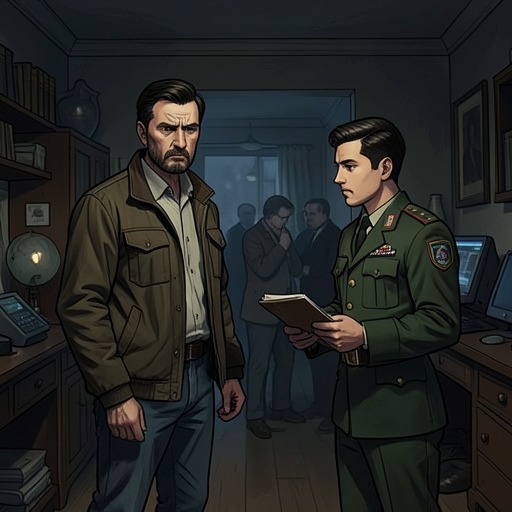
The project enters the story through the General’s political ally, the Anti-Communist Congressman, who serves on a subcommittee concerned with regulating movies and music. Having become friendly with Hollywood figures, he says a filmmaker has asked for advice on a war screenplay about the Phoenix Program. The Congressman admits that his own experience ended before that program began, so the General offers the unnamed narrator as a cultural attaché who can read the script and comment on its military and Vietnamese context.
The title initially surprises the narrator: The Hamlet is not a production of Shakespeare’s play but a story about a Green Beret saving a Vietnamese hamlet. Its writer-director, Auteur, has never served in the armed forces; his understanding of war comes from the John Wayne and Audie Murphy films he watched as a child. The narrator, by contrast, had served for two years on a United States Army Special Forces A-Team in several hamlets. His own childhood included a brief period in a northern hamlet before his family’s flight south in 1954, though that experience was far removed from the screenplay’s imagined battlefield.
The script casts Sergeant Jay Bellamy, a Harvard dropout from a wealthy St. Louis family, as the solitary American hero in a hamlet surrounded by veteran guerrillas led by King Cong. The hamlet’s Popular Forces are depicted as farmers and teenagers trained by a United States Army Special Forces A-Team, set against infiltrators concealed among apparently friendly villagers. In this arrangement, the Americans occupy the center as defenders, while Vietnamese characters and political loyalties are organized around the hero’s mission. The premise establishes the representational imbalance that the narrator will try to challenge as the film moves from screenplay to production.
Consultation and the Limits of Influence
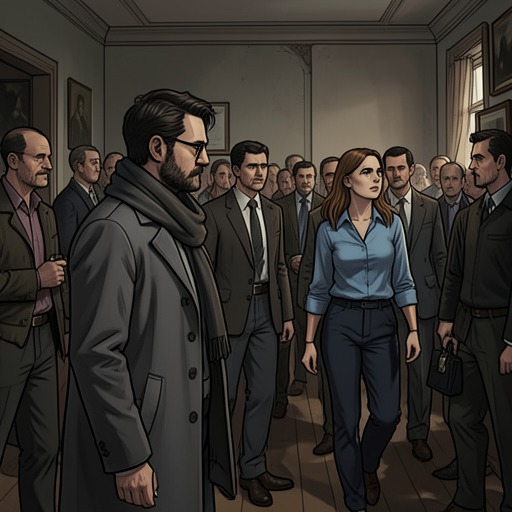
The screenplay reached the unnamed narrator in a thick manila envelope bearing his name misspelled in elegant handwriting. Its delivery was followed by an appointment arranged by Auteur’s assistant, Violet, who gave him no greeting or farewell on the telephone. In person, she continued in clipped phrases, avoided eye contact, and ushered him inside with a gesture he read as condescending. The narrator knew that his response might be sharpened by the recent death of The crapulent major and the disturbing apparition at the wedding banquet, but he suspected that Violet saw him first as racially foreign. Though he possessed American identification and had previously been treated as a welcomed foreign student, he now felt that his Eurasian appearance placed him outside the category of white Americans. The encounter unsettled the confidence with which he had entered the project: even before he could alter the film’s representation of Vietnamese people, he had become an object of American racial classification.
At Auteur’s home, the narrator argued that a film set in Vietnam should let Vietnamese characters speak rather than reduce their dialogue to directions indicating that villagers spoke in their own language. He suggested that even heavily accented English would be more convincing than voiceless background activity, and observed that the Green Beret’s lack of a love interest implied that the soldiers loved and died only for one another. Violet countered that Vietnamese audiences would not buy tickets, making the commercial audience the measure of whose speech mattered. Auteur then dismissed the advice by pointing to the narrator’s lack of filmmaking experience and ordered him out, treating authenticity as a craft the consultant had no standing to discuss.
The meeting also brought the narrator’s military memories into the room. As he looked at Auteur, he recalled a wiry Montagnard elder of the Bru minority, suspected of serving as a Viet Cong liaison, whom a captain had tortured with rusted barbed wire wound around his throat. The narrator had been unable to find a way to save the man; remembering his screams, he wrote AIEYAAHHH!!! across the screenplay’s cover with Auteur’s fountain pen and explained that this was how people in his country screamed. The gesture translated a Vietnamese victim’s pain into a mark on the American script, but it could not undo the violence being remembered or the unequal terms on which the film was being made.
Afterward, the narrator reported the encounter to The General and Madame, who were angered on his behalf. Despite Auteur’s hostility, the narrator continued to press the case for Vietnamese presence and speech. The confrontation thus exposed both the narrow opening available to a cultural consultant and the power that remained with the filmmaker: the screenplay might accept particular corrections, while its author still controlled the work and could decide whose experience counted as expertise.
Vietnamese Characters Added to the Film
The narrator’s objections produced changes in the screenplay, most visibly the addition of three Vietnamese characters with speaking parts: the older brother Binh, his younger sister Mai, and their little brother. Their parents have been slaughtered by King Cong, giving the siblings a place in the film’s conflict, but their stories remain arranged around the Green Berets’ heroism. Binh, nicknamed Benny by the Americans, hates King Cong, loves the rescuers, and serves as their translator. His allegiance makes him useful to the American unit, but does not protect him: he and the black Green Beret Sergeant Pete Attucks are captured, and Binh is tortured after the Popular Forces are defeated.
Mai’s part gives the Green Beret hero a romantic attachment, addressing the narrator’s point that the script had left its soldiers with no women to love. She falls for the young, idealistic Sergeant Jay Bellamy, then is kidnapped and raped by King Cong. The screenplay makes that assault the justification for the Green Berets to annihilate King Cong and his forces. The added Vietnamese woman therefore speaks and loves, but her suffering is also made an instrument in the American protagonist’s story, converting violence against her into a warrant for his retaliation.
The youngest sibling’s ending offers a different version of rescue. In the final scene he wears a Yankees cap and is airlifted to St. Louis, where Jay Bellamy’s family will take him in, give him a golden retriever, and call him Danny Boy. The ending removes the boy from Vietnam and folds him into the hero’s American home. Taken together, the three additions give Vietnamese characters names, speech, and plot functions, yet leave their fates subordinated to an American narrative of rescue, sacrifice, and vengeance. The narrator’s intervention has changed who appears in the film without displacing the Green Beret from its center.
Filming and the Violence of the Screenplay
The changes to the script did not remove its hierarchy; they gave Vietnamese characters speaking parts inside a story that still made their suffering serve the American lead. On set, the narrator sees the performers as Vietnamese actors, then corrects himself: they are actors playing Vietnamese people. The distinction sharpens the gap between lived experience and representation. The film’s additions may make its imagined hamlet more populated, but they do not give its Vietnamese figures control over the story that assigns them their roles.
The screenplay’s violence makes that imbalance concrete. After a Popular Forces squad is overwhelmed, Sergeant Pete Attucks and Binh continue firing until Attucks is caught in a bamboo bear-claw trap and loses consciousness, while Binh runs out of ammunition. Their captors mutilate Attucks, an act the narrator connects to Claude’s earlier interrogation lesson, which used images of similar violence to argue for a shared human capacity for cruelty. The film’s lurid spectacle thus draws on the same logic as the lesson: violence is displayed as proof, while the people subjected to it become material in someone else’s argument.
Binh’s capture leads to a staged water torture. James Yoon, playing Binh, is strapped to a plank as a cloth is wrapped over his head and water is poured from one of Attucks’s canteens. The actor’s stunt double performs the dangerous shots with his nostrils sealed and a breathing tube in his mouth; the narrator notes that the victim’s sensation resembles drowning. Around him, the performers playing the captors curse, kick, and strike in simulation, while the scene turns interrogation into a laborious performance of abuse. The narrator’s account distinguishes the staged mechanics from the suffering represented, without letting the production’s safety precautions make the violence seem harmless.
The scene also exposes a contradiction in the film’s claim to authenticity. Vietnamese extras are asked to improvise the captors’ insults because the script merely directs them to curse Binh in their own language. They supply the scene with fluent, forceful speech, but that contribution serves a portrayal in which Vietnamese characters enact cruelty against one another for the film’s spectacle. The narrator’s earlier effort to make Vietnamese voices audible has succeeded in a narrow sense; the production can now use those voices while retaining its power to determine what they say and what their suffering means.
Propaganda, Authorship, and the Limits of Authenticity
The longer the unnamed narrator worked on The Hamlet, the less he understood himself as merely a technical consultant and the more he saw his role as an infiltrator in a work of propaganda. Auteur could regard the production as art, but the narrator recognized Hollywood as a vehicle for Americanization: audiences around the world absorbed American stories, including audiences in countries later exposed to American bombing. The danger lay not only in a particular film’s message, but in the cultural machinery that made American ways of seeing feel natural and persuasive.
Man’s response to the narrator’s doubts did not tell him to withdraw. In a letter, Man addressed the refugee characters by reminding him that conditions in the film were exaggerated, then urged him to remember the Party’s principles and the need to root out its enemies. On the narrator’s fear that he was collaborating with Auteur, Man offered a briefer reminder: Mao at Yan’an. The reference pointed to the revolutionary understanding that art and literature could serve political struggle, reaching people through entertainment, while also becoming instruments of domination. Man’s counsel helped the narrator see his assignment as politically consequential even if the individual film seemed unimportant: the larger form of the American movie could carry its values into an audience’s imagination.
The narrator’s small script changes began to look less like a challenge to the film’s structure than an accommodation that made it more convincing. Auteur spoke of the work as something that would outlast the war, perhaps eventually becoming more real to later generations than the events it depicted. The narrator saw the vanity in that claim, especially when set against the millions of dead whose lives made the war real. The dead, like the extras, could not represent themselves; yet the film claimed the power to give their experience meaning. Its Vietnamese speech, dialect, and clothing might be accurate, while its emotions and ideas remained inventions organized around an American story.
That division made the narrator’s contribution feel like skilled labor in a production he did not control. He could help ensure that Vietnamese performers in the background spoke Vietnamese and wore the right clothes before being killed, but the wealthy white people who owned the production also controlled its means of representation. His effort had secured a few speaking parts and details of authenticity, not a change in who held narrative authority. The more credible the film’s surface became, the more effectively it could conceal the distance between Vietnamese experience and the story made from it.
The narrator consequently understood The Hamlet as both an afterlife of the previous war and preparation for another. The film’s staged deaths could reenact the obliteration of Vietnamese people or rehearse it for future audiences, with entertainment dulling resistance to violence. That interpretation sharpened when the production departed from the screenplay: the cemetery, originally spared when King Cong attacked the hamlet, was newly marked for destruction in an improvised spectacle. The narrator learned that the special-effects crew had already received instructions to rig it with leftover gasoline and explosives, turning the film’s claim to represent war into a plan to destroy the hamlet’s sacred ground.
The Cemetery and the Production’s Escalation
The cemetery became the point at which the film’s staged violence threatened to become an act of destruction in its own right. In the original screenplay, the graves had been spared during King Cong’s attack on the hamlet. The Auteur changed that plan at the last moment, ordering the special-effects crew to use leftover gasoline and explosives to prepare the cemetery for a new spectacle. The proposed scene placed suicidal guerrillas among the tombs before Will Shamus called down a white-phosphorus strike, with 155 mm shells meant to obliterate both the living and the dead. Harry, admiring the set rather than its sacred significance, told the narrator, “I love that cemetery. It’s the greatest thing you built.”
The cemetery’s planned destruction carried the film’s representational conflict beyond the script. The production was not merely inventing an attack on a Vietnamese hamlet’s ancestral ground; it was preparing to destroy the set that stood in for that ground, in order to intensify the spectacle. The narrator’s realization that the film could turn representation into material damage completes the reversal he had feared: his work on authenticity had helped build a more convincing world, but the production’s authority over that world also gave it the power to stage—and threaten to enact—its obliteration.
The Movie Theater as a Counterimage
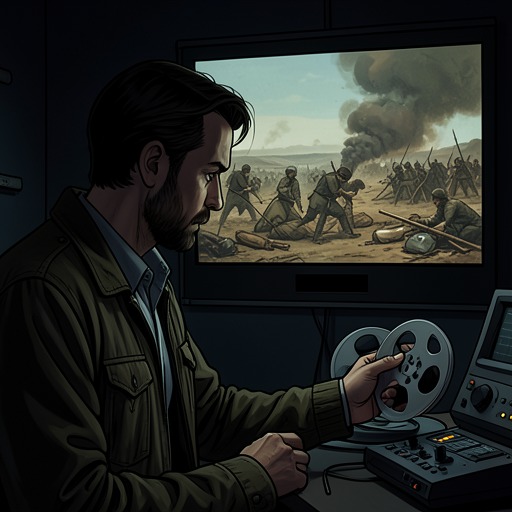
Elsewhere in the book, the movie theater becomes a darker counterimage to The Hamlet’s staged violence. During the narrator’s recovered memory of the Communist Agent’s interrogation, he learns that the room is called a movie theater when foreigners visit, but is used for interrogations when they are gone. It contains a Sony projector and a screen, with Claude watching as the agent is assaulted by three policemen while the crapulent major sits nearby. The room’s cinematic equipment does not make the violence a performance: here the screen and the language of entertainment conceal what is being done to a real person.
The juxtaposition complicates The Hamlet’s claim to represent war. On the film set, Vietnamese suffering is constructed for an audience and controlled by the production; in the room called a movie theater, the narrator watches actual violence while others treat observation as part of an interrogation. The remembered scene does not belong to the screenplay, but its hidden theater sharpens the book’s concern with who controls images, who is made to watch, and whose suffering becomes spectacle. The narrator’s work to make a fictional film more authentic thus sits within a wider world where the boundary between seeing violence and participating in its concealment is itself morally unstable.
The Narrator’s Position as Witness
The recovered scene also implicates the narrator in the chain of events that brought the Communist Agent into the room. She had been caught with a list of police names concealed in her mouth, and the narrator’s own name was on it: he had passed the list to Man, while the agent, as Man’s courier, knew Man’s identity. The narrator believed she did not know his. At Claude’s side, he watched as the crapulent major deferred to the three policemen. He protested that the assault was wrong and asked for time alone with the agent, but the request did not stop what followed. His objections register a limit he recognizes without overcoming: he remains a witness to violence he says should not happen.
After the three policemen raped the agent, one used a soda bottle as a degrading instrument and left it inside her. The narrator remembers the bottle, the water used to clean the room, and the agent’s silence afterward; the crapulent major later claimed to have ordered the cleanup. These details make the hidden theater more than a place where violence is watched. The room’s screen and projector frame the narrator’s own act of looking, while the agent’s concealed list links that spectacle to the covert loyalties and choices already at work beyond it. Against this remembered scene, The Hamlet’s staged Vietnamese suffering appears not simply as invented violence but as part of a larger problem of who controls the image, who is forced into it, and what responsibility belongs to the person who sees.