The Narrator and His Mother’s Mother–Son Bond
The SympathizerThe relationship between The unnamed narrator and The narrator's mother is the emotional and ethical thread that joins his childhood to his adult life in exile and captivity. She answers the injuries of his mixed-race childhood with fierce affirmation, shares food and opportunity despite poverty, and frames his origins as a destiny rather than a defect. Long after her death, her voice returns at moments when violence threatens to define him; memory makes their bond an active presence in the story, not merely a lost attachment.
Childhood exclusion and maternal protection
The narrator’s first lasting lessons about family arrive through an act of exclusion. At a New Year gathering, he approaches the adults with the greetings expected of the children, but Aunt Two withholds a Red envelope, explaining that she is one short. The maternal family watches as he stands with his arms respectfully folded, waiting for an apology or an explanation that does not come. His mother lays a hand on his shoulder and tells him to thank his aunt for the lesson. The restrained instruction does not erase the injury; it gives the child a way to leave the humiliating scene without being made to plead for acceptance.
At home, the cost of that composure becomes visible. The narrator’s mother weeps on the wooden bed they share. The other relatives have given him money, but he discovers that his share is only half his cousins’ and hears a cousin explain the difference by calling him half-blooded and a bastard. His mother’s anger is immediate, but her comfort turns the insult into a challenge: he must work harder, study more, and know more than those who demean him. He promises. Her encouragement does not make the discrimination disappear; it helps him build a self-image capable of surviving it.
Her protection is also expressed through material care and self-denial. In their impoverished household, she serves him most of the meal and claims not to be hungry when he notices what she has withheld from herself. Their reciprocal insistence that neither is hungry becomes a contest of love that ends, repeatedly, with him eating her portion. The memory later clarifies why his childhood understanding of injustice is never purely abstract: hunger is the bodily fact beneath questions about wealth, power, and who is asked to go without.
Education, origins, and competing explanations
The narrator’s mother supports his education from a position of limited opportunity. She is barely literate, reads aloud, and writes in a cramped hand; by the time he is ten, he writes for her. Their exchange reverses the usual direction of instruction without removing their dependence on one another. She gives him access to schooling and insists on his intellectual promise, while he helps her put words on the page.
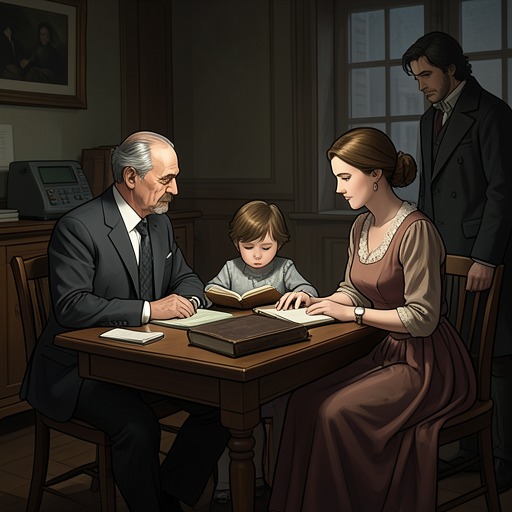
When the young narrator comes home crying after a schoolyard fight, he confesses what happened and fears that he may be unnatural. His mother holds him and reassures him that he is God’s gift to her. Then she asks whether he is ready to know who his father is, a question she connects to leaving childhood behind. He nods. She reveals that his father was The Father, a French priest for whom she had worked as a maid. He taught her to read and count in his language, and they spent evenings together as two lonely people who seemed to her to belong to no one else of their kind. Her account breaks off at the point of their sexual encounter, but she continues by interpreting the narrator’s existence through religious belief: God must have had a role for him, and he has a destiny among the meek.
This explanation offers love and purpose, but it does not settle the narrator’s divided inheritance. His mother presents his birth as meaningful within a Christian story; Man later interprets the childhood Red envelope as a sign of class and racial exclusion, and recasts red as revolution rather than luck. The narrator has confided the family humiliation to Man and Bon, but censored the intimate details of his mother’s body. Their responses show how a private maternal history can become part of his political education without ceasing to be a story of personal tenderness.
Separation, death, and the made grave
Before leaving to study in the United States, the narrator sees his mother for what will be the last time. He cannot afford to return for Tet or the summer, and his scholarship provides only one round-trip ticket. She calls him her petit écolier and gives him imported biscuits, a notebook, and a pen. She has saved most of the biscuits for him despite having tasted only a corner of one, while the notebook and pen stand for the education she could not attain and the future she hopes he will reach. He eats the biscuits on the airplane and fills the notebook with a college diary; the pen eventually runs out of ink and disappears.
During his junior year, his mother dies of tuberculosis at thirty-four. His father’s brief letter informs him that she is buried under a real headstone, a detail that signals the father’s payment for a marker she could not afford. The narrator reads the letter twice before grief arrives with force. Their separation had already been stretched across years and distance; now the objects she gave him are gone or used up, and no return journey can restore their last meeting.
Later, while working on a film in Luzon, he asks for the largest tomb in a cemetery built for the production. He puts a reproduction of the only surviving photograph of his mother on its adobe tombstone and paints her name and dates in red. The grave is a prop, not her actual resting place, but he takes comfort in giving her a place that looks fit for a mandarin’s wife on film. The gesture exposes the poverty of representation as well as its consoling power: an artificial set cannot recover his mother, yet it lets him make visible the importance she had in a life where she was otherwise treated as an extra.
The mother's voice in adult life
The narrator’s mother continues to speak in memory when he confronts what he has done. After he kills Sonny, he sees the blood on Sonny’s clothing and hears her remembered expectation that he will be better than those who wronged him. The words that once urged a child to overcome humiliation now sound against an act of killing. Their return neither absolves him nor supplies a simple judgment; it holds his adult violence beside the promise his mother elicited from him.
Her memory also accompanies the narrator’s guilt about the crapulent major’s widow and children. Looking at the children, he wonders whether his mother would still have considered him one of the meek. The widow’s meal intensifies the association: her shaking beef, greens, and winter melon soup recall his mother’s cooking, while the widow’s insistence that he eat repeats the maternal command he knew as a child. Food becomes a connection across bereavement, but it also makes his obligation to the bereaved family harder to evade.
In the reeducation examination room, hunger returns him to the meals his mother gave up for him. He remembers their childhood contest over portions and recognizes that sympathy alone cannot compel the rich and powerful to surrender what they hold. The political account he learned from Man explains why revolution might address material inequality, but it also leaves open whether collective liberation frees individuals. His mother’s remembered care therefore remains distinct from political doctrine: it is specific, bodily, and reciprocal, even when he tries to understand it through larger theories.
Birth, memory, and inheritance
Under interrogation, the narrator’s memories of origin and maternal presence converge in a recurring scream. As the recorded cries are used to disorient him, his thoughts move from the tortured Communist agent to his own conception and birth. He imagines his mother’s womb as the first world he inhabited, remembers her heartbeat, and recalls the doula’s account of his difficult delivery. The remembered details are not a calm biography: they surface amid light, heat, electric shocks, and exhaustion, as the narrator tries to identify whose voice he hears and what his own beginning means.
The doula had told him that his mother pushed him into the world along with her bodily waste, and that she had cut the membrane holding down his tongue so he could suckle and speak. In the recollection, birth is at once physical vulnerability and the beginning of speech; the mother is not an abstract emblem but the body that carried and delivered him. His awareness of being made from both his mother and The Father sharpens the divided identity that the novel has repeatedly placed under pressure.
Near the end, as he prepares to leave by boat, the narrator wonders when his mother began wanting him, the child conceived by a father who should not have been a father. The question does not cancel her documented devotion: her saved food, gifts, teaching, embraces, and fierce belief have already answered it in action. Instead, it shows how the bond remains unfinished in memory. Her love supplies neither a clean resolution to his origins nor protection from political violence, but it gives him a durable obligation to notice those who suffer and to keep questioning the systems that make suffering ordinary.