The Navigator
The SympathizerThe Navigator is Bon’s cousin, an experienced sailor from the old regime, and the organizer of the sea escape that The unnamed narrator and Bon join after leaving the reeducation camp. His earlier attempts to flee had both ended in capture; this time, rather than travel alone, he plans to take his extended family with him. He offers no assurance that the voyage will succeed. His practical knowledge and sober estimate of the danger make him a guide into uncertainty, not a rescuer who can promise safe passage.
Identity and Background
The Navigator enters the account through the escape plan that Man has arranged for The unnamed narrator and Bon. Man says that Bon has a cousin in Saigon who will help them, and that the cousin has tried twice to leave Vietnam and been caught both times. Man predicts that a third attempt, now made with Bon and The unnamed narrator, will succeed. The Navigator’s identity is therefore established through kinship and a history of failed flight before he appears in person: he is both a family connection and someone who knows firsthand what capture can cost.
After a two-day journey over mountain passes and crumbling highways, Bon and The unnamed narrator reach Saigon and go to The Navigator’s home. Their arrival unfolds against news of renewed war: Vietnam has invaded Cambodia after Khmer Rouge attacks, and China has raided Vietnam’s northern border. The city feels muted, and the absence of popular songs is itself a sign of the changed conditions. The Navigator confirms that yellow music has been banned and that only revolutionary music is permitted. His home is thus a meeting place within a country where the political order reaches into ordinary cultural life, as well as a staging point for departure.
Earlier Escapes and the Decision to Take His Family
The Navigator had previously tried to escape by boat without his family. He hoped to endure the danger alone, reach a foreign country, and then send money home so his family might survive or flee once he had proved the route safe. Both attempts failed, and he was sent to reeducation. He believes that capture a third time would mean transfer to a northern camp from which, as far as he knows, no one has returned. His choice to include his family is made with that prospect in view: he no longer treats escape as a journey he can test first and report back about later.
For this attempt, the scale of the risk changes. The Navigator is taking his wife, three sons and their families, two daughters and their families, and the families of three in-laws. The extended clan will either live or die together at sea. His decision does not erase the danger that led him to travel alone before; it distributes that danger across the family rather than separating one person’s risk from everyone else’s uncertain future. The plan that brings Bon and The unnamed narrator to him is therefore also a collective undertaking, with family survival tied to the same passage.
The Plan and Its Odds
Bon asks The Navigator to assess their chances. As an experienced sailor, he bases his estimate on the people who have fled and on the few whose fate he has learned: he has heard from only half of them, and assumes the rest did not make it. He calls the odds fifty-fifty. When Bon accepts that estimate, The unnamed narrator and Bon also agree to go. The Navigator offers a calculation grounded in incomplete knowledge, not a comforting prediction; the missing half of the reports remains part of the answer.
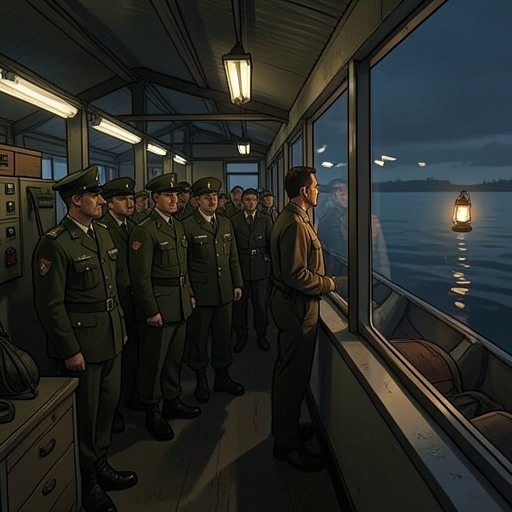
The departure plan relies on secrecy and a sequence of transfers. Families throughout Saigon will leave their homes as if going on a short trip. A bus will carry the group three hours south to a village, where a ferryman waits by the river. The travelers will use a coded exchange about an uncle’s funeral to identify the passage, cross by skiff to a hamlet, and join the rest of The Navigator’s clan. Farther downriver, a fishing trawler awaits. It is meant to carry 150 people, almost all hidden in a hold built for a third as many. The Navigator warns that the compartment will be hot and foul-smelling, and that its passengers will struggle to breathe once the hatches are shut. The route depends on coordinated concealment, but its final stage concentrates the physical danger in an overcrowded, sealed space.
Narrative Role and Ending
The Navigator gives the escape its route, its human scale, and its unsparing measure of risk. His prior captures distinguish him from a merely abstract guide: he has attempted the same passage twice, endured reeducation, and now brings a large family into the danger he once tried to face alone. Yet the narrative does not make his experience equivalent to certainty. The half-fifty estimate, the expected conditions in the hold, and the comparison that even astronauts have better odds of survival keep the voyage’s peril in view.
On the evening before departure, The unnamed narrator and Bon have paid their fares with gold supplied by Man, hidden in a false bottom of a rucksack. They are to carry both a shared cipher and their manuscript, wrapped in waterproof plastic, as they follow The Navigator’s plan. The account describes the coded meeting, the skiff crossing, and the waiting trawler, but does not establish whether the boat reaches safety. The Navigator’s story therefore closes at the threshold of escape: he has brought his family and companions to the point of embarkation, while the outcome remains beyond what the account confirms.