The divided self and its masks
The SympathizerThe divided self and its masks is a recurring structure in the narrator’s experience: he performs roles for others while struggling to distinguish those roles from his inward responses. The division appears in political speech, in his reaction to the killing of the crapulent major, and in an explosive crisis that renders his calm and hysterical selves distinct. Rather than resolving into a single, secure identity, these episodes show division returning in different forms, sometimes as deliberate performance and sometimes as an experience beyond his control.
Identity as a divided structure
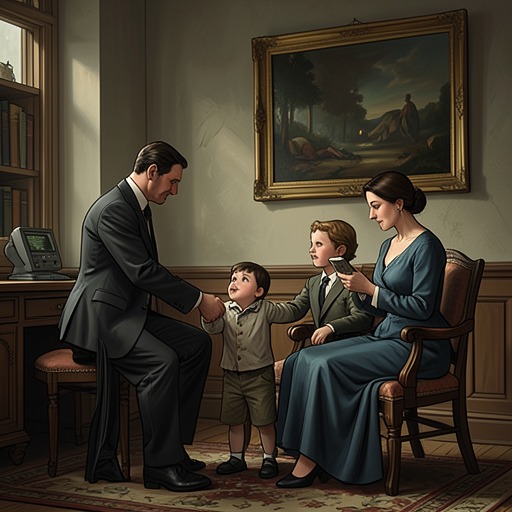
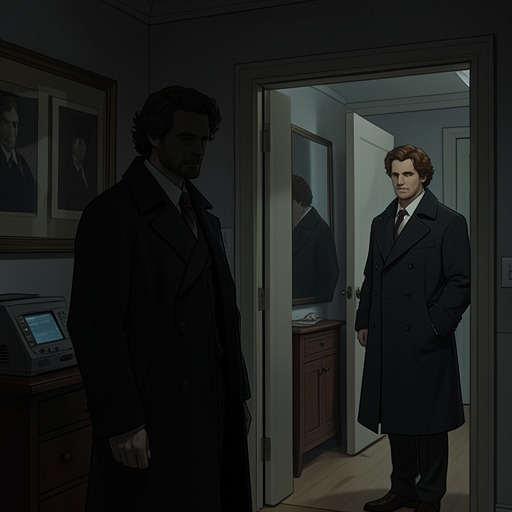
The narrator’s self-division is both psychological and practical. He can recognize that a public role does not express what he believes, yet he also describes the role as something he must inhabit convincingly. His masks are therefore not simply disguises adopted for an audience: they complicate his sense of where performance ends and personal identity begins. The image of the refrigerator decorated with twin columns of his divided self gives this split a domestic emblem. It stands beside an ordinary household telephone, the instrument through which he reports the killing to The General, joining the private setting of home to the political life he continues to perform.
This division is not presented as a stable arrangement in which one self always remains authentic and another merely false. At times the narrator can distinguish between his own judgment and the position assigned to his character; elsewhere, the boundary becomes difficult to locate. His account of masks that seem to become a face captures that uncertainty. The problem is not only that he conceals what he thinks, but that repeated performance can make concealment feel inseparable from the person doing it.
Political speech and the captain’s mask
The tension becomes explicit when the narrator responds to Madame after Auteur’s punch has unsettled him. He delivers a defense of limits on press freedom, although he states that he does not believe the position he voices. The belief belongs to the character he calls the good captain; as the actor playing that role, the narrator says he has to sympathize with the man. Political speech thus arrives as an act of identification as well as disguise: he must make the role intelligible from within, even while recognizing its distance from his own convictions.
The scene also complicates the idea that the mask can simply be taken off after the performance. The narrator contrasts his situation with actors who spend more time without their masks, then recalls dreaming of trying to remove a mask only to find that it is his face. His description makes performance feel less like a temporary public costume than an identity that has become difficult to separate from its wearer. The effort to adjust the captain’s face to fit properly suggests conscious maintenance, but not mastery: the narrator can prepare the role while remaining vulnerable to the possibility that it has become his only recognizable face.
Killing and the return of divided feeling
After the narrator and Bon kill the crapulent major, the split appears in a different register. In the car, numbness spreads through the narrator, while Bon explains that he could not shoot the man in the back and reassures him that the major felt nothing. The narrator’s concern is elsewhere: he wonders whether he himself feels anything. Their exchange distinguishes Bon’s stated concern about the manner of killing from the narrator’s anxiety about his own emotional response, without making that anxiety an uncomplicated sign of innocence or remorse.
The aftermath continues through practical actions. The two replace the car’s license plates in an alley; at home, the narrator cleans traces from his sneakers and calls The General to report that the task is complete. The sequence places routine concealment beside emotional uncertainty. He can carry out the report and remove evidence, but those actions do not settle what the killing has done to his sense of self. Later, he sees a red scar on Bon’s hand as they drink rye and toast the major during television coverage of the United States Bicentennial celebration. The narrator then cannot escape the image of the major’s third eye, which seems to expose something about him. In this return, the division is no longer only between a role and a belief: the dead man’s imagined gaze makes the narrator confront the self his actions have revealed.
Crisis, memory, and unresolved division
During the conflagration, the narrator perceives himself as two selves: one calm, observing the other as hysterical and screaming. The distinction gives narrative form to a crisis in which his sense of feeling and control is overwhelmed. As helplessness forces the two selves back together, separation does not yield a composed, unified identity; it becomes a pressured reunion under threat. The episode therefore echoes the earlier mask imagery while changing its terms. In the political scene the narrator consciously performs a role; in the explosion, the separation is experienced as part of a breakdown in his ability to remain a detached observer.
After escaping the immediate danger, he experiences his life as a rapidly reversing sequence. The remembered self diminishes from teenager to child and baby before the sequence ends in darkness. This backward movement gives the episode a formal counterpart to the narrator’s divided identity: the self is not narrated as a continuous, steadily advancing life but as an image that can be abruptly reversed and reduced toward its beginning. The account does not resolve what a single, whole self would be. Instead, its recurring masks, split perspectives, and reversed recollection show how the narrator’s identity is repeatedly made and unmade by political performance, violence, and crisis.