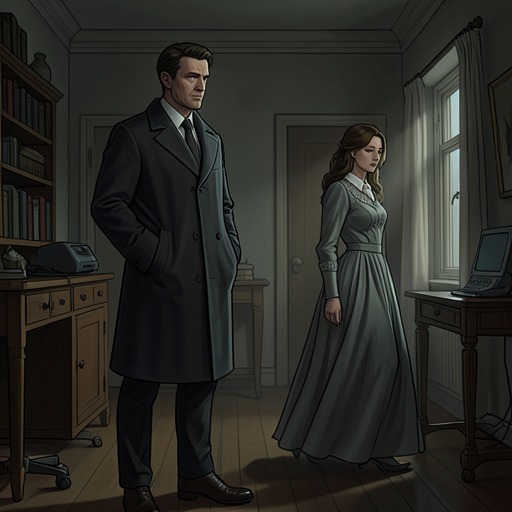
The narrator and Lana’s love affair
The SympathizerThe narrator and Lana’s love affair is a brief, concealed intimacy whose consequences reach beyond the two people involved: it breaks the familial and military roles The General and Madame have assigned to The unnamed narrator, and exposes how his bastard status limits the belonging they had seemed to offer him. The affair is disclosed not through Lana’s account but through her parents’ accusations, then returns in The unnamed narrator’s memory as he stands armed in a forest on a dangerous mission.
Unequal Positions and Familial Expectations
The unnamed narrator is not simply an outsider who approaches Lana from a distance. He has served as The General’s aide, lived in The General and Madame’s household, and been treated, in The General’s own formulation, as an adopted son. On the eve of departure, The General says that he had wanted The unnamed narrator at his side and would not have let him go except for the present breach. The offered closeness is real, but it is conditional: The unnamed narrator can be welcomed as a subordinate and presumed family member only while he observes the boundaries The General sets.
Lana is The General and Madame’s daughter, and their response makes clear that they understand The unnamed narrator’s earlier treatment of her as a child and sister to have established a permanent rule. Madame emphasizes the word sister when the parents confront him. What The unnamed narrator understood as a changed relationship, or at least as a private desire that could be pursued, is instead named by her parents as a violation of family order. Their accusations therefore concern not only his conduct but his supposed failure to remain in the role they had given him.
The Affair and Its Disclosure
At the airport, after The General and Madame have seen off the departing group, The General holds The unnamed narrator back for a private word. The parents are grim. They say rumors have circulated about The unnamed narrator trying to seduce Lana and about the pair making a spectacle of themselves at a nightclub. The unnamed narrator manufactures surprise and asks what they mean; the scene presents his dissembling as a practiced response, not as evidence that the allegations are false. He does not deny having crossed the boundary. Instead, his question about what The General means by “my kind” draws out the status judgment beneath the reprimand.
The confrontation makes the affair public within the family before it can be described on its own terms. Lana is absent from the airport exchange, and her parents speak for her, identifying the relationship as seduction and impropriety. The unnamed narrator’s brief replies cannot establish what Lana wanted or how she understood their encounter. The narrative later supplies one of her remarks, but not a full account from her perspective. This imbalance matters: the affair is central to the confrontation, yet the reader encounters it through The unnamed narrator’s recollection and the parents’ accusations rather than through a shared explanation by the couple.
Private Intimacy and Recollection
During the later mission, The unnamed narrator remembers the night with Lana while gripping his rifle. He recalls that he had gone back to her after leaving Sonny’s place; when she opened the door, she did not appear surprised, and he understood this as her having known he would return. In the forest, he compares the rifle in his hands to the way he had held Lana in her arms. The juxtaposition joins intimacy to violence without making them equivalent: the remembered embrace interrupts his immediate military surroundings, while the weapon remains the physical object anchoring him to the mission.
The memory also carries Lana’s judgment of him. In the aftermath of their encounter, she tells him that he is everything her mother would hate. The line links their intimacy to the family conflict that will soon be stated openly at the airport. The unnamed narrator says he is not offended, describing himself as already saturated with hatred. His response does not resolve the tension between them or establish that they share the same motives; it shows how readily he interprets personal rejection and desire through the accumulated language of hostility and exclusion.
The forest itself becomes associated with Lana in the remembered scene: The unnamed narrator says its scent is hers, and the damp earth recalls her. That sensory association occurs amid a night watch, with Bon beside him and the affectless lieutenant moving into the bamboo. The affair is therefore not a separate romantic interlude that has ended cleanly. Its memory intrudes into the expedition, coloring the landscape through which the men move and making private attachment part of The unnamed narrator’s unstable experience of danger, guilt, and return.
Rank, Belonging, and the Affair’s Consequences
The General’s rebuke turns on rank and place. He tells The unnamed narrator that a soldier should know that “Everything and everyone belongs in his proper place.” When The unnamed narrator asks what is meant by “my kind,” The General answers by identifying him as a bastard. The sequence converts an accusation about seduction into a judgment about birth: The unnamed narrator’s perceived offense is not only that he has pursued The General’s daughter, but that he has presumed to cross a boundary his parentage makes socially consequential.
The insult also revises the meaning of the family’s earlier adoption language. The General and Madame may regard The unnamed narrator as an adopted son, but their claim to familial closeness does not erase his exclusion when he seeks intimacy beyond the role of aide and surrogate family member. The General’s standard of proper placement offers affection and acceptance within a hierarchy, not freedom from it. The unnamed narrator is left at the departure gate with a bottle of whiskey, unable to answer; he describes the word as stuck in his throat. The scene ends the immediate exchange not with reconciliation but with the parents departing and their judgment left lodged in him.
The affair’s narrative force comes from this collision between private desire and public classification. Its remembered physical closeness contrasts with the airport scene’s formal reprimand; Lana’s remark about her mother’s hatred anticipates the parents’ condemnation, while The General’s adopted-son language is undercut by the revelation of The unnamed narrator’s birth status. The affair does not produce a clear account of the couple’s future or a final resolution between them. Instead, it leaves The unnamed narrator carrying both the memory of Lana and the family’s rejection into the mission, where desire persists as an intimate recollection amid military displacement.