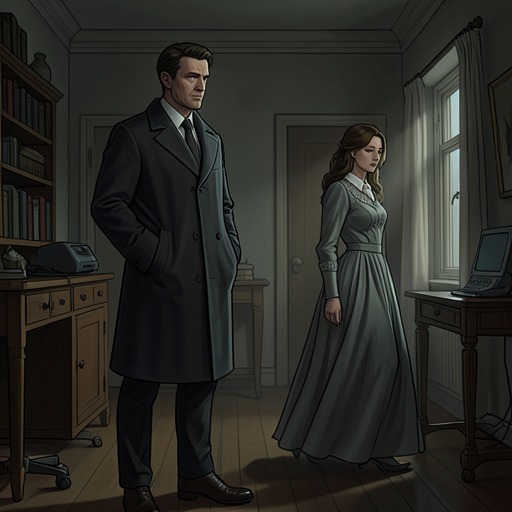
The narrator and Lana’s romantic relationship
The SympathizerThe narrator and Lana’s romantic relationship joins music, courtship, and political violence in a connection that offers the narrator intimacy without releasing him from his loyalties or guilt. He is captivated by Lana when she sings, pursues her with deliberate courtship, and comes to value her candor and compassion. Yet the relationship develops alongside his secret obligations: even an evening back with Lana after Sonny’s assassination cannot make the killing disappear.
Attraction and first encounter
The narrator’s interest in Lana sharpens after hearing her perform. Her song leaves him stunned while the audience applauds; he cannot even join in. As she returns to the performers’ table, he tells Bon he will be away for ten minutes and crosses the lounge to approach her. Bon warns him against it, but the narrator relies on a principle he has drawn from earlier failures: hesitation makes rejection more likely, while risking rejection is better than never approaching at all. He sits beside her without asking permission or waiting for her to begin the conversation.
Their exchange quickly turns from her unexpected singing to the circumstances of her life. The narrator admits that he had not known she could sing; Lana answers that she was only sixteen when they first met. He offers her a cigarette and asks what her parents think of her performing. She says they regard singing and dancing as a waste of time, and he distinguishes himself from the General by saying that he agrees with only some of the General’s views. Lana presses him on whether he agrees about music. His answer—that music and singing sustain life and hope, because feeling makes living possible—meets her own conviction that the capacity to feel is bound up with the capacity to love.
Lana also makes plain the expectations surrounding her future. Her parents want her to marry promptly to someone respectable and wealthy, and she challenges the narrator to acknowledge that he is neither. Rather than presenting those qualities as his credentials, he asks whether she would prefer him to be respectable and rich. The exchange establishes a difference between the approved marriage her parents envision and the attraction taking shape between the two of them.
Courtship, performance, and difference
The narrator treats courtship as something distinct from American dating. In his account, dating is a scheduled, practical arrangement, while courtship involves persuading someone who is not already inclined to make time for him. He therefore pursues Lana through letters written in careful cursive, poems in forms such as villanelles and sonnets, and songs he performs on her guitar when she lets him sit in her living room. His singing draws on Vietnamese music familiar to their diaspora community. Lana responds with enigmatic smiles, a place for him in the front row at her performances, and continued access to her company, limited to no more than once a week. Her measured encouragement leaves him grateful but tormented by uncertainty.
At the nightclub, their conversation also gives him a fuller sense of who she is beyond the singer who first caught his attention. She works for an art gallery in Brentwood, likes vodka martinis, and speaks freely about her former boyfriends and her political commitments. The narrator describes her as socially and economically progressive: she supports birth control, gun control, civil rights, and the liberation of homosexuals, alongside nonviolence, world peace, and national self-determination. Her views combine those commitments with support for liberal democracy and regulated capitalism. She believes Vietnamese people can sing the blues, and she names New York as the American city she would choose if she could not live in Los Angeles. For the narrator, her willingness to express her opinions is especially striking. He contrasts her candor with his generalization about Vietnamese women keeping their views private until marriage, when they no longer do so.
The narrator’s methods reveal as much about his approach to intimacy as his admiration does. He describes rules for initiating conversation, offering cigarettes, and making statements rather than asking questions. His confidence is partly a practiced response to childhood bullying and earlier romantic hesitation; it is also a way of managing the fear of rejection. His narration thus presents courtship both as a sincere effort to reach Lana and as a performance organized around tactics. Lana is not simply won over by that performance: her limited invitations, direct questions, and independent convictions give the relationship its own pace and terms.
Lana, Bon, and shared loss
The relationship changes in the presence of Bon. During an evening at the lounge, the narrator calls him over after an hour of conversation with Lana. Bon, warmed by cognac, talks with her about Saigon and its songs. Their reminiscence turns toward the fall of Saigon and the people left behind. When Lana asks about Bon’s wife and child, he says that they are dead and begins to cry. The narrator, who knows Bon rarely discusses Linh and Duc with anyone else, watches Lana embrace him and press his head against her cheek.
That gesture interrupts the narrator’s absorption in Lana’s appearance. He feels an aching love for his best friend as well as for her, and his desire for Lana becomes entangled with admiration for the tenderness she shows Bon. The scene makes her compassion an essential part of the attraction: she attends to Bon’s grief without embarrassment or withdrawal. At the same time, the narrator describes his desire in possessive, bodily terms. His account holds these responses together rather than resolving the tension between love as recognition of Lana’s character and desire to possess her. He leaves the encounter convinced that the attraction is mutual, but that certainty is his own conclusion, not a commitment Lana has expressly made.
Intimacy, restraint, and Sonny’s assassination
Later, Lana receives the narrator at her apartment in a University of California, Berkeley sweatshirt, faded jeans, and little makeup. They eat dinner in the living room while watching a television comedy, then drink wine. In this quieter setting, he speaks of his suspicion that the Auteur tried to kill him and admits to imagining the Auteur dead. Lana answers that people can have passing fantasies about others’ deaths, and shares her own hypothetical thoughts about her mother. The exchange gives the narrator a way to disclose another violent thought: he has imagined killing his father, a priest. Lana’s sincere surprise at this revelation endears her to him. He then tells her that his mother had accepted his origins as the child of a Vietnamese woman and a French priest.
As the conversation turns to whether he has forgiven his father, the narrator admits that he sometimes thinks he has and sometimes thinks he has not, especially when he thinks of his mother. Lana leans forward and rests her hand on his knee, suggesting that forgiveness may be overrated. Although he is close enough to kiss her, he pulls away, returns her guitar, and says that he must leave before he can do what needs to be done. Lana is astonished by his withdrawal but responds with amusement and says she likes serious men. For the narrator, the refusal is a consequential act of restraint: he leaves the possibility of intimacy unresolved because he has another obligation to fulfill.
That obligation is the planned assassination of Sonny. On the drive to Sonny’s apartment, the narrator steadies himself with mindful breathing, a practice Claude taught him for focusing on a target without shaking. After killing Sonny, he vomits beside his car. The next morning, Bon tells him that the deed had to be done and urges him to return to the battlefield. The narrator has already gone back to Lana after leaving Sonny’s apartment, and describes the evening with her as unforgettable, but it has not helped him forget the killing. Their relationship therefore does not function as absolution or refuge from political violence. Lana remains a person to whom he turns for solace, yet the intimacy between them cannot undo the act that precedes it; at this point in the narrative, the relationship’s ending remains unsettled rather than resolved into a promise of marriage or a clean break.