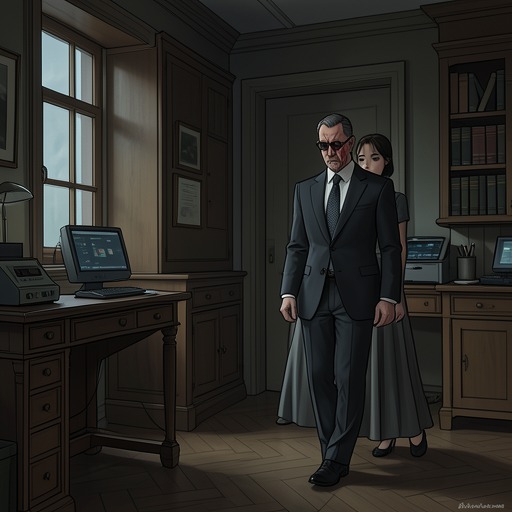
The narrator and Man’s brotherly bond
The SympathizerThe narrator and Man’s brotherly bond is tested at the moment when recognition seems impossible: Man, the narrator’s closest comrade, reappears as the faceless commissar responsible for his reeducation. Their relationship is neither simple rescue nor simple betrayal. Man uses the authority of the camp to keep the narrator and Bon alive, but the protection he can offer is inseparable from coercion and pain.
Recognition and Protective Friendship
Man’s return is first registered through a familiar voice in the commissar’s quarters. When he emerges from behind the mosquito netting, the narrator sees a face so severely scarred that he looks away; Man has to ask whether the narrator truly fails to recognize him. The recognition comes with a reversal of roles: the childhood and revolutionary friend is now the official overseeing the narrator’s confinement. His altered appearance makes visible the distance between the friend the narrator remembers and the person whom war and its aftermath have made, without erasing their bond.
Man explains that he had warned the narrator not to return, but their messages were watched, and he could not communicate freely. The narrator had come back because he feared Bon would be killed; Man says that this plan endangered the narrator as well. He had sought the commissar’s position specifically after realizing the narrator would return, then arranged for both friends to be sent to this camp. Man’s decision turns their friendship into a covert act within the institution meant to discipline them.
The protection is practical and costly. Man says that the camp holds men who continued guerrilla resistance or refuse to confess with sufficient contrition, and that Bon has already asked twice to be executed. The commandant would have sent the narrator to a demining squad, where his chances of survival were poor. Man instead persuaded the commandant to keep him in an isolation cell for a year, presenting continued reeducation as more useful to the revolution than killing him. He does not claim to control the system: higher commissars read the messages and direct the process. His friendship operates within those limits, securing the narrow space in which the narrator can live and write.
Estrangement, Shame, and the Torturer’s Role
Man’s protection does not restore the ease of their former intimacy. His disfigurement has made him fear the recognition of those closest to him: he tells the narrator that his wife flinches at his touch and that his children cry when they see him. He has not revealed himself to Bon, who has seen the commissar from a distance without knowing he is Man. Yet Man still hopes that Bon might recognize him, a wish that binds his longing for friendship to the shame that keeps him hidden.
The narrator tries to reassure him that his children would not fear him, but Man rejects the comfort as an assumption based on the narrator’s own perspective. Their closeness cannot make one man’s bodily and emotional experience transparent to the other. In this exchange, the friendship includes not only loyalty but also a limit: the narrator can grieve for Man’s estrangement from his family, but cannot claim to know what that estrangement feels like.
That limit sharpens when the narrator learns that Man is also the person directing his painful reeducation. After the examination, the narrator asks to see the commissar again, and finds Man uneasy, studying the pages he has written. The narrator recognizes that Man has been both interrogator and confidant, the person who inflicted pain and the friend who believed it necessary to make him reach an answer himself. Their bond survives not by making those roles compatible, but by allowing their contradiction to remain visible.
The narrator sees a parallel between them: each is divided, and neither can be understood as a single, settled self. Man’s ruined face makes that division literal, while the narrator’s divided identity gives him a way to recognize Man without pretending that recognition is complete. Their friendship is therefore neither absolution for the torture nor a repudiation of the care within it; it is an effort to face both truths at once.
Release and the Bond That Endures
Man’s final act of friendship is to secure the narrator’s and Bon’s departure from the camp and from Vietnam. He explains that confession may be enough to release the narrator, given his revolutionary record, but Bon’s crimes make money necessary: the commandant must be paid, and a substantial sum is needed to get both men out of the country. Man has taken money and gold from poor women to fund their escape. The rescue is an act of care, but not an innocent one; it requires Man to exploit others and make the narrator’s freedom materially possible at their expense.
The narrator recognizes the man who tortured him as the same friend who is setting him free. He embraces Man and weeps, understanding that Man cannot leave the camp with them and may be unable or unwilling to escape except through death. Their reunion offers no clean release from the past: Man’s protection, coercion, and suffering remain bound together. The narrator’s capacity to recognize him depends on accepting that contradiction rather than reducing Man to either torturer or friend.
Their connection is affirmed through the red scars on their hands, unchanged since their youth. They clasp hands, and Man returns their battered rucksack and their worn copy of Asian Communism and the Oriental Mode of Destruction. Its binding has split in two and is held together with a rubber band. Man gives it to them as a way to communicate again, offering a fragile channel between the friends even as they part. The shared scars and damaged book make their brotherhood tangible: marked by what they have endured, it persists beyond the camp.
The narrator’s understanding of Man also opens onto the irony of the revolution they once served. Its promise of independence and freedom has turned inside out: a movement that fought to liberate the country now withholds freedom from defeated compatriots, repeating the imperial habits of the French and Americans. Man’s divided identity and the narrator’s divided mind allow them to recognize this reversal without abandoning their bond. Their friendship does not erase the revolution’s betrayal; it gives the narrator a way to see and name it, and to leave with a message still possible between them.
The Courier, the List, and Shared Complicity
The bond between the narrator and Man also runs through the covert intelligence network that precedes their reunion in the camp. The Communist Agent, Man’s courier, was captured with a list of policemen’s names that she had tried to swallow; the narrator’s own name was on it, and he had passed the list to Man. The narrator later recalls watching her interrogation in the room the policemen called the movie theater, with Claude and the crapulent major present. His connection to Man is therefore not only one of friendship: it is entangled with the dangerous exchange of information that exposed both the courier and the narrator himself.
In that remembered scene, the narrator protests that the interrogation should not proceed and asks to speak with the agent alone, but the policemen sexually assault her while he watches. The memory returns during his own interrogation, as his efforts to recount it are drawn out through questions about who was in the room and what happened there. The agent’s ordeal makes the costs of the intelligence work surrounding Man impossible to separate from the friendship it serves. The narrator’s eventual recognition of Man as both protector and torturer thus sits within a longer history in which loyalty, information, and violence have already been bound together.