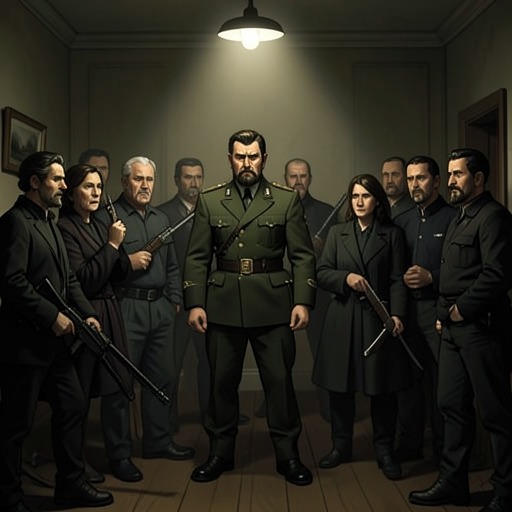
The narrator assassinates Sonny
The SympathizerThe unnamed narrator’s assassination of Sonny turns a strained political conversation between friends into a deliberate killing, exposing the gulf between the narrator’s revolutionary allegiance and Sonny’s refusal to believe him. Before the shots, the narrator tries to disclose his double life and present himself as an ally; Sonny instead interprets the confession as a jealous, dangerous deception.
Political Disclosure and Failed Persuasion
The meeting is already weighted by private history. Sonny speaks about Sofia Mori, acknowledging that having children with her is more dream than possibility and considering adoption. He says he wants to think beyond himself: though he still wants to change the world, meeting Sofia has made him recognize that revolutions also require people to examine themselves and how others see them. The narrator listens as Sonny describes this inward change, and his resolve to reach for the gun weakens. The friend’s unexpected openness delays the violence without undoing the narrator’s purpose.
The narrator tries to redirect the conversation to politics and discloses that he is a communist who has spent years working as an agent for both the opposition and the revolution. He offers the revelation as proof that the two men are allies. Sonny does not accept it as a confession. He suspects a trap designed to make him reveal his own political commitments so that the narrator can kill or expose him. His disbelief is entangled with their personal history: he accuses the narrator of jealousy over Sofia and of using the political disclosure to rekindle her interest. The narrator insists that he is trying to help, but the assurance cannot overcome Sonny’s suspicion. Their conversation has made the assassination more intimate, not less political: Sonny understands the revelation as manipulation, while the narrator knows it to be true, and the failed attempt to establish trust leaves the gun as the answer he has already come prepared to give.
The Shooting and Its Aftermath
The narrator finally raises the gun as Sonny continues accusing him of jealousy and deception. The first bullet punctures the radio, muffling but not silencing it. Sonny sees the weapon and throws up a hand; the next shot wounds it. He leaps up and runs, but a bullet between his shoulder blade and spine staggers him. The narrator jumps over the coffee table and catches him before he reaches the door. Following Bon’s advice about approaching a target from behind and entering his blind spot, he fires into the back of Sonny’s head. Sonny falls face-first, breaking his nose against the floor.
Standing over Sonny, the narrator sees blood spreading across the back of his cardigan and the wound in his raised hand. The killing does not bring immediate certainty: with a handkerchief wrapped around the doorknob, the narrator thinks he hears Sonny moan. He kneels beside him and tests the exposed eye with a finger. When Sonny blinks and his body shudders, the narrator fires once more into his temple. Only then does Bon confirm that Sonny is dead. From the first shot to that final one, a little more than three minutes have passed.
The narrator’s physical reaction makes the escape an act of control performed through nausea and shock. He breathes slowly to steady himself, wipes his fingerprints from his glass, and changes clothes: windbreaker and T-shirt for a blue polo shirt, jeans and canvas shoes for khakis and loafers. He reverses the windbreaker, replaces his fedora with a blond wig and baseball cap, and adds tinted glasses. Bon had devised the disguise to make him appear to be a white man; its ordinariness is its protection. Before leaving Sonny’s room, the narrator walks out with the confidence Bon recommended, though he has to concentrate on breathing as he descends the stairs.
In the lobby, a white man passes without looking at him. The narrator understands the disguise’s effect in that moment: the stranger treats him as unremarkable, and the narrator reaches the street without attracting notice. He makes it to his car before vomiting beside the wheel well, emptying his stomach into the gutter. The disguise enables his immediate escape, but the bodily aftermath registers what the successful exit cannot erase: he has killed a friend after failing to make his true identity and political allegiance believable to him.
Voices After the Killing
The narrator’s response is accompanied by three remembered voices that pull the act in different directions. As nausea and chills rise, the narrator’s mother asks whether her son will be better than all the others; Bon answers the immediate crisis by insisting that he is doing what must be done. Claude’s instruction to breathe then becomes a practical command, repeated as the narrator steadies himself and leaves. The voices do not undo the choice or settle its moral meaning. Instead, they make its aftermath a contest between inherited hope, a comrade’s justification, and the trained discipline required to keep moving. The narration gives no clean release from responsibility: even as Bon’s counsel enables escape, the narrator’s body continues to register the killing as shock and revulsion.
The Killing as a Rupture of Trust
The assassination turns the narrator’s claim of political solidarity into an irreversible breach between allies. He had told Sonny the truth about his communist identity in the hope that disclosure might establish trust; Sonny’s refusal to believe him leaves that truth unable to protect either their friendship or Sonny’s life. The scene’s sequence makes the failure stark: persuasion gives way to gunfire, and even the narrator’s first shots do not immediately end the violence. Sonny’s blink forces a final close-range shot, making certainty of death something the narrator secures through another deliberate act.
The event also reveals how the narrator’s divided loyalties become action rather than an abstract conflict. Bon’s tactical advice and Claude’s remembered command to breathe help him carry out the killing and leave, while his mother’s question and his own nausea resist any simple account of it as necessary work. The disguise gets him past a stranger unnoticed, but escape is not absolution: the narrator reaches his car and vomits. In the contrast between a successful public disappearance and an involuntary bodily reaction, the killing remains both a political decision and the destruction of a personal bond.