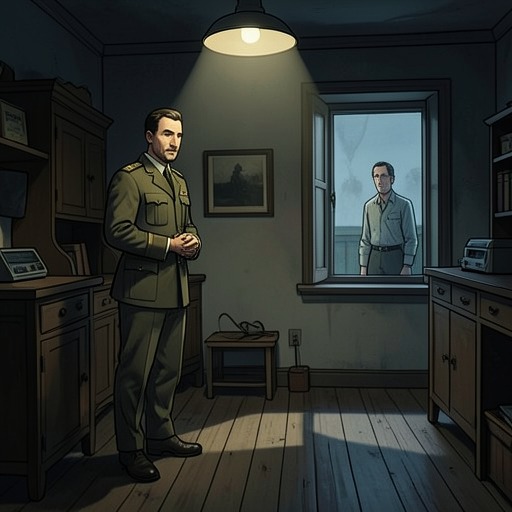
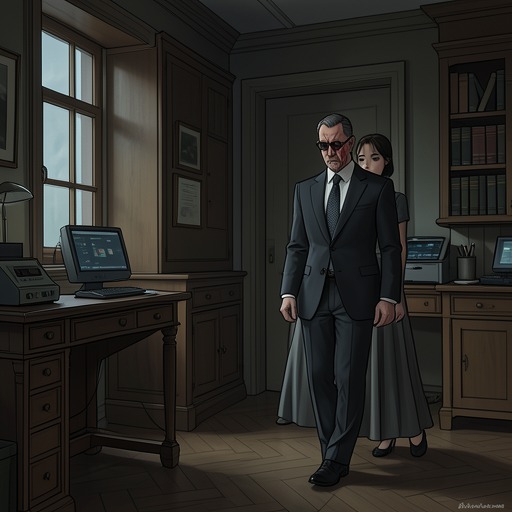
The narrator sent to the United States to spy on exiled soldiers
The SympathizerThe unnamed narrator’s assignment to the United States transforms his evacuation from Vietnam into a clandestine posting among the exiled soldiers he is expected to observe. Charged with monitoring The General and his fellow veterans for signs of renewed fighting, he becomes both a refugee and an intelligence operative: his new life in America is also a position from which to watch the military community gathering there.
Assignment and Revolutionary Network
The mission is arranged through Man, whom the narrator meets on Wednesday afternoons in Saigon’s basilica. Their apparent religious observance conceals a political relationship: the narrator confesses his failures, while Man answers with assignments rather than religious absolution. The basilica offers cover for a meeting between two former Catholics, but their work rests on a network whose structure is deliberately hidden from the narrator.
That secrecy reaches back to their lycée days. Man had led a three-person study group with the narrator and another classmate, directing their reading of revolutionary classics and Party ideology while Bon followed a more conventional path. The narrator knew that Man belonged to another, higher cell, but not who its members were. Man described successive committees above his own, each more committed than the last. The arrangement kept authority compartmentalized: the narrator received a task from Man’s superiors without being told their identities. He understood that this ignorance was a safeguard, not an accidental gap in his knowledge.
Man’s revolutionary inheritance gives the assignment a history beyond the immediate evacuation. He traces his politics to a great-uncle who had been conscripted by the French to serve in Europe during World War I, where the sight of dead white soldiers helped overturn the colonial image of European superiority. The great-uncle later joined the French communists after falling in love with a Trotskyist nurse. Their daughter, Man’s aunt, became the practical link between the secret network and the narrator’s coming exile: she had never joined the Communist Party and was therefore, in Man’s assessment, unlikely to be under surveillance.
The Decision to Go
The narrator had already informed Man of The General’s evacuation plan when Man disclosed the new task. Its purpose was to keep an eye on the old soldiers and determine whether they would get into trouble. The assignment assumes that evacuation will not end their military ambitions: Man stresses that men who have fought for years may continue fighting rather than simply lay down their cause. The narrator is therefore sent not merely to accompany the refugees but to observe what their defeat and displacement might produce.
The possibility of going had already acquired a personal attraction. The narrator recalls having imagined a cinematic refusal to board Claude’s plane, with The General pleading unsuccessfully for him to leave. In that imagined scene, he would claim he wanted to stay because the war was nearly over. But the mission conversation turns the fantasy inside out. Man argues that the narrator can do more good in America and invokes Bon, who would not leave if he believed the others were staying. He also insists that the narrator wants to go. The narrator’s extravagant vision of America—its supermarkets, superhighways, jets, carriers, and spectacle—makes that desire difficult to dismiss, even as his assignment gives departure a political rationale.
A Channel for Concealed Reports
To maintain contact after the move, Man gives the narrator a slip of paper bearing his aunt’s name and address in Paris’s thirteenth arrondissement. She is a seamstress with three Siamese cats, no children, and no suspicious political credentials. Because direct letters to Man would be unsafe, the narrator is to write to her as an intermediary. The arrangement makes an ordinary family correspondence serve as a covert communications channel.
The letters carry a second message through agreed conventions. References to the weather, the narrator’s health, the aunt’s health, and French politics signal that information has been written between the lines in invisible ink. If those expected topics are absent, Man is to read the letter as containing only what appears on its surface. The system lets the two men distinguish a concealed report from a genuine but unencoded letter without naming the secret operation openly.
The first letter is written in the summer of 1975, after the refugees have been transferred from Guam to Camp Pendleton in San Diego, California. The change in surroundings marks a sharp material contrast: tents hastily erected by Marines on Guam give way to barracks at Camp Pendleton, where the refugees begin their preparation for life in America. The narrator addresses Man’s aunt as though she were his own, but the letter is really intended for Man. Its opening describes Bon’s grief and the family’s recent losses; the private account of bereavement sits beside the letter’s potential use as intelligence, joining personal communication to political duty.
The Mission’s Early Limits and Significance
The first year in America yields little need for elaborate concealment. The narrator judges the exiled soldiers too unsettled to foment a counterstrike, so the information is useful but does not yet require secrecy. This is an important early limit on the assignment: the network has positioned him to watch a possible military revival, but the refugees’ immediate condition offers no sign that such an operation is imminent. His role begins as surveillance of a possibility rather than the reporting of an active campaign.
The mission also makes the narrator’s divided position concrete. He has shared The General’s evacuation plans with Man, then travels with the people he has been told to monitor; he is connected to the displaced soldiers while answerable to a revolutionary hierarchy that remains largely invisible to him. Letters to an apparently apolitical seamstress preserve that double allegiance in miniature: they can describe exile and grief on their face while carrying information underneath. The assignment thus gives the narrator’s movement to America two meanings at once—escape from a collapsing South Vietnam and entry into another field of political obligation.