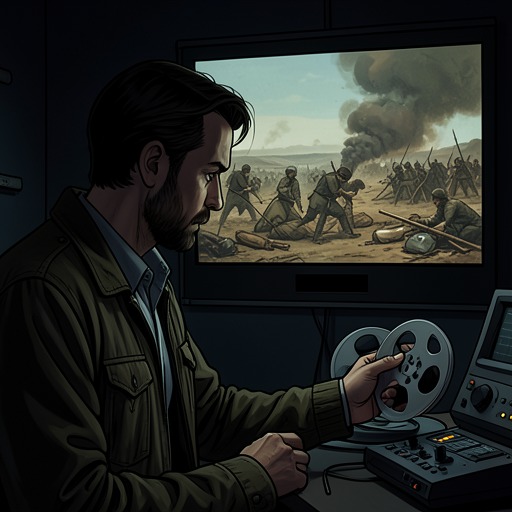
The narrator's confrontation with the Hamlet director
The SympathizerThe unnamed narrator's confrontation with the Hamlet director begins as a dispute over details in a screenplay and grows into a struggle over who has the authority to represent Vietnamese people. By challenging the characters' repeated screams and lack of speech, he tries to make the film acknowledge Vietnamese experience; the director's response makes clear how little influence that challenge can secure.
Challenging the Screenplay's Representation
The unnamed narrator arrives at his meeting with The Hamlet war-film director and Violet having researched Vietnam through the work of Joseph Buttinger and Frances FitzGerald. The director treats that preparation as grounds for confidence in his grasp of the country, but the narrator's growing frustration shifts the discussion from research to representation. He points out that Vietnamese characters with speaking parts repeatedly scream instead of speaking, and that the script gives their cries a fixed, exaggerated form. Among the examples are a villager impaled on a punji trap and a little girl killed after alerting Green Berets to an approaching enemy. The narrator insists that neither scene's scream sounds like the screams he has heard.
The disagreement turns personal when the screenplay's stylized cry recalls the narrator's first assignment as a lieutenant. He remembers being unable to save a wiry Bru elder, suspected of serving as a liaison for the Viet Cong, from his captain's violence. Rusted barbed wire tightened around the man's throat as he swallowed; the narrator remembers that this was only a prelude to the pain that made him scream. In the meeting, he writes a different cry across the screenplay's cover page with the director's Montblanc fountain pen, caps the pen, and returns it to its place. The gesture makes the dispute tangible: the narrator uses the director's own writing instrument to mark the difference between an invented sound and one informed by what he witnessed.
In the longer discussion, the unnamed narrator objects that Vietnamese characters in a film set in Vietnam have almost no speaking parts. Violet acknowledges the point but argues that Vietnamese audiences are not the people who will buy tickets. The narrator suggests that the villagers could at least speak in their own language, or have lines that signal an Asian language, rather than being reduced to a direction for the camera to cut to them speaking. He also notes that the absence of a woman in the Green Berets' story leaves the impression that the soldiers love and die only for one another. The objections connect small choices in the script to a larger pattern: Vietnamese people appear on screen, but the film's makers reserve speech, emotional complexity, and narrative attention for others.
The director answers by turning the discussion into a test of professional authority. He dismisses the narrator's suggestions as cheap ideas and points to his lack of filmmaking experience as a reason not to listen. Afterward, the unnamed narrator tells The General and Madame that the meeting continued in a more subdued fashion, but that the director had effectively wanted approval rather than criticism. Their anger on his behalf contrasts with the director's contempt, while the narrator's initial effort to intervene has established the terms of the conflict: authenticity is welcome only so long as it does not challenge who controls the film.
The Dispute Moves onto the Set
The conflict sharpened when the unnamed narrator challenged the production over its treatment of the extras and the planned rape of Mai. Most of the refugees playing villagers or soldiers could step into familiar roles, but no one wanted to portray Viet Cong guerrillas. The resistance was especially strong because the script required some of them to torture Binh and rape Mai. After the unnamed narrator pressed the issue of their pay, Violet agreed to double the wages for extras assigned to the guerrilla roles. The concession solved the casting problem with money, but it could not resolve the ethical dispute over what the film asked them to enact.
The day before Mai’s rape scene was filmed, the unnamed narrator asked Auteur whether the scene was necessary, objecting that it seemed designed to shock. Auteur defended it as a way to make audiences feel something and accused the narrator of being a sellout. The accusation struck at the narrator’s compromised position: he conceded that, as someone helping a white filmmaker make the movie, he could not deny that he occupied the losing side. He answered by describing his belief in American promises of friendship and respect, and the disillusionment of learning that those promises did not mean that Vietnamese people would be trusted or treated as equals. Auteur interrupted him with insults about his education and judgment. The unnamed narrator responded with an insult of his own; Auteur then threatened to kill him and described gouging out his eyes with a spoon. Violet dismissed the threats as a figure of speech, but the narrator regarded the specific threat as no less real than the violence the script staged.
The rape scene itself was filmed without the unnamed narrator present. Only Auteur, a small group of selected crew, the four actors playing the rapists, and Asia Soo were there; the narrator did not see the footage until a year later, in a crowded Bangkok theater. Two weeks after the filming, however, he witnessed the same four extras perform the water-torture scene against James Yoon, who played Binh. Yoon was stripped to the waist and strapped to a plank, while a cloth was placed over his head and water poured onto it. The most physically dangerous shots used a stunt double, whose nostrils were sealed and whose breathing tube was hidden in his mouth. The crew’s simulated blows and jeers made the torture look like action, but the narrator’s account emphasizes the labor and performance that manufacture such realism—and the gulf between staged violence and the suffering it imitates.
The Limits of Authenticity
The production’s staged violence also exposed how the film converted historical violence into a ready-made spectacle. In the script, Pete Attucks, the A-Team’s Black soldier, is caught in a bamboo bear-claw trap and captured alongside Binh. The guerrillas castrate Attucks and force the severed organ into his mouth. Claude had presented an image of a similar mutilation in an interrogation course, pairing an illustration of an Indigenous massacre with a photograph of a mutilated American soldier captured by the Viet Cong. His lesson was that such acts demonstrated a shared human capacity for violence; in the film, that history becomes another shocking episode in a narrative whose Vietnamese characters are largely denied speech and interiority.
The water-cure sequence with Binh made the contradiction between authenticity and exploitation especially visible. A stunt performer, rather than James Yoon, endured the shots in which water was poured over the cloth covering his face; the performer’s nostrils were sealed, with a tube in his mouth so that he could breathe. Around him, the extras simulated blows and abuse. The unnamed narrator describes the work of sustaining this performance—the exertion of the men striking and shouting as well as the effort of inventing a continuous stream of insults. The camera could make the scene appear real while its violence remained carefully staged, directed, and controlled. The narrator’s knowledge of interrogation lends the scene a perspective the screenplay itself does not provide, but that knowledge also makes him useful to the machinery he questions.
That usefulness became the measure of his limited influence. He had pressed for changes and helped secure speaking parts, yet he recognized that his work as technical consultant chiefly guaranteed accurate clothing, dialect, and background speech for Vietnamese people who would soon be killed on screen. The film could borrow the signs of authenticity while assigning its central emotions and ideas to an imaginative structure controlled by its makers. The unnamed narrator likens his role to that of a garment worker whose stitching is correct even though others own and design the finished outfit: improving the details did not give him control over what the film meant or whom it allowed to represent Vietnam.
His assessment reaches beyond a single production dispute. The Hamlet, in his view, follows the war it depicts and prepares the ground for another, helping make violence seem familiar to American audiences. The irony is that the unnamed narrator’s objections do alter some details, but those concessions help the film appear more credible without shifting ownership of its story. He had sought to make Vietnamese people more than scenery and sound; he ends this part of the conflict understanding that authenticity, when confined to costume and accent, can strengthen the very representation it was meant to challenge.
The Movie Theater and the Failure of Witnessing
The later recovery of the unnamed narrator’s memory shifts the meaning of the movie theater from a place of entertainment to a chamber of interrogation. When foreigners visit, the room is presented as a theater; otherwise, it is used to extract information. Its screen and projector remain in place as Claude advises and the crapulent major watches, while the unnamed narrator stands with Claude. The Communist Agent has been caught carrying a list of policemen’s names in her mouth, and the unnamed narrator recognizes his own name on it: he had passed the list to Man, though she did not know his identity. The staging turns spectatorship into part of the violence. The unnamed narrator watches, objects that the abuse is wrong, and asks for time alone with her, but the major says the General wants answers immediately and does not intervene.
The three policemen sexually assault the Communist Agent while the unnamed narrator remains present. When she gives her name as Viet Nam, their laughter precedes the attack; afterward, she is left silent on the table, and the men treat the scene as a joke. The unnamed narrator remembers the warm soda bottle in his hand, the policemen washing the table and floor, and the bottle left inside her. Claude insists he did not teach them that act, but his distinction does not undo what the men have done or the narrator’s witnessing of it. The memory’s return exposes not a clean position outside the violence, but a witness who protested and watched without stopping it. Set beside his objections to the director’s invented screams and staged brutality, the episode sharpens the difference between correcting how violence is represented and possessing the power to prevent violence itself.