The narrator's mother
The SympathizerThe narrator's mother is the central source of tenderness and ambition in The unnamed narrator’s childhood, and her early death turns memory itself into a measure of loss. Poor, barely literate, and marked by the social vulnerability of her relationship with The Father, she nevertheless insists that her son’s mixed heritage is no reason for shame. Her lessons begin in the humiliations of family life and continue after her death through the objects he loses, the grave he recreates, and the remembered voice that returns when he confronts violence.
Identity and Background
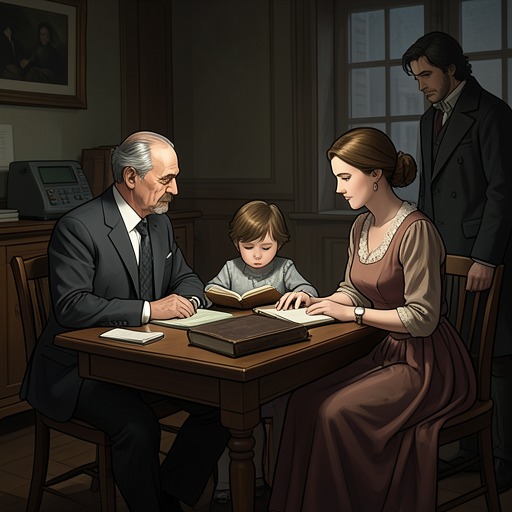
The narrator's mother grows up without the means for formal schooling. As she later explains to her son, she worked as a maid for The Father, who taught her to read and count in his language. They studied the Bible together by lamplight, and she learned through reading it and memorizing the Ten Commandments. She also heard stories about France and his childhood. In the narrator’s later reflection, she was thirteen when The Father began courting her; her account describes a young woman who was grateful for his kindness and recognized a loneliness in him that seemed to resemble her own. The story of their relationship is therefore bound up with both her access to learning and the profound imbalance of her circumstances.
Her son’s identity as a child born to a Vietnamese mother and a French priest becomes a source of cruelty within the maternal family. At a New Year gathering, Aunt Two withholds a red envelope, claiming to be one short, while the extended family watches. A cousin later explains the unequal sums of lucky money by calling the boy half-blooded and a bastard. The mother does not spare him the truth of the insult, but she makes clear where she stands: she comforts him and urges him to work and study harder than those who have diminished him. Her response converts exclusion into a demand for achievement without pretending that the injury was deserved.
Motherhood and Formation
The narrator remembers his mother’s protection through physical closeness as well as through what she tells him. After the New Year humiliation, she weeps with him on their shared wooden bed and asks him to promise that he will surpass the relatives who treated him as lesser. Her insistence gives the child a direction: study, work, and knowledge are ways to answer an injustice that the family has passed off as custom. The promise becomes part of the moral pressure he carries into adulthood, where acts of violence and betrayal repeatedly test the belief that effort can make him better than those who harmed him.
Another childhood episode shows her responding to shame with acceptance rather than condemnation. After The unnamed narrator beats a schoolmate who has told a joke about a dog and a cat, he returns home distressed by an image that has fused the animal scene with his mother’s face. He confesses what happened. She tells him he is not unnatural and affirms that he is a gift to her. Then, seeing that he is ready to hear the truth about his parentage, she reveals who The Father is. Her reassurance and disclosure arrive together: she protects her son from self-loathing while also insisting that he learn the history that will end his childhood innocence.
She describes The Father as kind to her, as her teacher, and as a lonely outsider in the village. She explains that their evenings together led to an encounter she interprets through faith, telling her son that God must have had a purpose for him. She draws on Christian examples of care for the meek and the rejected to give her son a framework for his birth. This account does not erase the vulnerability of her youth; it shows how she makes a sustaining belief from an experience whose full weight the child is not prepared to bear. He covers his ears and closes his eyes as she continues, registering the revelation as both a new knowledge and a rupture.
Separation, Death, and Memorial
The narrator’s education takes him away from his mother. The last time he sees her is a month before he leaves for the United States, expecting not to return for four years because his scholarship pays for only one round-trip ticket. She bravely calls him her petit écolier, after the chocolate-covered biscuits he loved as a child. She gives him a box of the imported biscuits, a notebook, and a pen. She has saved the biscuits for him at Christmas, though she has barely tasted one herself; the notebook and pen embody possibilities she could not pursue but hopes he will.
By the time he is ten, The unnamed narrator writes everything for his mother, who reads aloud and writes in a cramped, shy hand. He eats the biscuits on the airplane and fills the notebook with a college diary. The pen eventually runs out of ink and disappears. Later, he thinks of all three as useless things he would give anything to have back. Their importance lies not in practical value but in their connection to her care and to the last parting they shared.
During his junior year in college, she dies of tuberculosis at thirty-four. The Father sends the narrator a brief letter reporting her death and noting that she is buried beneath a real headstone. The narrator understands the emphasis as his father’s way of saying that he paid for it: she could not have afforded such a marker herself. The news first leaves him numb, then grief arrives with physical force. He also realizes how little they had seen each other in her final years, as his studies took him from Saigon to the United States and the cost of returning kept him away.
Later, on Luzon, The unnamed narrator finds a way to mourn her inside the artificial landscape of Harry’s film hamlet. He asks for the largest tomb in the cemetery Harry has made for authenticity. On its adobe surface he places a reproduction of the black-and-white photograph of his mother that he has carried in his wallet, paints her name and dates in red, and takes comfort that the camera will not distinguish the makeshift grave from a carved stone one. It is not her actual resting place, which is back in the hamlet where she died. The constructed tomb instead gives her a cinematic resting place befitting the importance she held for him, despite having been, in his words, an extra in everyone else’s life.
Memory and Continuing Presence
The mother’s influence returns at moments when the narrator’s sense of himself is under strain. While walking through the sleeping children of the crapulent major’s family, he wonders whether his mother would still have considered him one of the meek. The question joins her religious teaching to his own capacity for violence: the child she had comforted is now standing over children whose future sins he imagines but cannot know. Her past protection cannot settle the moral uncertainty of his present actions.
After he assassinates Sonny, the narrator sees Sonny’s blood spreading across his cardigan and recalls his mother’s demand that he become better than those who had wronged him. The memory arrives amid nausea and chills, not as uncomplicated comfort but as an accusation and a test. He steadies himself and continues with the tasks before him, while her remembered voice remains entangled with the violence he has committed. Across these returns, she is more than a lost parent in the plot: she is the intimate witness whose hopes the narrator carries, and whose words make his failures to live up to them impossible to dismiss.